
The following essay was written by Neha Sayeed part of a placement on the History of Art programme at University of Edinburgh. We are grateful to Neha and to the University for permission to publish her paper.
Project Analysis: What responsibilty do museums and art galleries have in diminishing the gender equity in the arts?
Introduction
In 1971, Linda Nochlin posed the important question to the art world regarding the lack of recognition of female artists. Her essay Why Have There Been No Great Women Artists? draws attention to the lack of representation of female artists in the realm of art history. For as long as the art historical canon of ‘great masters’[1] has existed, women have been overshadowed by their male counter parts. Nochlin argues that the reason for this is certainly not that female artists lack the talent or ability to achieve the same status of greatness as their male counter parts, but rather the historically underpinned social and institutional barriers that have limited women’s opportunities in art. An example of such an artist is the Motherwell born artist Millie (Amelia) Frood, who I found a deep resonance with through my time working at North Lanarkshire (NL) Council Museums, who exemplifies the gender disparity in the arts in Scotland.
Background of Millie Frood and Scottish Art in the Twentieth Century
Millie Frood was born in Motherwell in 1900. As one of the founding members of the New Art Club in Glasgow with John Duncan (JD) Fergusson and Margaret Morris, she became part of a movement which did much to revitalise the arts in Glasgow in the 1940s and 50s.[2] A student at the Glasgow School of Art and later a teacher at Bellshill Academy, she displayed her early works in a series of solo exhibitions in Lanarkshire and Glasgow[3]. It was only after her death that her work received global recognition in auctions in the USA and Japan.
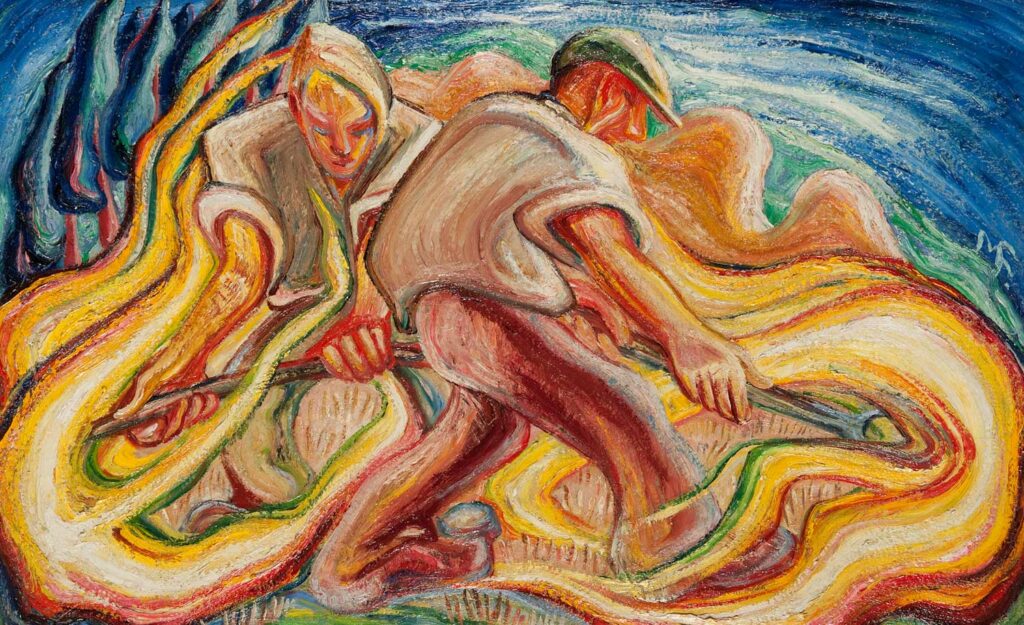
Fig.1

Turning Hay (fig. 1) is the artistic masterpiece that drew my attention and developed my desire to work for NL Museums. Her abstract expressionist style of painting rural landscapes and scenes of everyday of Scottish life set her work apart from her contemporaries. In Turning Hay, there is something about the lyrical, thick brushstrokes and bright, contrasting colours that breathed new life into the ordinary act of two farmers working in a field. In her depiction of rural labour, she combines ‘violent dislocation of the space with intense colour and patterns of brushstroke,’[4] a style representing many similarities with French Impressionist artists such as Manet, Cezanne and Matisse. This was also characteristic of the Scottish Colourists, a loose knit group of artists, active in the early twentieth century, influenced by the French artists’ use of bold colours and free brushwork which they learned through their time spent in France. This group consisted of four Scottish painters, Samuel John Peploe, Francis Campbell Boileau Cadell, George Leslie Hunter, and John Duncan Fergusson.
The Scottish Colourists achieved recognition during their lifetime, however, by World War II, their role in the Scottish arts diminished. Nevertheless, they were celebrated for their contributions to Scottish art by uniting features of Scottish heritage and the new Glasgow School style. The Glasgow School style was spear headed by Charles Rennie Mackintosh and is a distinctive style characterised by curving lines, organic forms, mannerist figures and simplified geometric patterns.[5] In this way, they paved the way for the next generation which emerged with the New Art Club in 1940.
The New Art Club was founded on JD Fergusson’s return from France in 1939 in opposition to the old established Glasgow Art Club[6]. They were a circle of artists who met twice weekly in Jean’s Tea Rooms in Sauchiehall Street to discuss a wide range of subjects and held an exhibition of their work each month, where they would discuss each other’s work. It was not until 1943 that they held their first public exhibition as the New Scottish Group at McClure’s Gallery, which Millie Frood was also a part of. The style of this exhibition varied from influences of Picasso and European expressionism, which highlighted the diversity of styles of the members of the New Scottish Group. They continued to host successful exhibitions for the next few years, providing encouragement to artists of diverse backgrounds and styles, motivation to paint and an opportunity to exhibit their work to exchange ideas about art. This introduced a new kind of art to the public as William McLellan wrote: ‘The most useful thing the New Art Club has done is to have proved that independent art can exist in Glasgow.’[7]
Questions to Ponder
My project during my time at NL Museums was conducting research on Millie Frood. Frustratingly, she is amongst a group of artists of which there is limited material available in published sources. She is clearly acknowledged in works such as Charlotte Rostek’s Scottish Women Artists and Duncan Macmillan’s Scottish Art in the 20th Century, 1890-2001 but nothing seems to have gone into more depth about her work. In fact, when we think of the great masters of Scottish art our minds go straight towards Charles Rennie Mackintosh, renowned for his design of the Glasgow School of Art, or John Duncan Fergusson, internationally celebrated for his influence to the Scottish Colourists. I found myself asking the same questions Katy Hessel asked herself when writing The Story of Art Without Men: how many Scottish women artists could I name off the top of my head?[8] The answer was none. This revealed the shocking truth that I had essentially been looking at the history of art from a male perspective,[9] as many of us do. Millie Frood, like many of her female counterparts is rarely found in any galleries, contemporary art shows, or the broader context of art history. There is a prominent sense of elitism in the art world, where society has always prioritised one group in history, which has persisted in the canon of art history from the time of E. H. Gombrich’s The Story of Art. This so called ‘bible’ to art history is a terrific introduction for all those seeking to learn more about the field but contains one catastrophic flaw: the first edition included zero women artists and the latest, sixteenth century edition includes only one, evident of the persistent problem of women being written out of art history.
The Role of an Industrial Museum
Fig.2
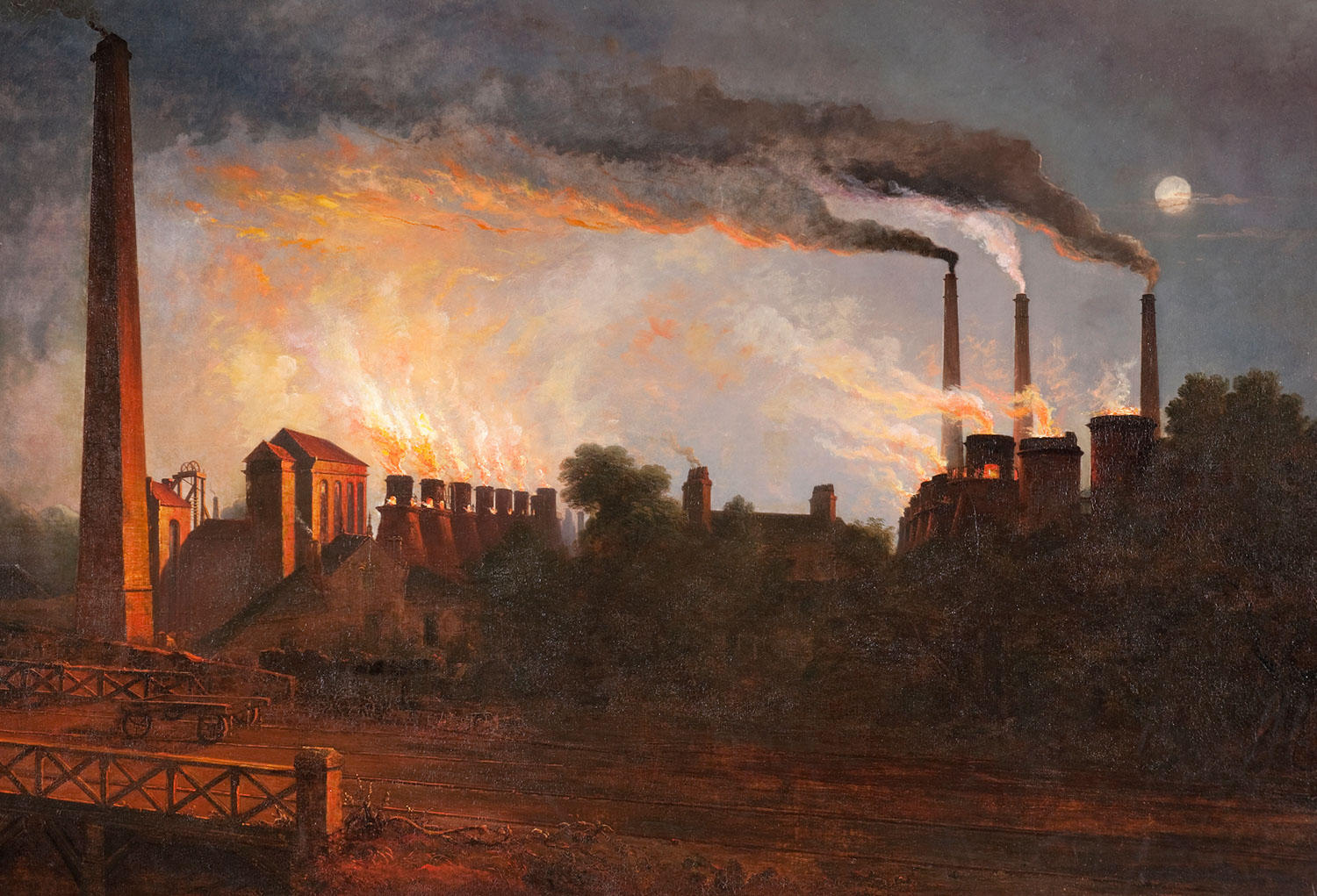
I will now turn my attention to NL Council Museums, my main case study for this essay. The museum is home to sharing ‘stories of North Lanarkshire’s lives past and present.’[10] It holds the responsibility for presenting Scottish heritage and unknown stories to an audience, while preserving the industrial history of Scotland in regards to its prestigious status as one of the most significant centers of heavy industry in Britain. This focus on is brilliantly captured in Caleb Robert Stanely’s Gartsherrie by Night (fig. 2), their most popular and sought-after oil painting illustrating a large scale depiction of the largest Victorian iron works in the world which led directly to the founding of the town of Coatbridge.[11] This art work is exhibited proudly amidst the structures of the old coal mines and early industrial equipment, placing the visitor directly in the atmosphere of the nineteenth century industrial town. Therefore, it is appropriate for the museum to house and display art works of this genre, depicting an industrial landscape, but it begs the question: where does Millie Frood’s painting fit into this atmosphere, considering her depiction of a landscape of rural Scottish life does not directly comply with the theme of the institution? Why is her work not in a gallery celebrating the revival of Scottish art? These questions lead back to Linda Nochlin’s essay regarding who decides which artists receive recognition and the institutional barriers preventing certain groups of artists from receiving the recognition they deserve.
The main dilemma that I encountered during working on my project on Millie Frood was the very lack of information available on her. Considering this difficulty I was facing through finding data in published materials, I decided to take a more personal approach by reaching out to members of the local community, in hopes of connecting with someone who may have had a connection with her or a family member through an article I directed for the Scottish Daily Record.[12] However, even this effort failed and the fact that I did not receive any responses made me ponder over how profound her influence in reality was over the Scottish Arts. On the other hand, I wondered would I have faced the same problem had I chosen a male artist from the time period, or an artist that was more appropriate to the industrial theme of the museum? Perhaps not. And I think that question and its answer speak volumes about the root of the problem itself. Writing about Millie Frood and using her as an important artist in Glasgow who even the institution housing her work has no information on, leads into more burning questions of why her artwork appears there without any information and not someplace where it can achieve greater recognition? Critical questions like these go back to the narrative of the responsibility of art institutions in bringing justice to the stories of the artists they are representing.
The Glasgow Boys – The ‘Heroes’ of Scottish Art
Upon my recent visit to the Kelvingrove Art Gallery and Museums in Glasgow, I noticed a large collection dedicated to ‘The Glasgow Boys,’ a group of radical young painters who represented the beginnings of modernism in Scotland. Coming together in 1880, banded together by their disagreement with academic painting, their works depicted rural subjects, often painted from life. The Boys were a lose knit group of 20 artists linked by their training and work in studios in Glasgow. They developed a distinctive style, with a focus on colour, texture, and pattern, putting Glasgow on the cultural map and encouraging other Scottish artists to ‘have confidence in their own abilities and be open to new developments in art’. [13] At the same time, The Glasgow Girls were also an active group, and undoubtedly one of the most unrecognised groups of women in Western Art History.[14] The fact that they were overshadowed by the Glasgow Boys is established in the fact that the museum has an entire collection dedicated to the boys but no single art work or mention of a female artist of the same time period. The name ‘Glasgow Girls’[15] illustrates that these women artist were the female equivalents to The Boys but their contributions to the changes in Western art were considered inferior to that of their male counterparts. In fact, this trend was prevalent throughout the museum’s collection, while making my way through hundreds of artworks of the Scottish collection, only a handful were by women. Does this mean that paintings by woman artists are not valued enough to be presented in the same capacity or vicinity as male artists? This leads back to the idea of who decides the hierarchal value of paintings.
When discussing this issue with my colleagues at NL Museums they sympathised with me on the fact that more should be done to celebrate women’s contributions to the culture and heritage of the area. They do have a project they are awaiting funding for, which will look into the role of women in industry, a major breakthrough for the museum, since the 2020 exhibiton feauturing the female watercolour artist Lesley Banks,. This solo women artist exhibition beautifully captures the magnificent coastal and inland waterways of Scotland.[16] Observing Bank’s artwork (fig. 3 and fig. 4) and comparing it to Frood’s, I noticed an obvious similarity in the theme: both artists paid attention to the landscape of Scotland, in their own dramatic style. Historically, landscape paintings were considered a lowly form of art in the hierarchy of genre paintings with history paintings and portraiture at the top. Could this be the reason why paintings by women were not given the same value as that of their male counter parts? This led me to further investigate the themes that women artists during the period focused on in their paintings.

The Glasgow Society of Lady Artists Club – The ‘Heroines’ of Scottish Art
I decided to turn my attention to the Glasgow Society of Lady Artists Club, founded in 1882 for the study and practice of painting, due to the limitations of women receiving formal artistic training at the time. They held annual exhibitions to showcase their artwork to the public and these exhibitions were frequently covered by the newspapers, which I discovered while studying their archives at the Mitchell Library in Glasgow. It was not surprising that the subjects of paintings by these women artists were focused towards landscapes, and more specifically, flowers. For example, Katharine Cameron, a pioneering exhibiter of the group painted beautiful flowers in watercolours such as Marguerites (fig. 5) and Irish Elegance (fig. 6). There is a certain femininity associated with flowers and the female body which is also seen in Georgia O’Keefe’s floral forms depicting vulvar imagery (fig. 7) which led me to consider if there was an underlying motive behind the paintings of the Glasgow Society of Lady Artists. However, due to the lack of information and interviews with the women of the club, this question remains a mystery.
The Role of Women Artists in Global Abstraction at the Whitechapel Gallery
Apart from the subject of Millie Frood’s work, I would also like to draw attention to Frood’s exquisite style of painting. Her abstract expressionist style truly makes her an artist well ahead of her time. When we think of abstract expressionist painters, some of the names that immediately come to mind are Jackson Pollock, William De Kooning, and Mark Rothko to name a few. This is because the origins of this particular style have been associated with men and ‘the women who forged a radical new painting style alongside them were marginalised or forgotten.’[17] The Whitechapel Gallery in London recognised this as an issue and currently has an exhibition titled ‘Action, Gesture, Paint: Women Artists and Global Abstraction 1940-70,’ celebrating 81 international women artists working with gestural abstraction after the Second World War.[18] The goal of this exhibition was to break the stigma around the concept of the Abstract Expressionist movement being synonymous with the names of white male painters and expanding the canon to the generation of women who helped ‘redefine art in the wake of the Second World War’.[19] Furthermore, the selection of artists from all over the world displays the geographic breadth of the movement and expands the artistic movement’s association with the USA, and demonstrates how lesser known women from different backgrounds were using this as a medium of self-expression but also exploring its political influence. For example, Janet Sobel, a self-taught Ukrainian American artist, sometimes called ‘the grandmother of drip-painting,’[20] was interested in the all-over composition a year before Jackson Pollock started making his drip paintings (fig. 8). However, her work (fig. 9), was dismissed by the critic Clement Greenburg as a ‘housewife,’[21] and is now only being rediscovered in light of this exhibition. Her gestural process embodied on the entire surface of the canvas represents a sense of freedom and shows that ‘nothing is privileged on the canvas – it’s the whole thing,’ as said by Candy Stobbs, the show’s assistant curator.[22]
When researching the other artists in this exhibition, it did not surprise me that their name only shows up a limited number of times and most of them have only been championed by their contributions to the Whitechapel’s exhibitions. Like Millie Frood, the names of these artists do not appear in any other published resources and their names are only linked to the one or two exhibitions that their works are mentioned in. In fact, what I found even more appalling was that many of the brief labels of the artworks made references to male artists, such as Elaine de Kooning, the wife of William de Kooning. This opened my eyes to another issue of how even exhibitions devoted to works of female artists are still contextualised in relation to the men they knew, but never the other way around.[23] Why are William De Kooning’s paintings never labeled as ‘husband of Elaine De Kooning’? And as far as Millie Frood is concerned, there is not enough information available to determine whether she was even married. However, perhaps this fact works in her favour, allowing her to preserve her independence, and not have her accomplishments linked to any male figure in her life.
The purpose of bringing attention to the Whitechapel’s exhibition is not to relate it to the type of work Millie Frood was doing. In fact, my aim is the opposite. It is to highlight that Millie Frood exists in a context which is not of her making. As Katy Hessel states, ‘the power of art is to tell stories beyond the binaries of gender.’[24] And this is exactly what Millie was doing. Unlike the artists presented in the Whitechapel’s exhibition, her work is not trying to achieve any radical change, rather her work speaks at a level of ordinariness, and represents her connection to Glasgow and her local influence. Even her method of working in which her group did not meet in a prestigious, well known institution but rather in a small café in Glasgow. It is the advancing feminist practice about being present in the art world which places her in an empathetic feminist narrative and speaks to the global problems of who makes art and who decides whether it is recognised.
When comparing The Glasgow Boys, The Glasgow Lady Arts Club, and the Whitechapel Gallery’s current exhibition, it brings to surface the critical theme of the separation of male and female artists. The recent surge of exhibitions in well acclaimed galleries worldwide to champion long lost or forgotten female artists is an event that is certainly long overdue but is something that needs to be proceeded with caution. The very fact that the theme of these exhibitions frames the female gender may just be aggravating the problem. Why is it that even after long standing debates about feminism, equality, and justice, art institutions still seem to isolate the two genders? Furthermore, when taking a broader look at the narratives about equality and justice, it is not just female artist who face this issue. Often times, it is also artists of colour whose works are separated in galleries. Is this a way of elevating the successes of the particular group of artists? Or does it go back to what Katy Hessel said about female artists being situated outside the traditional white male hierarchy? And if so, are these artists and their artworks exclusive in their own right? Overall, exhibitions like these reveal how concrete the male dominance is in art institutions and in this overarching hierarchal system, female artists such as Millie Frood do not have much hope, which is why my essay is important, as a way to prevent artists such as her from getting lost in this patriarchal culture.
The Fate of Millie Frood
So, what is the fate of these artworks, if not in private galleries or art museums? Where are they now? In a conversation with Alice Strang, a curator of British modern and contemporary art, who shares an interest in women artists, she connected me with an art collector Robert De Mey, who has a personal interest in collecting paintings from Millie Frood, obtained from various auctions. When asked how much he bought the paintings for he said it was for relatively small amounts of money. In addition, during my visit to the Glasgow Museums Research Centre, I discovered that Hayricks (fig. 10), the painting part of their collection, was bought by the museum for only £5! Appalled by how undervalued her paintings are, it only increases the urgency to tell her story more and raise her profile through exhibitions. Would one even dare to imagine a contemporary male artist such a JD Fergusson’s paintings being sold for the same price? The obvious answer here is no.
Revising the Story
To conclude, I would like to take a step back in redressing the balance of the art world, where women have been sidelined, stepped over, and trampled upon. What role has Millie Frood played, if at all, in cracking open the canon of art history to include more women? This is where the story gets interesting. Often, the reason women are excluded in the canon is because they are not given positions of leadership or power, however, for the case of Millie Frood this is not true, as she was one of the founding members of the New Art Club. So, is the fact that her name is not engraved in Scottish Art history a cause of her own doing? I would not say this is entirely true. Let us remind ourselves of the aims of the New Art Club – to give emerging, diverse artists motivation to paint and a platform to exhibit their works. As previously mentioned, Millie Frood was an artist of her own right. She was making ‘art for the art’s sake,’ independent of any social value or hidden political agenda. It is the patriarchy of the art world that has unintentionally inserted Millie Frood’s absence into the evolving feminist practice about being present in the art world and constructing an urgency that they are just as worthy of attention as their male peers. In this regard, I would say there is an underlying sense of defiance in her work, of wanting to be heard but in an unconventional way. Rather than producing paintings along the conventional themes of feminist paintings, her paintings pay tribute to her Scottish heritage depicting the landscapes and people. This radical act of defiance speaks to important issues about justice and inequality in the absolute canon of art.
Conclusion
Millie Frood is just one artist who signifies a long history of injustice towards women in the art world, as outlined by Lina Nochlin in 1971. There are significant voices to be heard of those who have been expunged from art history. Despite the difficulties, women continued to work as artists but have rarely been acclaimed until recently. This is why my work is important. For too long men have controlled the gaze while their female contemporaries have been slyly tucked away. Although the balance is changing, obstructions are being erased, and more women artists are being recognised and reevaluated, there is still significant reformation required. My project on Millie Frood reflects the critical weight that female artists have been denied for centuries in the discipline. With bits chipped away over time, I reached the liberation of realising that maybe we will never discover everything about art. Perhaps the next step is to have studies dedicated to the overlooked artists of the past and present. Without filling in these crucial gaps in our knowledge, we will never be able to obtain a complete ‘story of art,’ which applauds not only the heroes, but also the heroines, who have contributed to the history of art.
[1] Nochlin, Linda. “Why Have There Been No Great Women Artists?” Women, Art, and Power and Other Essays, 2018, 145–78. https://doi.org/10.4324/9780429502996-7.
[2] “Paintings of the Forties: Members of the New Scottish Group and Millie Frood Studio 1900-1988.” gerberfineart.co.uk, April 8, 2017. http://gerberfineart.co.uk/2014/paintings-of-the-forties-members-of-the-new-scottish-group-and-millie-frood-studio-1900-1988/.
[3] Ibid.
[4] Macmillan, Duncan. Scottish Art: 1460-2000. Edinburgh: Mainstream, 2000
[5] “Charles Rennie Mackintosh & the Glasgow School Style.” TheCollector, August 9, 2022. https://www.thecollector.com/charles-rennie-mackintosh-glasgow-school-style/.
[6] Macmillan, Duncan. Scottish Art in the 20th Century, 1890-2001 / Duncan Macmillan. [New, updated ed.]. Edinburgh: Mainstream Publishing, 2001: 80.
[7] The New Scottish Group / [foreward by J.D. Fergusson]. Glasgow: MacClellan, 1947.
[8] Hessel, Katy. The Story of Art without Men. W. W. Norton & Company, 2022: 9.
[9] Ibid.
[10] Culturenl Museums. Accessed April 1, 2023. https://www.culturenlmuseums.co.uk/#about.
[11] “Gartsherrie by Night by Caleb Robert Stanley (1795-1868), 1853.” CultureNL Museums. Accessed April 1, 2023. https://www.culturenlmuseums.co.uk/SIModes/Detail/19654/.
[12] Bunting, Ian. “Museum Supports Student’s Research into Life and Work of Lanarkshire Artist.” The Daily Record. February 25, 2023.
[13] Wall text, Kelvingrove Art Gallery and Museum, The Glasgow Boys, Glasgow, Scotland.
[14] Hasta. “Dear Scotland, Love the Glasgow Girls.” HASTA. HASTA, November 20, 2021. http://www.hasta-standrews.com/scotland/2021/11/20/dear-scotland-love-the-glasgow-girls.
[15] Term coined by William Buchanan in the Catalogue for the Scottish Arts Council Exhbition of the Glasgow Boys in 1968
[16] North Lanarkshire’s Exhibition Programme 2020 (Location: North Lanarkshire Heritage Centre, 2020, CultureNL).
[17] McGivern, Hannah. “Abstract Expressionism’s Women Emerge from the Shadows.” The Art Newspaper, February 2023.
[18] “Action, Gesture, Paint.” Whitechapel Gallery, April 5, 2023. https://www.whitechapelgallery.org/exhibitions/action-gesture-paint-women-and-global-abstraction-1940-70/.
[19] McGivern, “Abstract Expressionism’s Women.”
[20] Schwarz, Gabrielle. “Different Strokes: The Forgotten Women of Abstract Expressionism.” The Guardian. Guardian News and Media, February 16, 2023. https://www.theguardian.com/artanddesign/2023/feb/16/women-abstract-expressionism-whitechapel-gallery-krasner-sobel.
[21] McGivern, “Abstract Expressionism’s Women.”
[22] “Action, Gesture, Paint.” Whitechapel Gallery.
[23] Hessel, Katy. “Why Do We Still Define Female Artists as Wives, Friends and Muses?” The Guardian. Guardian News and Media, February 20, 2023. https://www.theguardian.com/artanddesign/2023/feb/20/why-do-we-still-define-female-artists-as-wives-friends-and-muses?utm_source=dlvr.it&utm_medium=facebook&fbclid=IwAR3hx7-Y6CS64JoVrj0riZMVA4yqF1_k4xLdvh0j8Skm_b3EI5vdVdlr2tM.
[24] Ibid.
Bibliography:
“Action, Gesture, Paint.” Whitechapel Gallery, April 5, 2023. https://www.whitechapelgallery.org/exhibitions/action-gesture-paint-women-and-global-abstraction-1940-70/.
Buekens, Filip and Smit, JP. “Institutions and the Artworld – A Critical Note” Journal of Social Ontology 4, no. 1 (2018): 53-66. https://doi.org/10.1515/jso-2017-0008.
Bunting, Ian. “Museum Supports Student’s Research into Life and Work of Lanarkshire Artist.” The Daily Record. February 25, 2023. https://www.dailyrecord.co.uk/in-your-area/lanarkshire/museum-supports-students-research-life-29285466
Culturenl Museums. Accessed April 1, 2023. https://www.culturenlmuseums.co.uk/#about.
“Gartsherrie by Night by Caleb Robert Stanley (1795-1868), 1853.” CultureNL Museums. Accessed April 1, 2023. https://www.culturenlmuseums.co.uk/SIModes/Detail/19654/.
Fergusson, John Duncan. Modern Scottish Painting / [by] J.D. Fergusson. Glasgow: W. MacLellan, 1943.
Hasta. “Dear Scotland, Love the Glasgow Girls.” HASTA. HASTA, November 20, 2021. http://www.hasta-standrews.com/scotland/2021/11/20/dear-scotland-love-the-glasgow-girls.
Hessel, Katy. “Why Do We Still Define Female Artists as Wives, Friends and Muses?” The Guardian. Guardian News and Media, February 20, 2023. https://www.theguardian.com/artanddesign/2023/feb/20/why-do-we-still-define-female-artists-as-wives-friends-and-muses?utm_source=dlvr.it&utm_medium=facebook&fbclid=IwAR3hx7-Y6CS64JoVrj0riZMVA4yqF1_k4xLdvh0j8Skm_b3EI5vdVdlr2tM.
Hessel, Katy. The Story of Art without Men. W. W. Norton & Company, 2022.
Macmillan, Duncan. Scottish Art in the 20th Century, 1890-2001 / Duncan Macmillan. [New, updated ed.]. Edinburgh: Mainstream Publishing, 2001.
Macmillan, Duncan. Scottish Art, 1460-2000 / Duncan Macmillan. Edinburgh: Mainstream, 2000.
Macmillan, Duncan. Scottish Art: 1460-2000. Edinburgh: Mainstream, 2000.
McGivern, Hannah. “Abstract Expressionsim’s Women Emerge from the Shadows.” The Art Newspaper, February 2023.
Nochlin, Linda. “Why Have There Been No Great Women Artists?” Women, Art, and Power and Other Essays, 2018, 145–78. https://doi.org/10.4324/9780429502996-7.
North Lanarkshire’s Exhibition Programme 2020 (Location: North Lanarkshire Heritage Centre, 2020, CultureNL).
Schwarz, Gabrielle. “Different Strokes: The Forgotten Women of Abstract Expressionism.” The Guardian. Guardian News and Media, February 16, 2023. https://www.theguardian.com/artanddesign/2023/feb/16/women-abstract-expressionism-whitechapel-gallery-krasner-sobel.