
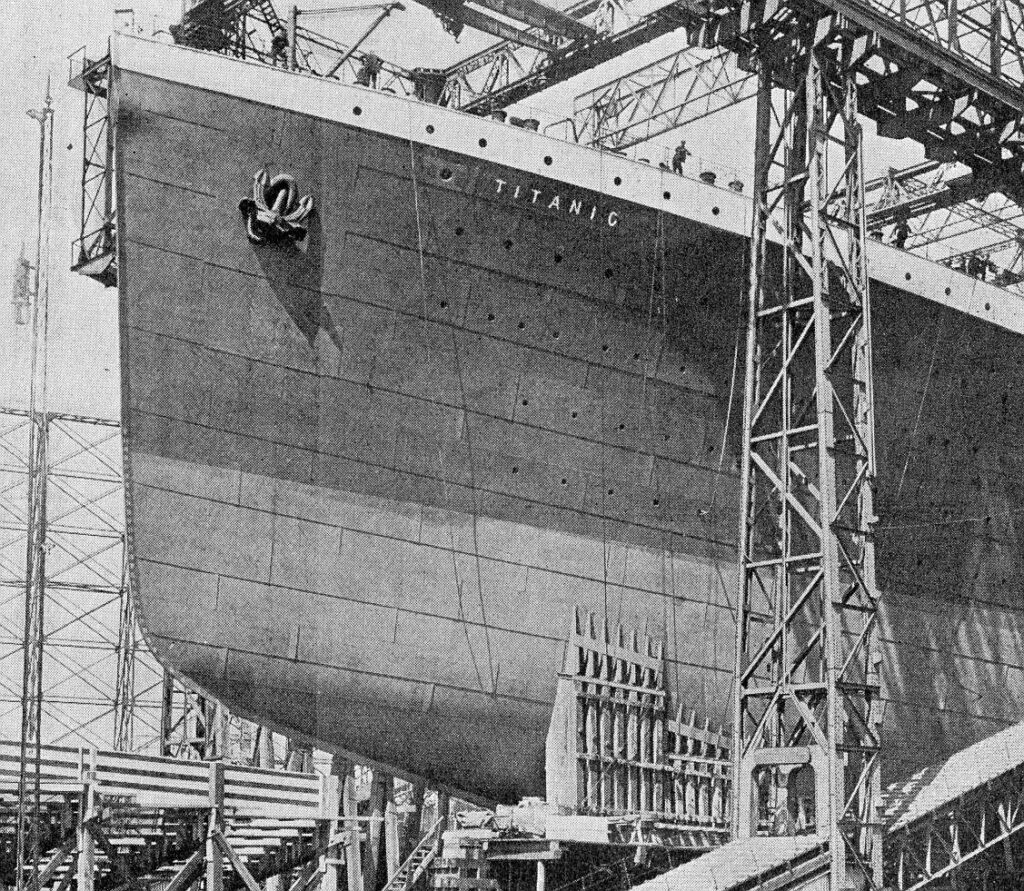
The tragic story of the liner RMS Titanic has entered folklore.
The story of the huge, supposedly ‘unsinkable’ ship hitting an iceberg on its maiden voyage with the loss of 2,224 people has become shorthand for human hubris. Inevitably, myths and rumours have grown up around the ship but the facts themselves are remarkable.
RMS Titanic was designed and built, alongside its sister ship the Olympic, at the shipyard of Harland and Wolff in Belfast. Yet, North Lanarkshire firms played a crucial role in the ship’s construction.

The Olympic at an early stage of construction in 1909. The keel plates of the Titanic can be seen in the background.The Olympic and Titanic were built side-by-side on slipways 2 and 3 at Harland & Wolff’s Belfast shipyard
Because of the unprecedented size of the new ships, new slipways had to be built to accommodate them. The massive steel crane gantry over the slipways was constructed by William Arrol & Co of Glasgow and was based on a similar, smaller gantry they had built for William Beardmore & Company’s Dalmuir shipyard on the Clyde.
Steel from Motherwell

Tapping an open hearth furnace at Dalzell Steel Works in the early 1900s.
When completed in March 1912 the Titanic was the largest ship in the world at 291 metres long. The ship and its sisters Olympic (1911) and Britannic (1914) were built for the White Star Line to help it compete with Cunard’s record-breaking new liners the Lusitania and Mauretania.
Such enormous ships were made possible by the move to steel construction in shipbuilding in the late 1800s. Unlike malleable iron, which it replaced, steel could be produced in large quantities with a high level of consistency. Steel was also lighter and cheaper and very strong. However, Ireland didn’t have a steel industry.
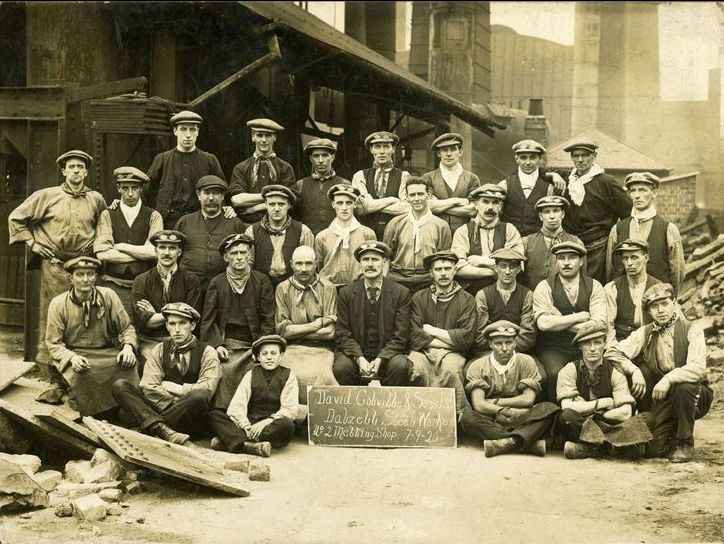
The Titanic’s hull was made from 2,000 rolled steel plates that were held together by 3 million malleable iron rivets. The steel plates were supplied by David Colville & Sons from their Dalzell Steel and Iron Works in Motherwell, Lanarkshire.

Dalzell Steel Works offices, Motherwell.
David Colville & Sons had started making malleable iron at Dalzell in 1872 but a decade later moved over to steel production. The firm made its name supplying steel for the second Tay Bridge after the collapse of the first, and for the Forth Bridge, the first large-scale steel structure.

The Titanic on the slipway, nearly ready to launch. The steel plates of the hull were between 2.5 and 3.8mm thick.
The steel was made from a mixture of pig iron and scrap, heated together in rows of huge ‘open hearth’ furnaces.
The steel was cast into ingots which were then re-heated and passed between giant rollers to reduce them first to slabs and then down to plate steel of the required thicknesses.

A view of the underside of the Olympic’s hull on the slipway in 1910. You can see the rivets holding the steel plates of the hull in place.

RMS Titanic after launching on 31 May 1911. The Olympic had been launched the previous October.
Disaster – and Controversy

An early 1900s picture postcard sent by a ship passenger, showing an iceberg “near where the Titanic went down”.
Following the discovery of the wreck of the Titanic in 1985, which revealed the large gash in the ship’s side, debate grew about how an iceberg could cause so much damage. One argument put forward was that the ship’s hull was brittle due to impurities in the steel and that this had been made worse by the cold temperature of the waters off Newfoundland.
However, a 1998 study by metallurgist Timothy L Foecke suggested that the point of weakness in the Titanic’s hull was not in fact the steel plates but the malleable iron rivets that held them in place. He argued that the rivets contained a higher than normal level of impurities (slag). The hull plates didn’t shatter when they hit the iceberg, instead they were dented and deformed, causing the rivets holding them together to break.
The steel used in Titanic’s hull was not of as high quality as modern steel but it was certainly up to the standards of the time.
Winches
Parts for the Titanic were made by a wide variety of firms who specialised in different things, eg lifts, electrical equipment, telecommunications.
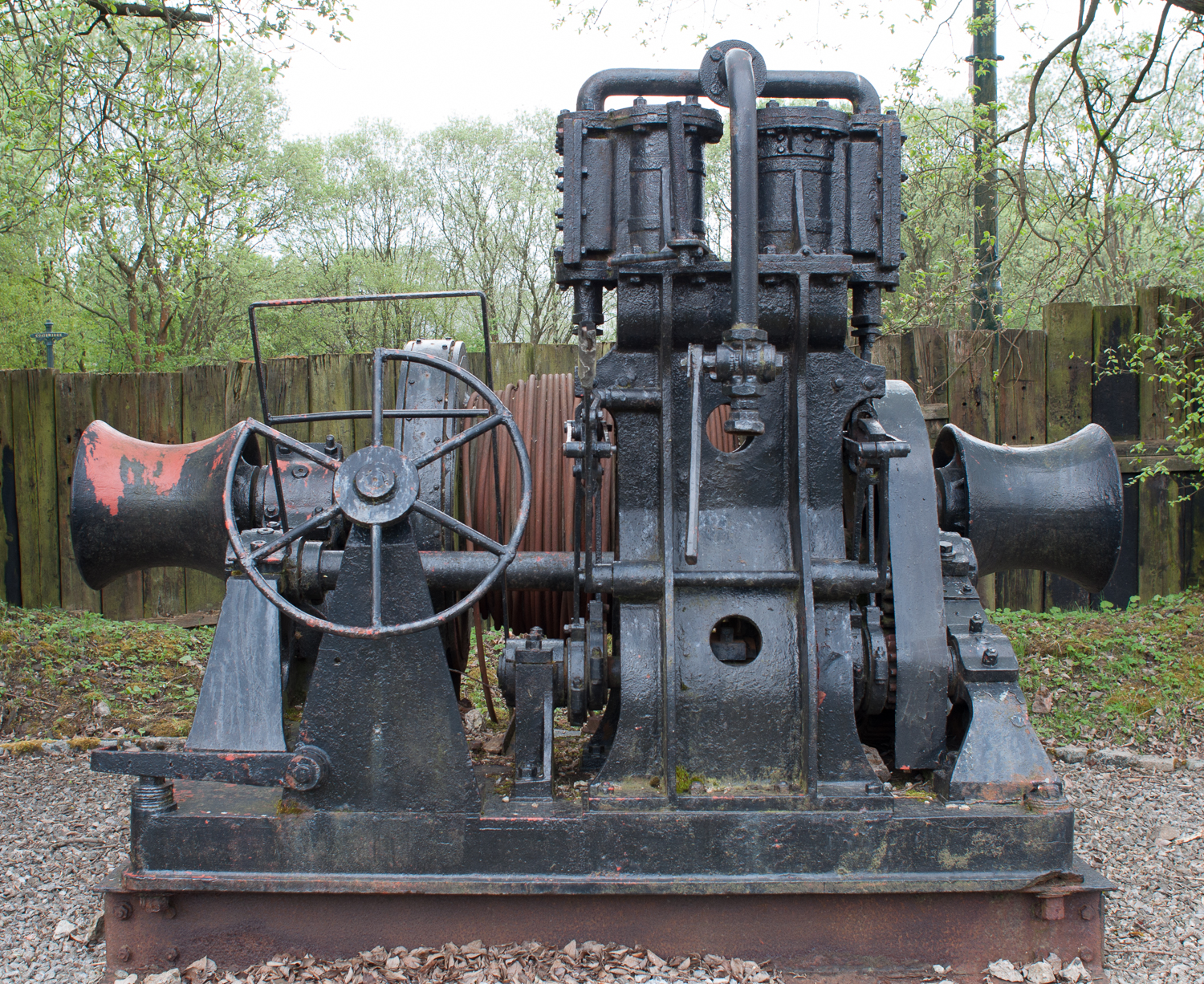
A Motherwell engineering firm, Chambers, Scott & Co provided electric winches for the Titanic’s engine rooms from their Dalzell Engineering Works.
Park Street in Motherwell was a centre for engineering firms, with crane builders and boilermakers congregating near the steelworks. Among them was Chambers Scott but the firm was to be short-lived, put of business by a fire at their factory in 1926.
The blaze completely destroyed the factory buildings and its contents, including all of the valuable drawings and patterns for the firm’s products. Happily, a Chambers Scott steam winch for coal mines is preserved at Summerlee Museum.
Passengers & Crew
Three people from the area that is now North Lanarkshire are known to have been aboard the Titanic on it’s doomed voyage:
Andrew Orr Cunningham (1873-1932) was born in Shotts. He was onboard as a 1st Class Bedroom Steward. When the ship sank he jumped into the ocean and swam clear before becoming one of the small number of people who were rescued from the water by people in the ship’s lifeboats.
James Marks (1884-1912) was born in Wishaw. He was Assistant Pantryman Steward (1st Class) and died in the sinking. James had married Minnie Renyard in Portsmouth in 1908 but then abandoned his wife and baby a year later. Their son, Ronald would go on to join the RAF and fought during the Second World War.
Annie Moore Ward (1874-1955) was born in Calderhead, although her family emigrated to Pennsylvania when she was young. She survived the sinking.
Aftermath of the Sinking
Official inquiries into the sinking conducted by the United States Senate and the British Wreck Commissioners. The British enquiry led to changes in navigation and safety procedures including a requirement for ships to carry enough lifeboats for everybody onboard.
The Olympic was rebuilt after the disaster so that instead of just having a double bottom, it had a double hull above the waterline. New safety design features were incorporated into a third ship in the class, the Britannic which was completed in December 1915. However, less than a year later the Britannic sank after hitting a German mine while serving as a hospital ship in the Aegean.

The Olympic and Titanic slipways as they are today, seen from through the windows of the Titanic Belfast museum.
Dalzell Steel Works would soon see a major expansion as business boomed, driven by the pre-World War one European arms race. Although steelmaking ended at Dalzell in the 1970s as British Steel phased-out the Open Hearth method of making steel, it continued to operate a rolling mill producing steel plate for shipbuilding, etc.

Dalzell Steel Works, June 2024.