
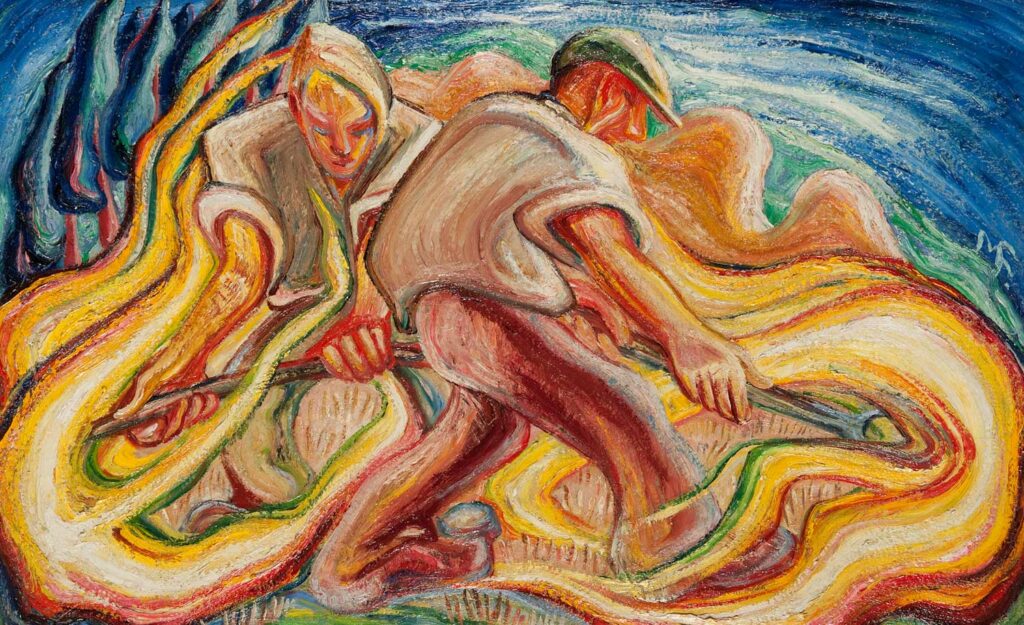
When we think of the great masters of Scottish art our minds go straight towards Charles Rennie Mackintosh, renowned for his design of the Glasgow School of Art, or John Duncan Fergusson, internationally celebrated for his influence on the Scottish Colourists. A name that never comes to mind, particularly to those who do not know her work is Millie Frood. A Motherwell born artist born in 1900, Millie Frood was part of the movement in the 1940s and 50s which did much to revitalize the arts in Glasgow. However, her recognition for her contributions has been under celebrated in comparison to her male counter parts of the time. A student at the Glasgow School of Art and later a teacher at Bellshill Academy, she held many solo exhibitions in Glasgow and Lanarkshire. It was only after her death that her work received the international recognition it deserved in the USA and Japan.
Frood’s abstract expressionist style of painting was very different to that of her contemporaries. The subject of her paintings was Scottish landscapes with one or two figures, highlighting aspects of rural Scottish life. Turning Hay features two farmers doing the ordinary job of turning hay in the fields. However, Frood’s use of thick paint, bold, contrasting colours, and lyrical, swirling brushstrokes breathed new life into the mundane task. As one of the founding members of the New Art Club with JD Fergusson and Margaret Morris, she was part of the wider revolution of the arts in Scotland after World War II, which provided diverse artists like herself motivation to paint and a platform to exhibit their works. It also provided the public with a foundation to the new kind of art of the period. Frood took part in all of the Art Club’s exhibitions and immensely benefitted from the positive public response the group’s effort received.

What puzzled me when researching Millie Frood and the New Art Club is how little information there is available on an artist who contributed so much to the stimulation of a new kind of art in Scotland. Was it her status of a woman artist of the period that prevented her from receiving the celebration she deserved, in a time when men were credited more for their achievements? Or was it her style of painting which was not considered ‘high art’ at the time? And if Millie Frood is just one of the artists who has not been acknowledged in Scottish art history, are there more profound artists like her whose contributions have not been accounted for? These are just a few questions that come to mind when addressing the mystery surrounding this brilliant artist of the Scottish art revolution.
About the author:

Neha Sayeed is a penultimate MA Honours History of Art student at the University of Edinburgh. Her passion for art history stemmed from her upbringing in Pakistan where, initially, the arts were not given the importance they deserved in the academic field. Her interest in feminist art and artists inspired her to do a work placement at North Lanarkshire Council Museums and independently conduct research on the artist Millie Frood.