
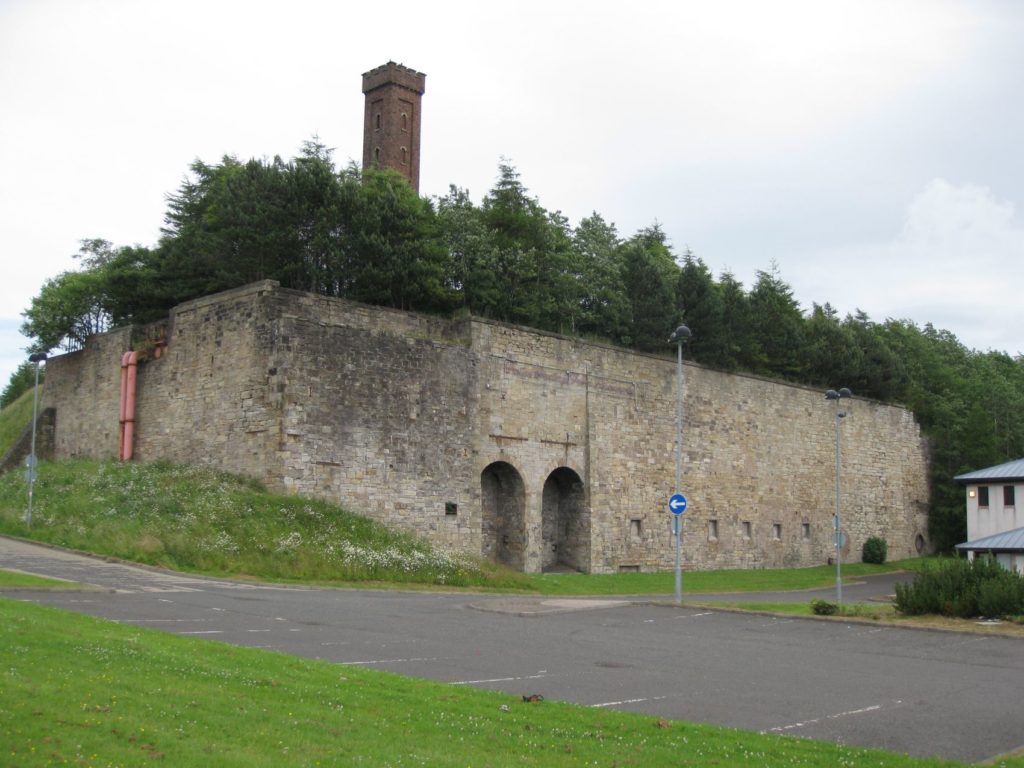
Starting production in 1802, the Shotts Iron Works became world famous for its decorative castings, particularly lamp standards. Shotts ironwork can be seen decorating the streets of Edinburgh’s New Town and in many other places around the world.
However, it wasn’t just ironstone and coal that fed the furnaces at Shotts. The company relied upon money made from the enslavement of human beings.

The founders of the business, Robert and Hugh Baird were engineers with a works at the Applecross canal basin on the Glasgow Branch of the Forth and Clyde Canal. Robert Baird would later supply a punching machine to help build?the Vulcan, Scotland’s first iron boat.
Money Worries
In 1801 the Bairds took out a lease on the mineral-rich land on the banks of the South Calder Water in the north-east of Lanarkshire. Ground was allocated for blast furnaces to make iron and for the reservoirs to supply the ironworks. The Shotts Iron Company was formed by the Bairds with three partners, George Munro, Walter Logan and John Baird. John Baird became the lead partner and he supervised construction of the first blast furnace.
The company had been founded during a boom in the price of iron. However, that didn’t last and the works grew slowly at first and despite starting a second furnace, the partners were losing money and the business didn’t have enough capital to keep going.
New Shotts Iron Company
In 1810 the business was reorganised as the New Shotts Iron Company. Hugh and Robert Baird dropped out of the partnership and were declared bankrupt the following year but John Baird remained as manager.
Two new partners took their place. Both John Blackburn and Robert Bogle were West India merchants and enslavers, described in Court of Session papers as, “persons of great wealth”. The new injection of funds meant that the company could afford to buy outright land that it had previously been leasing. The historian Cait Gillespie writes that ‘Blackburn’s slavery-derived wealth was significant. Part of the Glasgow West India Association, Blackburn owned five different plantations in Jamaica across his lifetime, including the Wallens and New Works estates in St Thomas-in-the-Vale, which on abolition had 565 people enslaved there. Bogle and Blackburn both had diverse investment portfolios, including in transport and utility companies, typical of wealthy returnees, which cultivated lasting generational wealth that permeated Scottish society.’ (Gillespie, Cait, with Dr Stephen Mullen, North Lanarkshire’s Historic Connections to Atlantic Slavery, Modern-day Legacies and Memorialisation (University of Glasgow, 2025)).
Robert Bogle of Gilmorehill (1757-1821), along with his trustee William Hamilton part-owned Dunkley’s Estate in Jamaica. Dunkley’s was a large plantation in the south of Jamaica. There, enslaved people were employed producing sugar and rum. At the time of abolition, 286 people were enslaved on the plantation.
We don’t know how many other estates Robert Bogle had shares in when slavery was abolished but his son, Archibald received compensation of £69,383 (over £10 million in today’s money), covering 11 estates across British Guiana, Trinidad and Jamaica.
The Centre for the Study of the Legacies of British Slavery at University College London has James Robertson’s 1804 map of Jamaica with information on the individual estates on which people were enslaved Maps | Legacies of British Slavery
A trustee for one of the partners of the new company was William Hamilton, who had made his fortune through the labour of enslaved people in the West Indies. Hamilton would go on to receive substantial government compensation with the abolition of slavery in 1834. It is likely that at least part of this money made its way into the New Shotts Iron Company.
The number of enslaved people on the Bogle and Hamilton plantations at the time of emancipation in 1834 was in the region of 1,500.
The company was taken over by a consortium in 1824 and became the Shotts Iron Joint Stock Company. The takeover was led by John Horrocks of Tullichewen.
The historian Cait Gillespie writes, ‘Horrocks was from a Lancashire cotton spinning family, Horrocks and Company of Preston, who owed Tullichewan Castle in Vale of Leven near Loch Lomond. The Horrocks take-over was Edinburgh-orientated, with goods increasingly exported out of Leith. Iron castings went to Montreal, and pig iron to the United States. Demerara, Haiti, Venezuela, Rio de Janeiro and Trinidad also provided the company with export markets.’ (Gillespie, Cait, with Dr Stephen Mullen, North Lanarkshire’s Historic Connections to Atlantic Slavery, Modern-day Legacies and Memorialisation (University of Glasgow, 2025)).
A Company Town

The workers’ housing of Flat Row on the east side of Benhar Road with the Shotts Iron Works in the background.
The Shotts Iron Company built large numbers of houses for its workers and people were attracted to the area to work in the ironworks and associated mines. It was thanks to the Shotts Iron Company that the town grew into a single settlement, joining together the villages of Dykehead and Stane.
Edinburgh New Town

Shotts lamp standards at the foundry.
Just as the company’s owners were largely wealthy merchants so were their clients. Shotts decorative ironwork was used widely in Edinburgh’s New Town where many who had become wealthy through slavery made their homes. By the 1850s the Shotts Iron Company made a special feature of gates and railings it produced for ‘gentlemen’s seats’.
In 1831 the company acquired the Caledonian Foundry in Leith in order to expand production of castings.
A Long Shadow
The Shotts Iron Company’s slavery connections continued.
When original partner Walter Logan died in 1843 he was succeeded as company Chairman by Robert Bogle’s son, Archibald who held the post for the next 14 years. When slavery was abolished in the British Empire, Archibald had received compensation for people he held enslaved on multiple estates in British Guiana and Jamaica.
The Shotts Iron Company continued in business until 1951. Its coal mining interests were nationalised on 1 January 1947 and three months later the furnaces were blown out. The foundry was run on a smaller scale by the National Coal Board to make castings for coal mines until the late 1970s.