
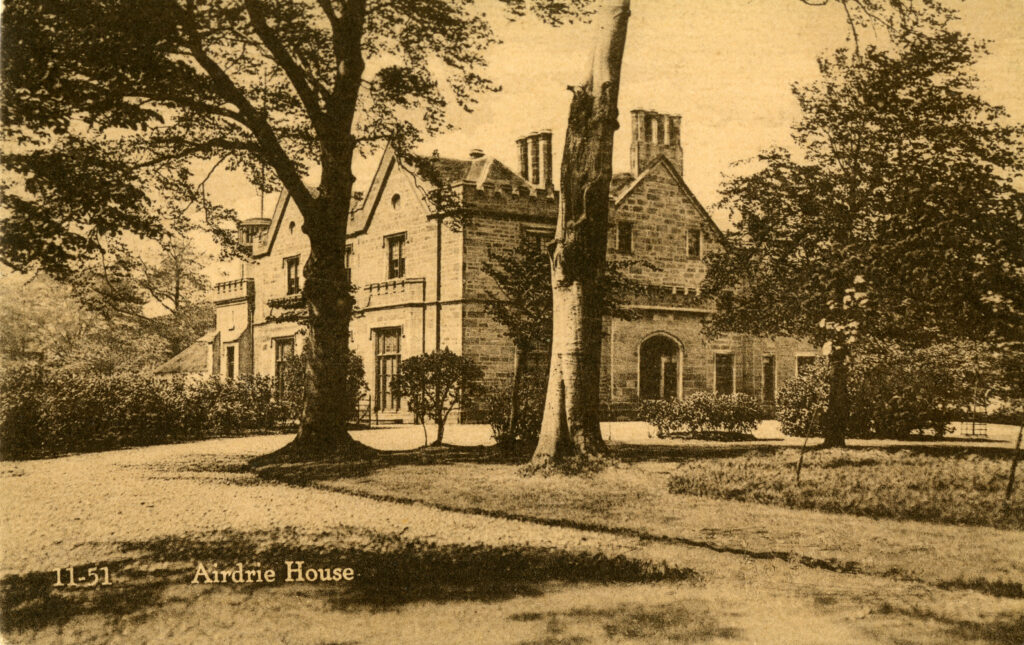
The Aitchisons of Rochsolloch had lands in the Airdrie area since 1685 and have long benefitted from Empire and colonialisation. Sir Archibald Acheson, a relative of the Airdrie family branch, was involved in the colonisation of Ulster, Ireland, and Nova Scotia, Canada. In 1769, the family bought Airdrie House which is now the location of the Monklands Hospital. The family eventually gave their name to Aitchison Street in Airdrie and were later one of the main voices in promoting the Bill to make Airdrie a Burgh in 1821. To afford the grand Airdrie House, the Aitchison family generated their wealth through exploitation of enslaved people in the island of Grenada.

View of Airdrie House, North Lanarkshire Council Archives
The Aitchison family began to benefit from lands in the Caribbean after The Seven Years War (1756 – 63) which resulted in several French territories being ceded to the British. These territories included Canada, Tobago and Grenada. In 1763, the same year as the Treaty of Paris which officially gave these lands to the British Empire, John Aitchison acquired Belmont Estate on the island of Grenada. During French rule, the island was subjected to a plantation system for production of sugar cane and indigo – this labour was carried out by the exploitation of enslaved Africans. When Britain took over the island, this plantation foundation was dramatically transformed, making Grenada a centre for the exportation of sugar, coffee, cotton, cocoa and eventually nutmeg. The Aitchison’s benefitted directly from this exploitative economy, buying Airdrie House only 3 years after acquiring their Grenadian land. It is interesting to note, that prior to the Aitchison’s Airdrie House was owned by another enslaver, Robert Dinwiddie, former Governor of Virginia. Indeed, in this period, a number of the wealthy families who could afford to buy land and large estates, were also financially entangled with slavery.

Carved wooden coat of arms formerly in Airdrie House, North Lanarkshire Council Collections
Not long after John Aitchison acquired Belmont Estate in Grenada, he passed away. His new plot of land was then inherited by his father John Aitchison senior. Along with the land itself, Aitchison senior inherited machinery for production and an unspecified number of enslaved people who were forced to work said land. Not long after the death of his son John Aitchison Snr leased the plot to an Alexander Campbell in 1770. The lease was for a 13-year period for a sum of £2,520 per year.[1] During this 13-year lease, the American Revolutionary War broke out (1775 -1783) which resulted in Grenada changing hands to the French, before being returned, once again, to British control in 1783. During this period, potentially because of the turmoil and unknown situation on the ground on his lands, Aitchison senior actually relocated from Scotland to Grenada. An unusual move, as he has long been an absentee landlord. He died on the Belmont Estate in 1780 and his grave is still there.

View of the Belmont in the Island of Grenada, 1821, James Dodds former plantation Overseer, copyright Belmont Estate
Alexander Campbell, the 13-year tenant for the Belmont Estate was later executed during the Fédon Rebellion in 1795. Wanting to create a republic like their neighbour Haiti, a number of French, free people of colour, and some enslaved led an uprising again British rule. It was eventually crushed by the British in 1796, not before a number of enslavers were killed, including Campbell.
After the death of Aitchison senior in 1780, the Belmont Estate was bequeathed to three of his daughters; Bethia, Margaret and Isabella for them to sell and share the profits between them. By this stage, the estate consisted of animals, a sugar mill, land, outbuildings and, again, an unspecified number of enslaved individuals, all of which were sold for the sum of £21,183. In today’s money and rates, this amounts to almost £39 million. It is often not considered that white women also took part in the enslavement and exploitation of African bodies. Women like Bethia, Margaret and Isabella Aitchson, alongside their contemparies like Cecilia Douglas, who’s collection can be seen in the likes of Kelvingrove in Glasgow, upheld and benefitted directly from The Slave Trade in wealth, land and influence. Indeed, the Aitchison’s other sister Christian, married another known enslaver, William Alexander (1729-1819) who also owned slave-labour plantations in Grenada.[2]

Summerlee Museum, as viewed from the Monklands Canal, North Lanarkshire Council
Like many Scottish enslavers, the Aitchison’s invested the wealth accrued from slavery back at home. As well as their seat in Airdrie House, the Aitchison’s contributed to the construction of the Monkland Canal, a section of which still runs through the Summerlee site. Beyond physical built investment, the Aitchison’s gave Airdrie it’s coat of arms in 1771, and advocated for the town to become a Burgh in 1821. The Aitchison’s were truly involved in the Airdrie area, but could fund this involvement, and this influence through benefitting from the Trans Atlantic Slave Trade.

Image of modern day Rochsolloch Farmstead. The Aitchison’s owned the land this farmstead used to operate on. Photo: Justin Parkes.
Like many other wealthy North Lanarkshire Families, the Aitchison’s legacy is still tangible today; through Airdrie’s built heritage and civic symbols. What is not so tangible, are these legacy’s link to slavery.