
Human Ingenuity in times of Inhumanity
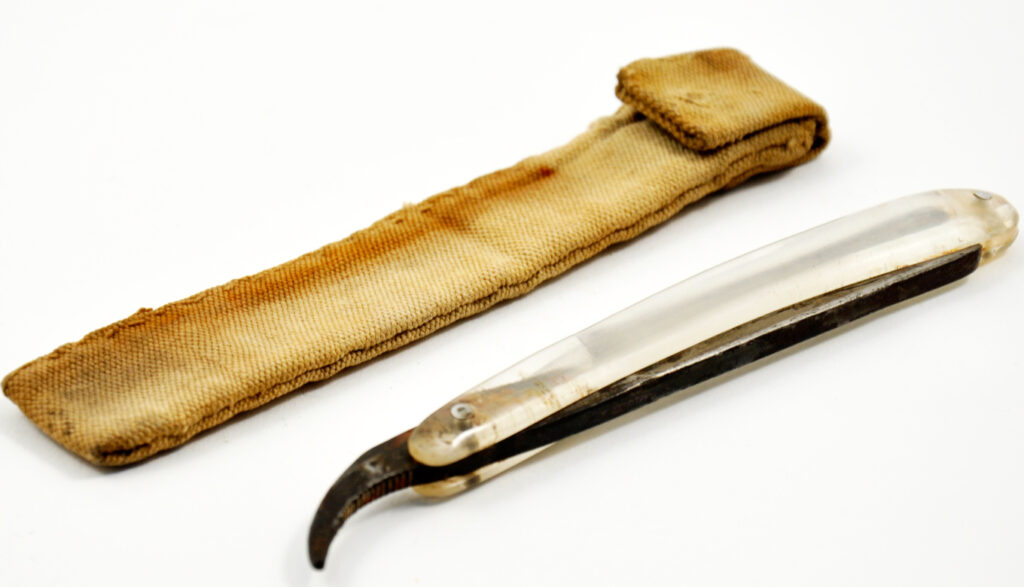
This article examines the social context behind a unique artefact: the straight razor a soldier made by hand while held as a prisoner of war in Japan.
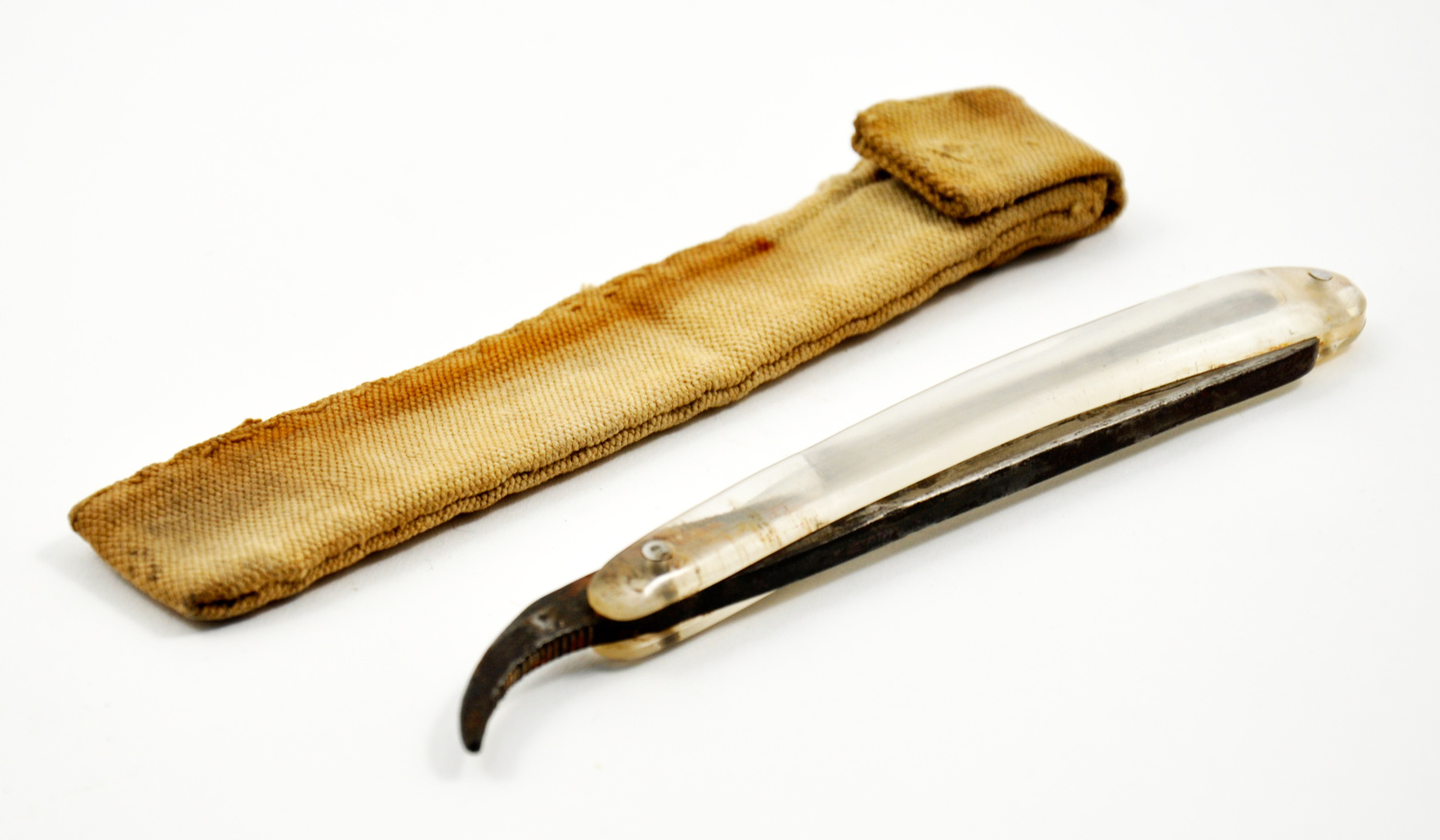
This razor was crafted using a car spring and plastic obtained from an unknown source. The maker also fashioned a sleeve out of canvas or sack cloth to hold the tool in. How well the razor worked for shaving is a mystery, but the soldier’s creativity is commendable and his sentimentality in keeping it for decades after the war is certainly moving.
Early in the Second World War, Japan achieved many victories against the British and Commonwealth troops, taking nearly 200,000 of them prisoner in East Asia. The first Geneva Convention, an international pact determining basic human rights during wartime, was signed in 1864. The original version called for wounded and sick soldiers to be protected from capture and destruction, along with the civilians who treated them; unbiased treatment for all combatants; and acknowledgement of the Red Cross Symbol to identify everyone protected by this official agreement.
The first edit to this pact was made in 1906. The second Geneva Convention made the original agreement explicitly applicable to naval warfare. Another change, this time concerning the treatment of prisoners of war, was introduced in 1929. This third Geneva Convention decreed that opponents treat their captives humanely, provide information about their status as prisoners, and allow neutral countries to send officials on inspections of the prison camps. It also required that prisoners were fed adequately, provided with essential supplies, and safe from being tortured for information.
International policy changes take time to be implemented, however, and Japan had not yet agreed to these new terms five years later. In 1934, at the International Conference of the Red Cross in Tokyo, a separate draft of terms was approved for submission to a diplomatic meeting scheduled six years in the future. But the Second World War began in 1939, and this conference never took place. As a result, Japan was not legally bound to follow the most recently established standards of treatment for prisoners of war, and many prisoners of the Japanese suffered from an often fatal combination of neglect and abuse.
Hardly anything was known about the terrible treatment of war prisoners in East Asia until 1944, when the Foreign Secretary, Anthony Eden, exposed the conditions in an address to the House of Commons. Soldiers were not the only ones held prisoner by the Japanese – among them in the camps were a number of women serving in the Queen Alexandra’s Imperial Military Nursing Service. For more on nurses in the Second World War, see The Women of World War Two.
Some prisoners later recalled being given two daily meals of a few ounces of boiled rice and an insubstantial vegetable stew, with the occasional cube of meat or fish for protein. The prisoners were given grindstones to mill rice and peanuts. The severe lack of nutrition in the camp caused a variety of fatal health conditions, or else left prisoners too weak to recover from illnesses which would have been treatable under typical circumstances. In a three-year span, the Japanese permitted only three Red Cross supply parcels to enter the camp, and the prisoners were often denied any news regarding the progress of the war. Camp conditions would have been beyond grim, with no certain end in sight.
It is the significance of this historical context that makes a handmade straight razor such an extraordinary artefact. To have been taken prisoner, to have endured such fear, hunger and neglect, and still maintained a sense of self by fashioning a tool for personal grooming, speaks volumes about the endurance of the human spirit and the comfort of familiar habits. Sometimes the simplest objects are the most poignant mementos.
Bibliography
“Into Captivity.” Sisters in Arms: British Army Nurses Tell Their Story, by Nicola Tyrer, Hachette UK, 18 Sept. 2008, pp. 59–70.
ihl-databases.icrc.org/en/ihl-treaties/gciv-1949
britannica.com/event/Geneva-Conventions
iwm.org.uk/history/what-life-was-like-for-pows-in-east-asia-during-the-second-world-war
culturenlmuseums.co.uk/story/the-women-of-world-war-two/
About the Author

Sara recently graduated with her MSc in Museum Studies from the University of Glasgow. Her research interests are very broad, but generally tend to focus on medical history. She moved to Scotland from Canada, bringing her two cats with her.”