
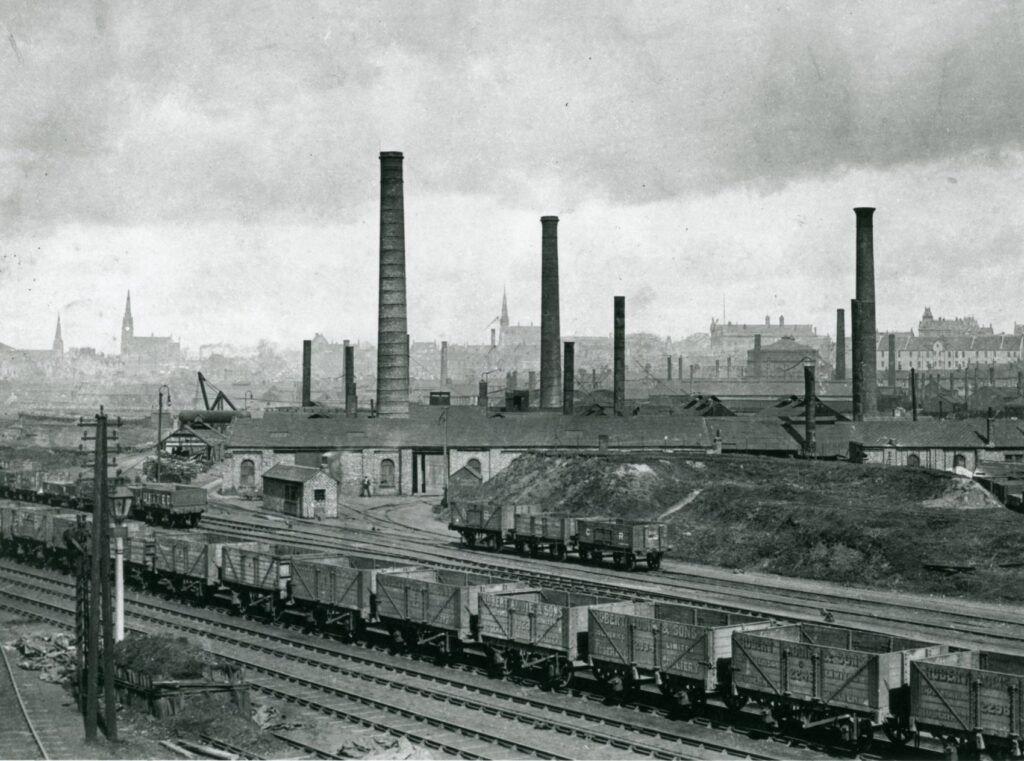
‘The Tinplate’ was a factory in Coatbridge with little-known colonial connections.
The Palm Oil Industry

Palm oil
Today palm oil is heavily used in the food and beauty industries and production is centred around Indonesia, although the oil palm is indigenous to West Africa. There are now grave concerns about deforestation as a result of the mass planting of oil palms.
Back in the 1800s the global palm oil industry started in West and Central Africa where the export industry was the product of empire and slavery.
Palm oil had long been used for cooking in West Africa, as is common today. However the British colonised much of West Africa and exploited it through slavery. Millions of Africans were enslaved and traded to the British and other European nations, who forcibly transported them to the Caribbean and America to work on sugar and tobacco plantations.
Through these trade networks the British became aware of palm oil and started to use it. They used palm oil as a lubricant for the machinery that was driving the Industrial Revolution. Other uses it was put to were making soap and also as a crucial ingredient in producing tinplate.
After the abolition of the Atlantic trade in enslaved people within the British Empire, palm oil served as a new source of income for the kingdoms of West Africa. The 2022 film The Woman King starring Viola Davis dramatises this change in the Kingdom of Dahomey, a territory that was unusual in having female warriors called Agojie.
Palm oil was a valuable commodity. In January 1868 the ship Euphrates was lost with all hands off the coast of Wales en route to the Clyde from West Africa. The cargo of palm oil was valued at £37,000 (Glasgow Evening Citizen, 18 January 1868). What was recovered from the sea was auctioned in Glasgow the following month.
Palm Oil and Tinplate
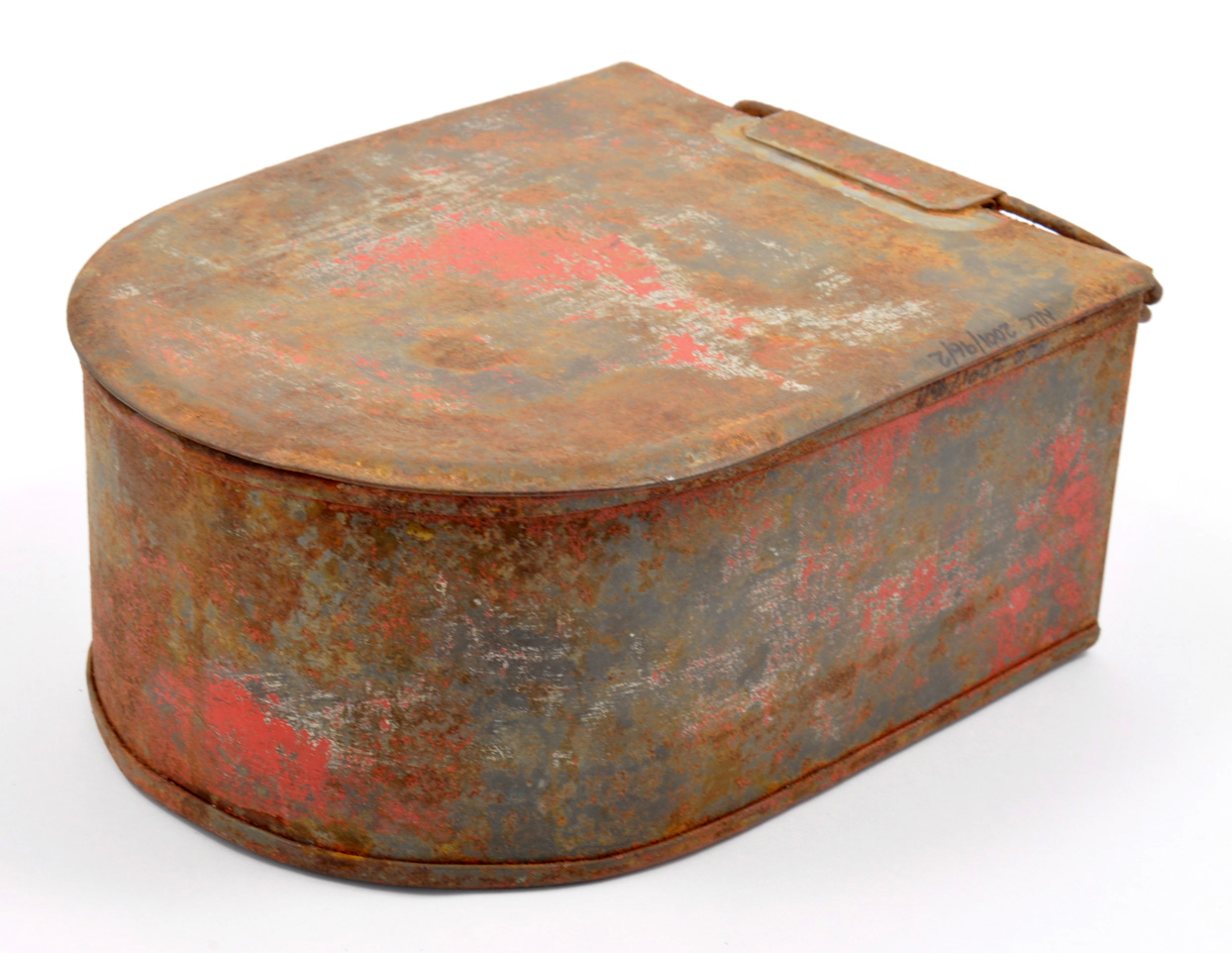
Tinplate consists of thin sheets of steel (iron in the early days) which have been coated with a thin layer of tin in order to stop them from rusting. It was used to make products like low grade pots and pans. These were cheaper and lighter than cast iron and were non-toxic except for when heated up. Then the tin plate would give off dangerous fumes.
Tinplate first became popular in the 1850s and ’60s. Making it was labour intensive and that didn’t really change until the 1900s. Tinplate is still used today although it is more common for steel to be galvanised to stop it rusting.
To make tinplate, thin sheets of iron were heat treated and then cleaned in acid. In order to stop the metal from rusting before the tin coating was applied, it was put in a bath containing palm oil mixed with tallow (sheep fat). Next the sheet metal was submerged in molten tin with more oil which helped keep the layer of tinplate thin and avoided wasting tin.
There were already several oil merchants trading in Glasgow by the time the Coatbridge Tin Plate Works was started in 1863 but their adverts didn’t usually list all of the oils they sold. For that reason it is hard to tell how widely used palm oil was in the Strathclyde area at that time. The 1886 Glasgow Post Office directory lists 26 oil importers, one of which was the British & American African Traiding Company, which advertised African palm oil.
The Coatbridge Tin Plate Works

Coatbridge Tinplate Works, around the 1920s. By this time the works was no longer making tinplate but continued as a malleable ironworks.
Opened by John Baillie and Edward Bell in November 1863 the Coatbridge Tin Plate Works near Whifflet was Scotland’s only tinplate producer until about 1880. The factory consisted of a malleable ironworks where hard, brittle pig iron was processed into flexible sheets of iron. These were rolled thin and then taken to the tinplate department to be coated with tin.
A few years earlier a new method of dipping iron plates into a bath of molten tin had been developed, involving semi-submerging the sheets while running them through rollers. This gave a more consistent coating than the previous method. Coatbridge was a major centre for the malleable iron industry so the skills and infrastructure for making the iron plates were already in place.
The town’s first historian, Andrew Miller described the new works in 1864:
These works, which are situated on one of the most eligible sites in the district, on the estate of Whifflat, at the Laigh Coats, were started at the latter end of the present year. They are the only works of the same description in Scotland, and the proprietors (Messrs Baillie and Bell) deserve credit for their enterprising spirit in thus adding another branch to our iron manufacture, which, it is calculated, will give employment to about seventy individuals.
‘The Rise and Progress of Coatbridge and Surrounding Neighbourhood’ by Andrew Miller, 1864.
By ‘the latter end of the present year’ Miller must mean 1863.
Having described the plant which he said were ‘of the best description, with all modern improvements’, Miller said that ‘in the tinning process’ (as opposed to the ironmaking side of things), ‘females are employed, so that this is a new phase in iron manufacture in the district.’
Children were employed there too, as an account of an accident in the Airdrie & Coatbridge Advertiser dated 25 February 1865 makes clear:
On Wednesday afternoon, a boy aged ten years, named Edward Hodgkiss, residing with his parents in Buchanan Street, met with a severe accident at the Tin Plate Works of Messrs Baillie and Bell. He was employed in cutting scraps at the shears, when his feet slipped, and falling forward, his right arm went into the shears, and was nearly severed in two between the elbow and shoulder joints. Doctors Robert Wilson and Adams attended, who peformed the operation of sawing off the broken pieces of the bones, and joining the two – for the purpose of saving the arm – should fever not ensue, it is thought the operation will be successful.
Such accidents were not uncommon and two years later another boy was reported to have had his hand crushed in a machine at the Tin Plate while playing there, resulting in amputation (Glasgow Herald, 5 November 1866).
The Advertiser gave a fuller description of the works in April 1864 in a article that detailed how the iron plate was made but didn’t describe how the tin was applied:
Proceeding towards the work, which here differs in no respect from others where cast iron is converted into malleable, the sight wanders and becomes lost among machinery in motion while the ear is filled with astounding din.
Airdrie Advertiser, reported in the Glasgow Saturday Post, 9 April 1864.
Thankfully a piece in the Glasgow Herald the following year gives us an insight into the tinplating process and the astonishing labour done by women and girls:
…the [iron] sheets are dipped in certain acids, and scoured by the hands of women. An active woman will scour upwards of 6700 plates per day; and I can assure the reader that their fingers require to go very nimbly about the business before this can be accomplished. When scoured and done over with acids, the plates or sheets are dipped into a trough filled with melted tin and boiling tar, and then comes more dipping, previous to the polishing process. They are polished by girls with dust and coarse flour, and finally get a rub over the surface with a fine cloth or chamois skin, when they are examined, counted, and packed up into square wooden boxes.
‘A Day at Dundyvan’, Glasgow Herald, 28 August 1865.
The Coatbridge Tin Plate Works seems to have had a rocky start as the partnership between Baillie and Bell ended in March 1865 thanks to Bell’s debts. A new company, the Coatbridge Tin Plate Company (Limited) was founded to run the works.
When the Institution of Mechanical Engineers visited in 1879 they found ‘the works are very considerably larger than they were at first.’
In the tinplate process the sheets are first rolled in batches to the requisite gauge,
and are then sheared to certain standard sizes . These ” blackplate s ” are then twice annealed and cleaned from oxide in a bath of diluted sulphuric acid : they are next placed in a mixture of hot palm oil and tallow, and then dropped one by one into a frame below
the surface of a bath of melted tin . This frame, rising by mechanical means, sends the plate up between two smooth rollers, half immersed in the tin, which remove all superfluous metal, and leave a perfectly even coating of tin over the whole surface. The plates , after cooling, are wiped quite clean and dry, and are finally packed in boxes for sale .
Proceedings of the Institution of Mechanical Engineers, 1879, p567.

Coatbridge Tin Plate Works on the 2nd edition Ordnance Survey map, 1898 (National Library of Scotland).
By this time the iron manufacturing side had expanded from 2 puddling furnaces to 12. There was also an additional steam hammer and rolling mill, improvements that had been made from 1867 onwards.
However, the works was described as able to produce between 500 and 550 boxes of tin plates per week, barely more than the 500 described by Miller in 1864. Unlike the malleable iron plant, the tin plate side of the business had seen little growth. The company had also tried to diversify into other businesses on the premises, such as a sawmill and the manufacture of washers from metal offcuts.
The Coatbridge Tin Plate Works stopped making tinplate about 1889, instead concentrating on the production of malleable iron. However, the name stuck. The works even had its own football team, the Coatbridge Tinplate Thistle. Only two years after the Coatbridge works stopped making tinplate, the United States, the single biggest market for the product imposed a tarrif on imports. This had a devastating impact on the industry in Britain. Perhaps the company saw this coming.
After a difficult period after the Second World War where it closed and changed hands again, the works finally closed in 1956. The name was briefly resurrected on in a different site in 1958 but the new company went into liquidation in 1969. The original works was one of the last places in Scotland where malleable iron was made using the labour intensive puddling technique, a process 120 years old by that time.
As for palm oil, the British oil industry was changed completely by James ‘Paraffin’ Young’s discovery in the mid-1800s that he could extract mineral oil from the shale deposits of West Lothian. Scotland no longer needed to import as much oil for industrial purposes.
The story of the Coatbridge Tin Plate Works shows how Scotland’s colonial links were tied up with the country’s industrial expansion. The works’ links with the exploitation of Africa didn’t end with palm oil either. In October 1867, the journal Engineering reported:
There have been some considerable sales made by the Coatbridge works to the furnishers of provisions for the Abyssinian expedition.
‘Engineering’, 4 October 1867.
The Abysinnian expedition was a punative military campaign launched by the British in what is now Ethiopia. The crisis was sparked by the seizure as hostages of a group of Europeans by the Emperor Tewodros, who had unsuccessfully appealed to the British for support for his regime.
The British responded by sending a heavy force of tens of thousands of men to free the hostages. As well as killing hundreds of Ethiopians, the British looted and burned Tewodros’ fortress at Maqdala.