
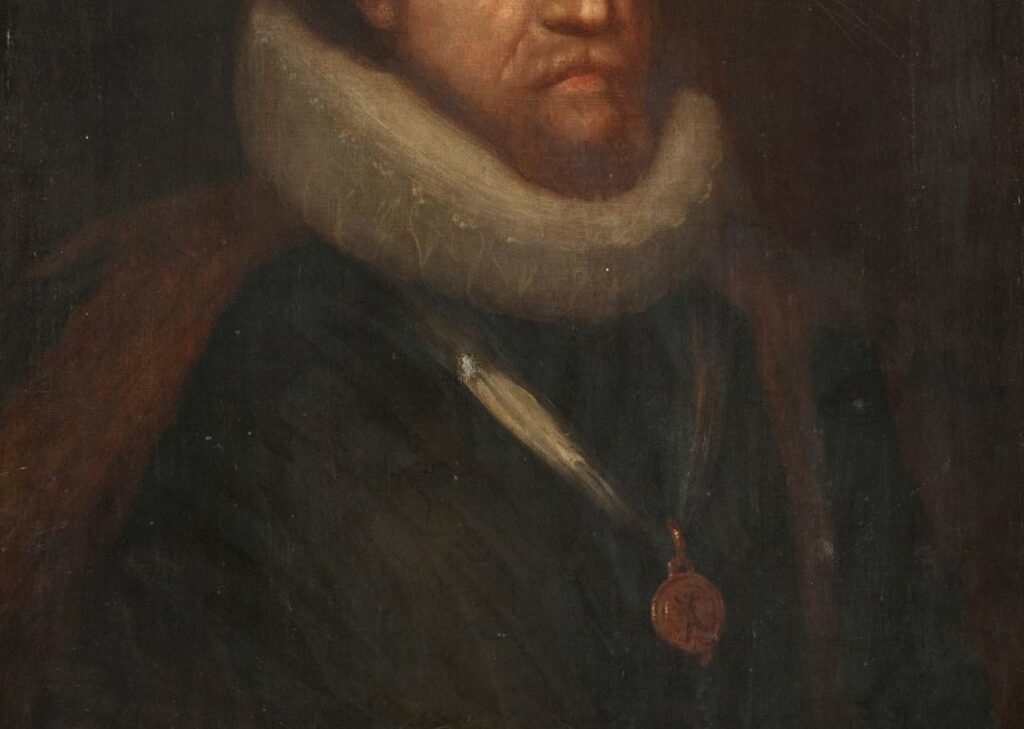
James VI and I had a tumultuous reign. Coming to the throne of Scotland as an infant on the back of his mother’s (Mary Queen of Scot’s) forced abdication, he was immediately thrust into the brutal world of early modern Scottish politics. His early years as King included a kidnapping by the Earls of Gowrie and Angus during which he was held at Ruthven Castle for ten months. He came to the Throne of England in 1603 following the death of his distant cousin, Elizabeth I. One of the most famous events of James’ reign was the Gunpowder Plot of 1605, but in more recent times James has become famous for his scandalous love affairs with his close male favourites. The relationship between James and his most prolific lover, George Villiers Duke of Buckingham, has recently been featured in Sky TV’s ‘Mary and George’ which tells the story of George’s epic rise to power after finding favour with the King. In 2017, Bendor Grosvenor identified a portrait of George in Pollock House near Glasgow as being by Peter Paul Rubens. Unlike his lover, James was not overly involved with his image making. Instead, he was more interested in philosophy, clothing and jewels. As a result, his portraits became somewhat standardised with similar compositions of the King being reproduced by artists to represent him.

Holland, Compton: Exchange, James I, 1616-1621, engraving on sheet paper, the Royal Collection, RCIN 601381.
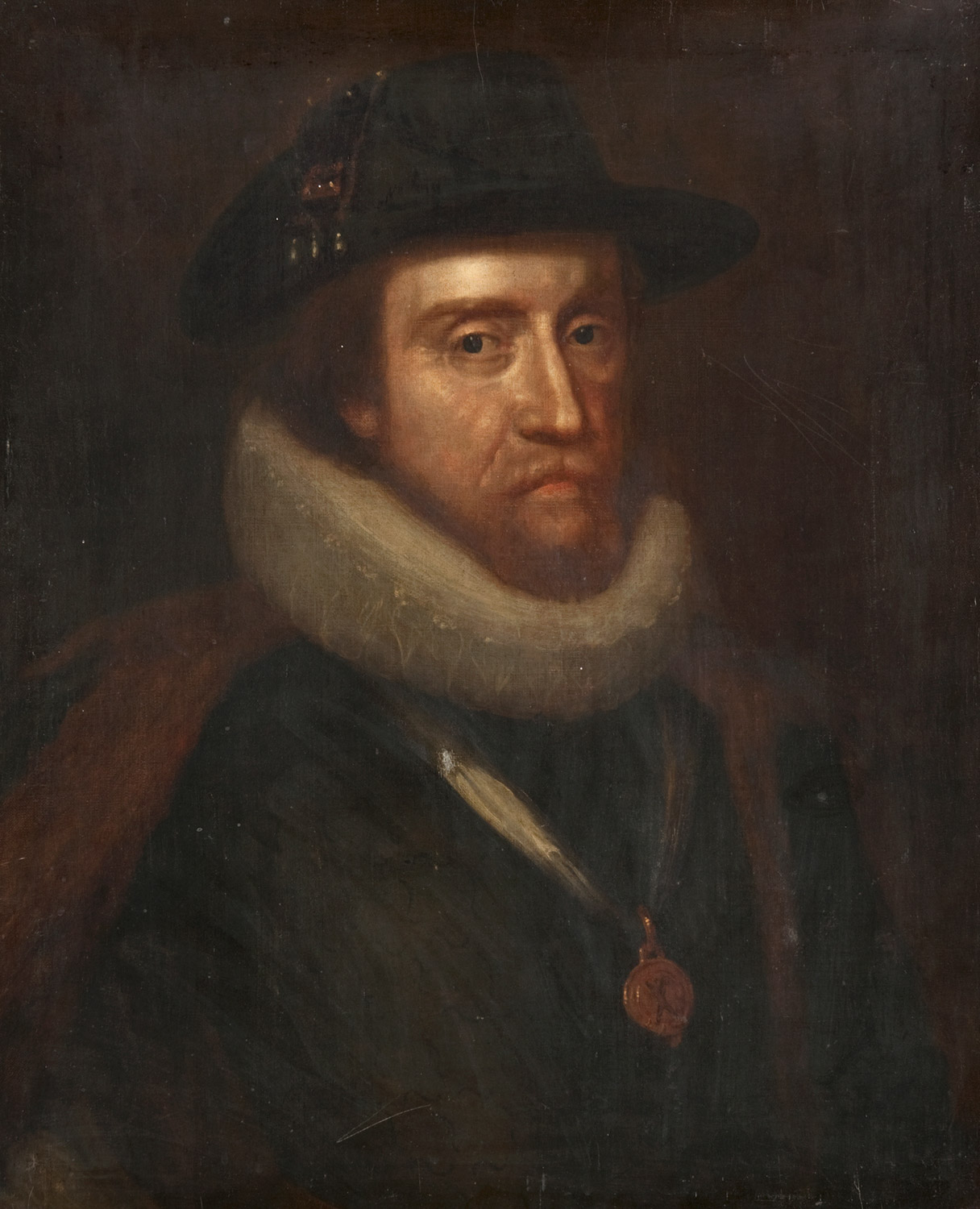
One such example can be found in the North Lanarkshire Council Museum’s collection. Until recently known as a ‘Portrait of an Unknown Man’, the painting has since been re-identified as James VI and I. Through stylistic and compositional comparisons to other works such as one in the collection of the University of Edinburgh, it has been possible to concretely identify the painting as James. The portrait at North Lanarkshire Council Museums fits within a long tradition of painting James VI and I in three quarter profile, in fashionable 17th Century dress, and with large jewels. In particular, the jewel he wears on his hat forms the shape of a crown with diamonds and rubies which allude to his royal status. There are several near identical paintings and prints from the period including one at Blickling Hall in Norfolk (former home of the Marquess of Lothian). All of these portraits seem to stem from a print produced by Holland, Compton: Exchange in 1616 and so the portrait must date to after this and not from James’ reign during Scotland. This also explains why the composition was so widely reproduced as artists had easy access to prints being made of the King.
The painting in the North Lanarkshire Council’s collection came from Dalzell House in Motherwell and was embedded within the panelling of the drawing room. It features in a photograph from when the house was used as a hospital during WWI. After the war the house was converted back into a domestic dwelling and was lived in until Lord Gavin Hamilton (the then owner) died in 1952. The contents of the house were sold off that same year save for the paintings embedded into the panelling of the drawing room. It was transferred to Motherwell District Council in 1975 and was converted into flats in 1985. It was at this point that the paintings were removed and found their way into the collection of the Council. This included the portrait of James whose identity was most probably lost at this time.

Photograph of the Drawing Room of Dalzell House from, Dalzell House Hospital Christmas 1914 photograph album, North Lanarkshire Heritage Centre, NLC/MHC929/2.
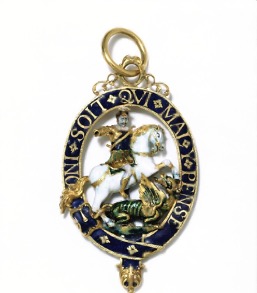
What sets the image in North Lanarkshire apart from other depictions of the King is what is around James’ neck. Whereas every other similar composition has James wearing the English Order of the Garter, here we can see the Cross of St. Andrew on a green ribbon. This means that the heraldic order around James’ neck is actually the Order of the Thistle. This tells us two very important things. Firstly, that this painting is almost certainly Scottish. Secondly, it could lead us towards a date.
-

- Order of the Garter
-

- Order of the Thistle
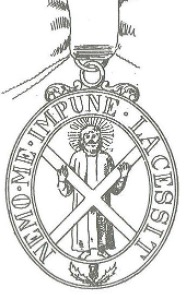
The Order of the Thistle was not an active heraldic order during James’ lifetime. There are no other depictions of James wearing the Order in the public domain. Whilst the Cross of St. Andrew was worn in some portraits of Renaissance Scottish Kings such as in a 1579 portrait of James V, this was most commonly on a chain and not on a green ribbon. The Cross had been previously used as a symbol of the monarchy and the country rather than as a symbol of the Order of the Thistle. It is only because the Cross is hung from a ribbon like the Order of the Garter that we know this is supposed to represent an existing heraldic order. This would therefore date the painting to after James VII and II’s re-establishment of the Order of the Thistle in 1687.

Unknown Artist, James V, 1579, Oil on Canvas, National Galleries of Scotland
There are a few notes in the Motherwell archive on the painting that date it to being from the 18th Century. Whilst they do not state their reasoning or sources, they seem to be right in this assumption. Because of the way the Order of the Thistle is depicted, the most logical time for the painting to have been completed was during the early Georgian period. At this time Scotland had strong Jacobite sentiments. It was very common within Scotland to depict past Scottish Kings as symbols of a romantic Scottish past and express a dissatisfaction with the Act of Union in 1707. In doing so, artists and patrons celebrated the Stuart dynasty who had been replaced by the Hanoverians in 1714. Many Scots saw the son of the exiled King James VII and II as the rightful monarch and supported his attempts to recapture the throne.

Anton Raphael Mengs, Prince James Francis Edward Stuart, 1740s, Oil on Canvas, National Portrait Gallery.
By depicting James VI and I in the Order of the Thistle, the artist or patron were probably aligning themselves with the Stuart dynasty. It is probable that this painting was completed during or after the first Jacobite uprising in 1715. Who commissioned this piece and exactly why they might have had Jacobite leanings still remains a mystery, but this painting’s use of a distinctly Scottish Order which had been founded by the exiled King would seem to suggest that this painting expresses Jacobite sympathies. The fact that the portrait is not overtly obvious in its symbolism and follows established visual tropes of James VI and I, also supports the idea that this could be a Jacobite painting. With support for the exiled Stuarts now being treasonous, Jacobite’s had to look for new and secretive ways to express their political leanings. This meant that visual ties to the Jacobite cause had to be subtle and only obvious to those who knew how to read them. The exiled Stuart Prince’s had taken to being depicted wearing the Order of the Thistle in many of their portraits to emphasise their claim to Scotland. By depicting their direct ancestor wearing an order that was distinctly Scottish and had direct links to James VII and II, their legitimacy is emphasised and this could be the key to understanding how and why this painting came to be.

Louis Gabriel Blanchet, Prince Charles Edward Stuart, 1739. Image: Royal Collection Trust/ His Majesty King Charles III.
This portrait of James VI and I is an interesting connection between North Lanarkshire and the Jacobite cause. Being Scottish in origin, it is an insight into how portraiture was practiced during early 18th Century Scotland and what sources artists were drawing upon. With Scotland having suffered enormous losses during the uprisings of 1715 and 1745, it speaks to the tragedy of those events and the hope that the viewers might have had of restoring the would-be James VIII and III to the throne. Having been largely forgotten over the past 70 years, James VI and I’s portrait is now beginning to have light shed upon it and can now be found correctly identified on Art UK’s website.

Cameron Webster is a third-year Art History student at the Edinburgh College of Art. He has been conducting his placement with North Lanarkshire Council since January and has been focussing on the Dalzell House collection. In his spare time he works at The Georgian House for the National Trust for Scotland.