
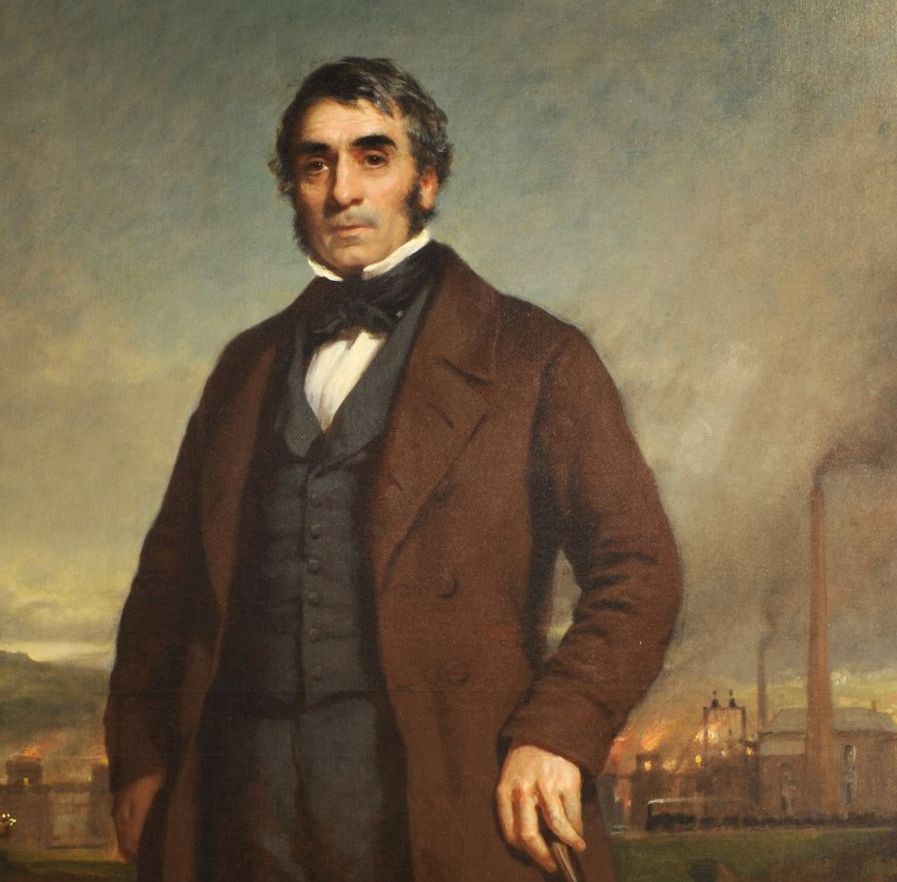
This story by Ruoyan Guo, a Postgraduate student in the History of Art at the University of Edinburgh, focuses on a portrait of William Cameron by Daniel Macnee which is in our museum collections.
Standing against an unusual industrial backdrop, William Cameron calmly gazes beyond the canvas, meeting the eyes of the viewer. In his left hand, he holds a cane, dressed in a brown overcoat and a black suit, exuding a typical sense of decency and gentlemanliness. (fig.1)
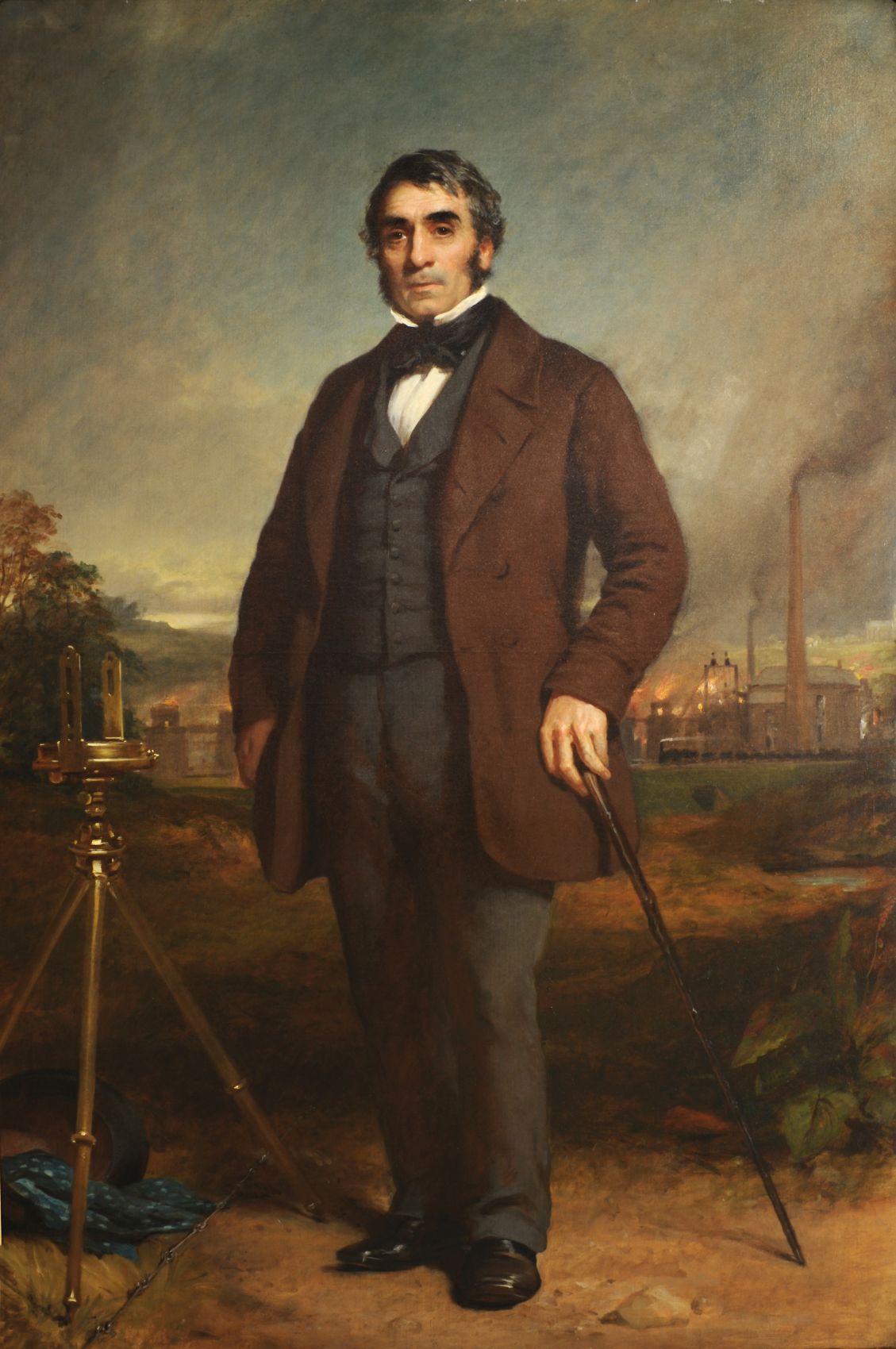
More attention-grabbing than the sitter himself is the scene of this portrait. In the foreground, there is a theodolite on its tripod and a measuring chain, tools for surveying new mine workings. A theodolite is a measuring instrument typically used to measure horizontal and vertical angles. It can be visualised as a triangular frame with a telescope that can rotate and tilt. In the distance, one can observe the blazing furnaces of the Gartsherrie Iron Works, with Gartsherrie No.1 Pit on the right. These details meticulously showcase his identity. Without any prior knowledge, one can immediately deduce his profession is intricately tied to the industrial landscape. In reality, he is William Baird and Company‘s underground manager, involved in the company’s operations since its early days in 1816. He held the crucial responsibility of exploring lands for potential iron extraction, a role pivotal to the company’s profitability. The artist behind this portrait is Daniel MacNee, a renowned Scottish portrait painter who, in 1845, painted a full-length portrait for Queen Victoria and was knighted by her in 1877, serving as the president of the Royal Scottish Academy. Given the artist’s stature, it is evident that William Cameron, who the artist had already painted the Queen before being commissioned to paint him, was a wealthy, trusted, and highly respected figure.
Returning to our focus on the portrait’s scene, we can highlight its unusual nature by comparing it to other works by Daniel McNee and contrasting it with portraits of industrialists from a similar period.
Firstly, among Daniel McNee’s 128 works on ArtUK, 85 are documented male portraits with known sitters. Detailed observations on the subjects’ professions and background types reveal that 14 are related to the industry, 4 have outdoor backgrounds, and 9 have backgrounds related to their professions, such as clergy members in religious attire or scientists with globes or instruments. Most importantly, there are zero portraits where the occupational background is industry-related and directly tied to the subjects’ work. 14 sitters were men of industry (16.5%), only 4 had outdoor backgrounds (5%), and 9 had backgrounds related to sitters’ occupations (including clergy wearing religious attire or scientists with globes or relevant instruments) (10.6%). From this comparison, we can infer that placing industrialists in an industrial setting was not MacNee’s usual artistic inclination. However, considering his early experience in landscape painting, it is possible that he aimed to showcase the close connection between William and the industrial landscape in this portrait.
Fig.2

Gartsherrie staff, 1858, after a painting by Daniel Macnee. Here we see James Baird surrounded by his senior staff including on the far right his Underground Manager William Cameron.
In the second comparison with portraits of industrialists from the Industrial Revolution and later, the focus tends to be on wealth displayed through homes, furnishings, and jewellery, with fewer outdoor backgrounds. As engineers’ professional spirit grew in the latter half of the 18th century, and their aspirations for gentlemanly status (rich class) intensified, painters incorporated them into standard portrait types, highlighting homes, furnishings, wealth, and social status. An important example is a portrait of William Baird and Co’s staff (fig.2), where industrialists, dressed decently, gather around a table for discussions, with William among them.

Fig.3 John Loudon McAdam by unknown artist, circa 1830. © National Portrait Gallery, London
However, during this period, some industrialist portraits aimed to maintain honesty about their ownership of mines, which was an increasingly important source of landed wealth. Sitters wished for their achievements to be explicitly conveyed rather than partially disguised under aesthetically pleasing covers. An exemplary case is John Loudon McAdam in the National Portrait Gallery (fig.3). In the background of his portrait, workmen are seen laying down a road, with Bristol visible in the distance, where McAdam first applied his construction technique on an extensive scale in 1816. Yet, careful observation reveals that the industrial background elements in these works are distant from the sitters, like John Bedford portrait by Moses Houghton (fig.4). Physically, either factories and blast furnaces are visible only through windows, appearing minuscule compared to the sitters’ indoor scenes, or factories and workers are below the sitters’ line of sight, and the sitters stand on high ground, seemingly unaffected by the smells and heat emanating from the factories.

Fig.4 John Bedford by Moses Haughton, 1788. Amgueddfa Cymru.
This portrait created around 1850, adheres to the presentation and display methods of portraits in the 18th and 19th centuries. Given its substantial dimensions (H: 239cm W: 163cm), it is likely hung in places suitable for entertaining guests, like dining rooms, living rooms, or studies. It serves not only as a commemoration and honour of his career but also as a display during social gatherings. Instead of showcasing and flaunting gentlemanly attributes (wealth, elegance, social status), William chose to exhibit his career and the honesty and loyalty he holds for it. This perhaps is the most noteworthy aspect of this portrait—the exceptional industrialist who not only succeeded in his career but also possesses a modern sense of professional responsibility, respect, and pride in his vocation.
Reference
- ArtUK
- Celina Fox. 2010. The arts of industry in the Age of Enlightenment. Paul Mellon Centre
- https://museum.wales/collections/online/object/c9b5e2c1-8afc-36af-9112-ea78b6e1c0bd/John-Bedford/
- https://www.npg.org.uk/collections/search/portrait/mw04081/John-Loudon-McAdam?LinkID=mp02851&role=sit&rNo=0