
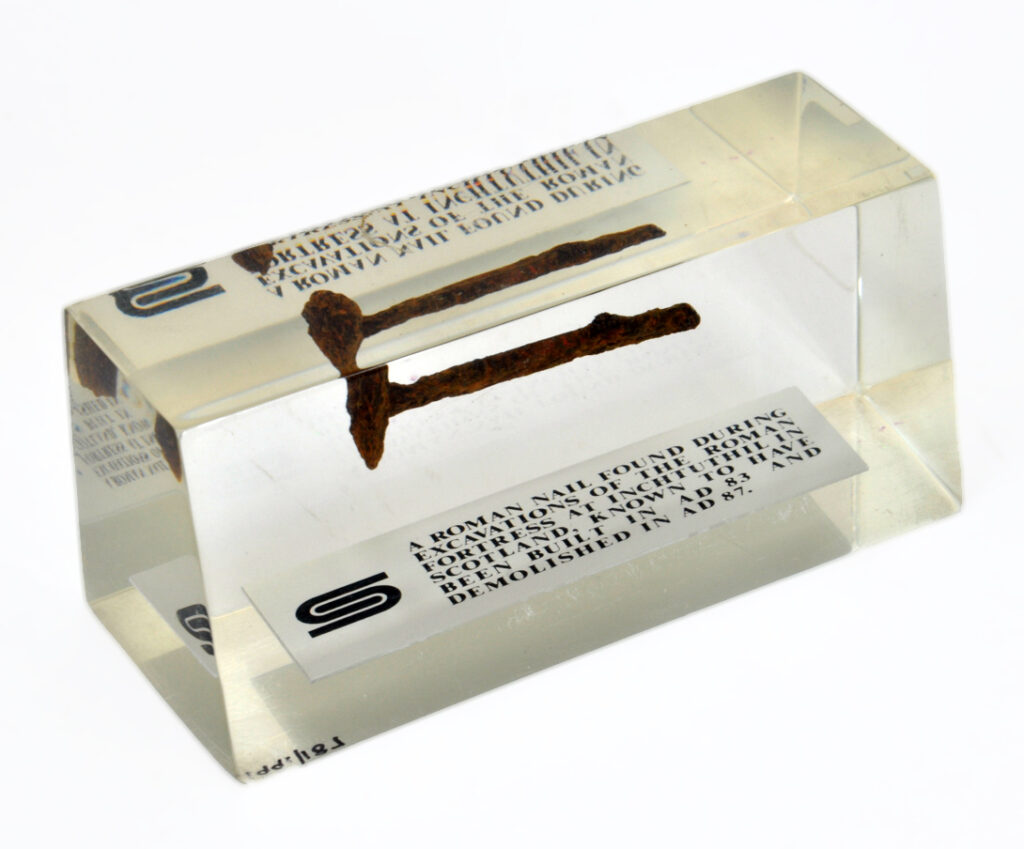
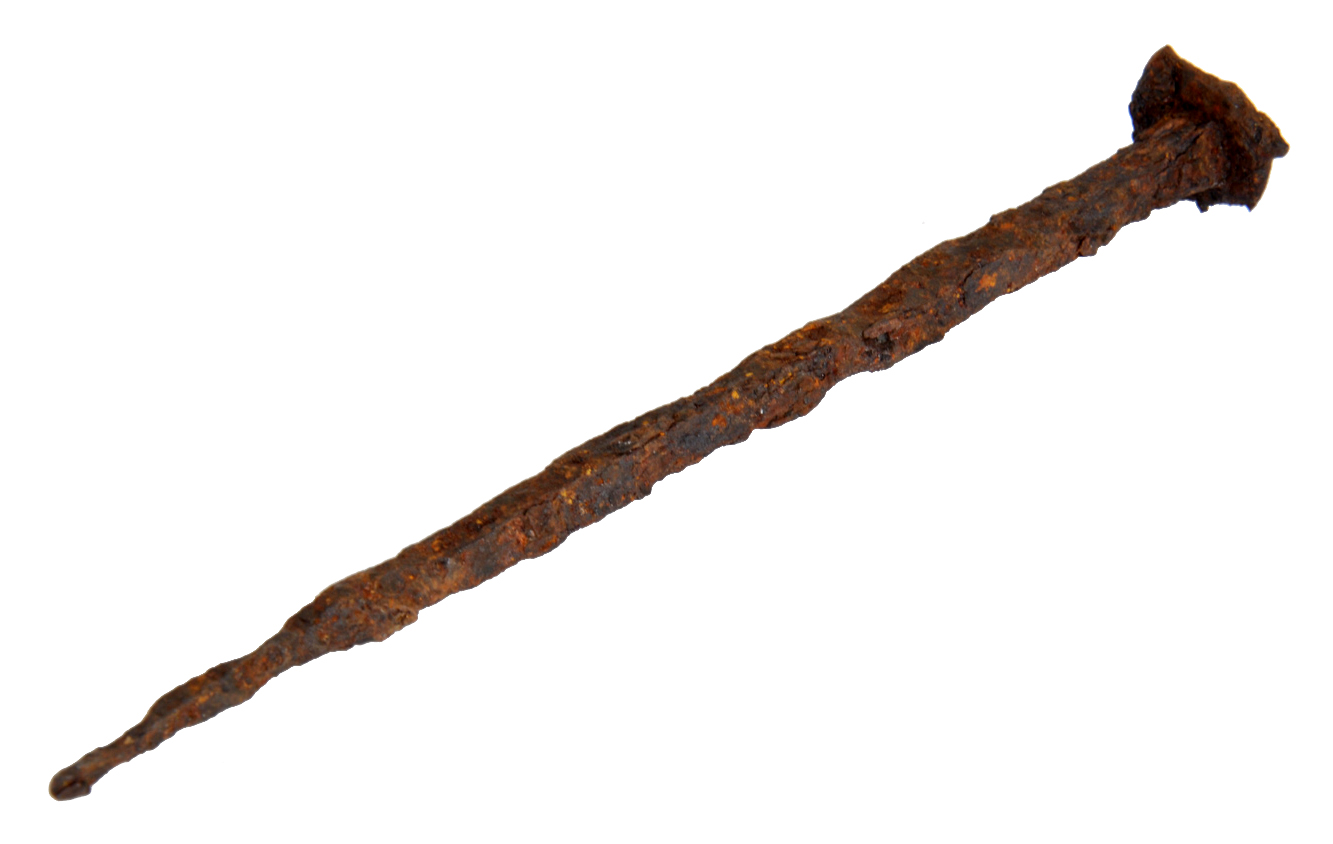
These nails may seem unassuming and boring when first observed, but their history tells of a fortress that had the capability of become a central Scottish city.
Today, Inchtuthil fortress is little more than grass and pastures. However, just under two millennia ago, it was on its way to becoming an imposing fortification. Whilst Scotland is home to a great many Roman forts, Inchtuthil is Scotland’s only Legionary fortress. There are four types of Roman fortification: the Marching camp, the Auxiliary fort, the Legionary fortress, and the Vexillation fortress (the last being a recently added classification). The Marching camp is the smallest. Comprising of a single narrow ditch and interior rampart, they acted as quick places to stop for the night. The Auxiliary fort was the next biggest, housing troops known as (unsurprisingly) the Auxilia. These troops lacked the training the Legions had and were generally smaller. Vexillation fortresses were larger so that they could house half a legion and several Auxilia. The Legionary fortress was the largest. They were permanent, imposing structures, all fairly uniformed to house a legion (approximately 5,200 men).
So, what is the story behind Scotland’s only Legionary Fortress and why is it best known for its incredible pile of iron nails?
Inchtuthil fort began its life around 83 AD in order to control the local Caledonian tribes after the Roman victory at Mons Graupius. The fort was roughly the size of 25 football pitches (53 acres), even larger than the Legionary fortress at York. The defences would have been heavy enough to give any Caledonian pause, with ditches, palisades (tall wooden stakes that acted as fences) and watchtowers. It contained a military hospital for about 300 men, a workshop for craftsmen, 6 granaries, and stables for 1000 horses.
Unfortunately, this impressive home for the legion was never completed. Due to a change in fortune and circumstance elsewhere in the Empire, it was instructed that Inchtuthil was to be abandoned and razed to the ground around 87 AD. This, the demolition of a structure, was common practice to avoid locals laying their hands on valuable material that could be turned into weapons or sold for a good profit. So, what was a Roman commander to do when faced with a hurried evacuation and roughly ten tonnes of iron nails? Well, one option was to carry them south but this was not sensible. That many nails would have wasted valuable resource space and would have slowed the retreat down considerably. They could not just leave them, however, because of the valuable nature of iron. The only logical solution, dig a great bit massive hole twelve-foot deep and burry them. So, that is what they did. The hole was dug, the nails were buried, the ground wacked flat, and just for good measure, the workshops set alight over the top so it masked the burial completely. The Romans clearly did a very good job as the hoard of 875,000 nails was found undisturbed in 1960.
Nowadays, Roman Legionary fortress sites are well known cities. Places like Exeter, York and Chester all have their beginnings as these impressive Roman forts. It is speculated that, if the fortress at Inchtuthill had survived and been occupied for longer, it likely would have followed in the same footsteps and become a city of equal size. However, that was not to be the case, and it stands as it does today, an unassuming scope of countryside that was, until recent, home to ten tonnes of history.
About the Author
Written by Digital Collections Volunteer Bryony Chapman. Bryony has a BA (Hons) in Ancient History and an MSc in Museum Studies. Her main area of interest is Roman life and influence in Scotland.