
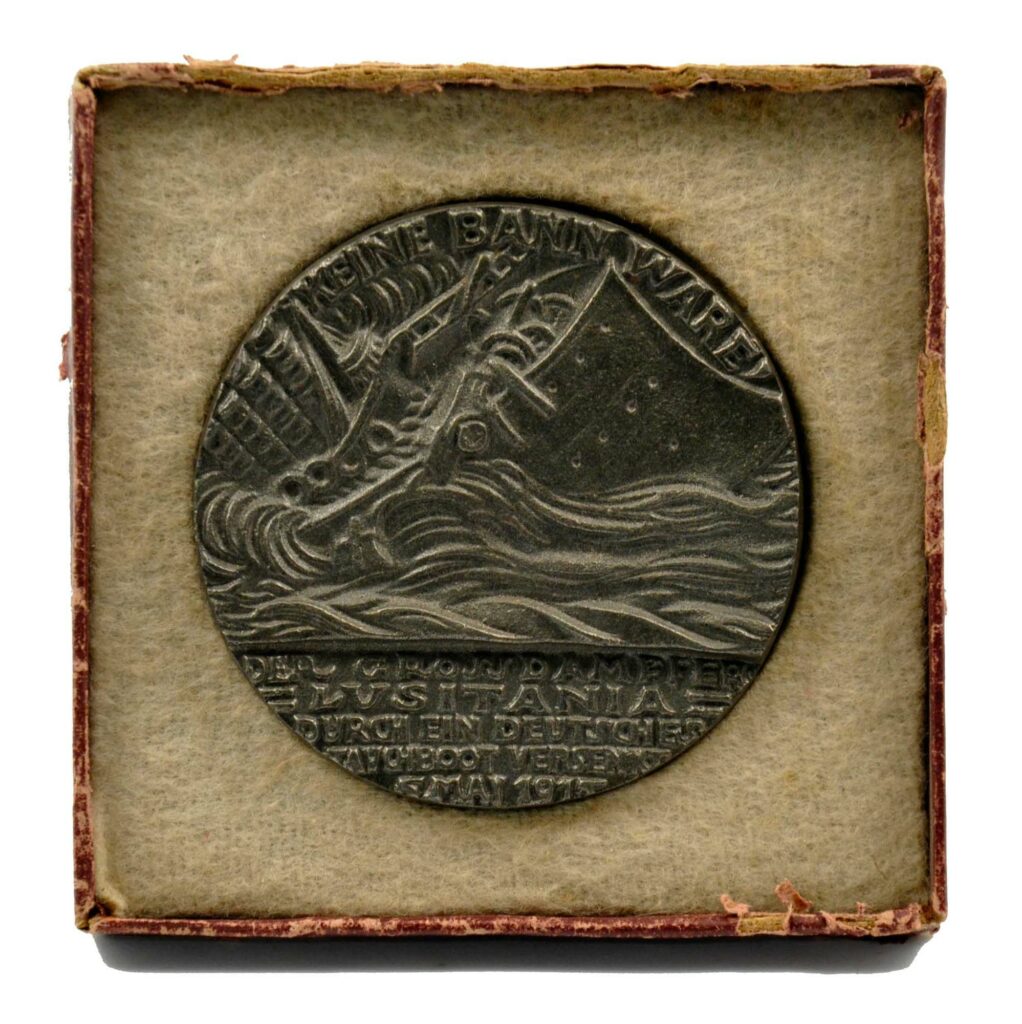
In the collection is a medal designed by German artist Karl Goetz. Goetz was a medal and medallion maker who’s art often commemorated the First World War. Although making medallions on the theme of war, in many cases, he seems to condemn the idea of awarding of a medal for tragedy and violence. Some of his depictions of war show Death as a figure or Skeleton and politicians are drawn as cartoonish caricatures. Many of his designs also have a satirical tone. The medal in the collection concerns the sinking of the ship RMS Lusitania in May of 1915. This tragic event lent itself well to the propaganda machine of the First World War, making this little medallion very divisive.
In amongst the rest of the NLC collection, this little German medallion seems out of place. How did it get here? Why do we have it? Indeed, not much is known about how this object ended up in North Lanarkshire, but we do know it was donated in 1989 by a woman from Motherwell. What is perhaps most interesting about this ‘Karl Goetz medal’ though, is that it is a fake. It is one of nearly 300,000 fakes created by British Navy Intelligence to spread propaganda and is a great example of propaganda as its own form of warfare during WWI. In this small object, we see the clash of two countries battling to tell their own story of what happened to the Lusitania.
What Happened to the Lusitania?
In February 1915, a militarized naval zone was established around the British Isles. This meant, any vessel within this zone could be attacked by German U-Boats or submarines. In the same year, Germany also declared unrestricted submarine warfare, meaning any type of ship or vessel, if it entered this militarised zone, could be attacked by the Germany navy.

The Launch of the Lusitania, 1906
The Lusitania was a Cunard Liner, renowned for its ability to travel across the Atlantic at record speeds. Before departing New York, the captain, crew and passengers of the Lusitania were all warned of the dangers of ocean travel through the militarised zone around the UK. It was well known that German U-Boots could attach liners and warships within this area. On the 7th of May, just off the coast of Ireland, a U-20 submarine torpedoed the Lusitania causing irreparable damage to the ship. The torpedoes caused more explosions within the hull, which sank the ship in a mere 18 minutes. Out of a total of 1,959 passengers on board, 1,198 drowned. The event is often credited with influencing America to enter into the First World War as 128 American passengers died in the attack. After the sinking, uproar followed, and Britain and America accused Germany of specifically attacking a passenger liner full of non-combatants. Propaganda soon began to circulate. What was not revealed until later, however, was that the Lusitania was also carrying a large amount of weaponry: 173 tonnes of rifles and ammunition was also on board.
So where does Goetz’s medal come into this story? To answer this, we need to look both at the fake held in our collection, and at the original designed by Goetz. When the British Naval Intelligence became aware of the medal, they commissioned over 300,000 fakes to be made which then spread through society with additional documents and propaganda. The differences between the original and these fakes are key to understanding how successful the propaganda machine of both Britain and Germany worked during WWI.
The Original

Second edition of the original Lusitania Medallion. ©National Museums Liverpool
MMM.2004.142.2
Let’s look at the original medal first. One side of the medallion shows passengers lining up to buy tickets for the Lusitania. You can see ‘Cunard Linie’ or ‘Cunard Line’ written on the side. Death, in the guise as a skeleton, is at the booth, and is seemingly an employee of the Cunard. He sells unassuming passengers tickets to what will be their own drowning. The overhead text reads ‘GESCHÄFT ÜBER ALLES’ or ‘BUSINESS ABOVE ALL ELSE’. It is a comment on money making; the exploitation and carelessness by the Cunard ship company to allow nearly 2,000 civilian passengers to travel into a known, active, militarized warzone. The figure of death then takes on a specific meaning; he appears almost as Charon, the ferry man of Greek myth, leading the passengers into dangerous waters.
In the crowd, a man reads a newspaper with the headline ‘U-BOOT GEFAHR’ or ‘THREAT OF U-BOATS’. Goetz wants to highlight that the ship companies knew of Germany’s unrestricted submarine warfare, and that the Lusitania would sail through these dangerous waters. Indeed, the British Admiralty advised the captain of the ship to use evasive manoeuvres and zig-zag tactics to avoid torpedo attacks. He ignored this suggestion. The text ‘BUSINESS ABOVE ALL ELSE’ is therefore a criticism of the ship company that put ticket-sales over the lives of its passengers.

Second edition of the Lusitania Medallion with the correct date 7th May.
©National Museums Liverpool
MMM.2004.142.2
On the reverse, we see the fate of the Lusitania as the ship is sinks into the sea. The text above reads ‘KEINE BANNWARE’ or ‘NO CONTRABAND’ which probably refers to the transportation of nearly 200 tonnes of ammunition to the UK. Goetz is being ironic here. On the bow of the ship, there is what appears to be a WWI fighter plane, along with objects that look like guns, spilling over the sides of the ship. With no sign of the enemy submarine in the waters, it seems as if the ship is sinking under the weight of its ‘contraband’. Indeed, after the first torpedo hit the ship, a second explosion occurred which is credited with the damage that sank the ship in 18 minutes. Some theories suggest that this second explosion may have been caused by the ignition of the ammunition in the cargo hold.
The text at the bottom of the scene reads ‘THE GREAT STEAMER LUSITANIA, SUNK BY A GERMAN U-BOOT 5TH MAY 1915’. Importantly, the date is incorrect as the ship was sunk on the 7th of May. By the time Goetz had realised his mistake and re-released the medal with the correct date, it was too late. The British had seized their opportunity. This mistake by Goetz, then became a key feature of the fakes and accompanying propaganda made by Britain.
The Fake
The fake medals that were produced by Britain, showed a different story of the sinking of the Lusitania. Those unfamiliar to Goetz’ work would see a medal, an object normally linked with celebrating heroism, which is commemorating the sinking of a passenger vessel by the German Navy. In this interpretation, Death plays a different role. The fake medals suggest there is an inevitability to the sinking and that the ship was specifically targeted by the U-Boot.

On the reverse of the fakes, the German ‘MAI’ is replaced with the English ‘MAY’ making it clear that this is indeed a British replica. Although they changed the German month, the incorrect date is kept the same. This plays an important role in suggesting that the Lusitania was a premeditated target. It is as if the original date of the attack was planned for the 5th of May but they missed their chance, only to succeed two days later.

The reverse of the medallion in the NLC collection with wrong date and the English ‘May’
Language is also an important factor in the success of these fake medals as propaganda. It is unknown whether the donator of this particular medal could speak German, but let’s assume that everyday people who came across one of these fakes most likely didn’t understand much of the German language. By changing ‘Mai’ to ‘May’, the idea of premeditated attack was easily conveyed to the English-speaking masses, without needing to understand the rest of the text. The fakes use selective translation which uses the language barrier to its advantage.
In the fake, the dimensions also obscure some of the original text. If you look at the fake in our collection, the line above the crowd is harder to read. It looks like it could read ‘GESCHAFT VEER ALLES’ which doesn’t quite make sense. We could assume that this is another instance of incorrect language (Like the May instead Mai). By looking at the original however, it is clear that the fake cuts off the umlaut, the double dot above some German letters, of the letter A in ‘Geschäft’ and the U in the word ‘über’. This cropping hides the meaning of the original German text. Only by looking at the original medallion, can you understand Goetz’s original commentary. Obscuring the meaning of the artwork through selective translation and cutting off parts of the text was a key element of this propaganda. It allowed the British to essentially pick and choose which information was spread by only making specific parts of the medallion understandable and readable.
This small medallion in the collection essentially leads a double life. On the one hand it copies an artist who condemned the Cunard Line company for continuing to carry civilians into a warzone with full knowledge of the consequences. On the other hand, it has been manipulated to show a celebration of civilian death with the figure of Death mocking the passengers. Goetz’s own rhetoric and art was used against him in the propaganda arena of the First World War. By taking it out of its original context, i.e., German speakers, and criticism of using the Lusitania’s passengers as a human shield for the transportation of weapons, the British were able to increase anti-German feeling by using the tragedy of the Lusitania. How it ended up in Motherwell is credit to the success of this type of propaganda. It was easily carried from place to place, carrying its meaning with it.