
The history of medicine and healthcare is fascinating and wondrous. Medicines and treatments came into fashion and went out of fashion again. Practices once deemed state-of-the-art and innovative are now looked on as unhygienic and in many cases barbaric or weird.
Medieval Britain could provide various examples of this but one weird (by modern standards) medical treatment was bloodletting; there was a belief that some ailments were caused by having too much blood in your body…so the obvious solution was to remove a lot of the patient’s blood to get them well again!
Childbirth as an Expectation
Turning to the history of childbirth, it’s a fascinating avenue in medical and social history to explore. It’s important to note that like with many other parts of history, there were differences due to culture and geographical location, social class, and individual situations, to give a few examples. As such, this piece gives a snapshot into a tiny part of that history.
There were certainly women who truly wanted to be wives and mothers, just as there were women who did not, but at the heart of it, women had no legal protections until the late 1800s-early 1900s and generally had very little choice. Traditional social roles were the norm and therefore many women were delegated to the ‘private’ sphere of the home with the expectation of becoming wives and mothers (except for lower-class women who also had to be working on top of these other roles). Therefore childbearing was a process many women went through.
Developments in the 1900s
The 1900s brought a variety of changes such as the role the midwife played (becoming increasingly trained and knowledgeable about birth and medicine). There were advancements in the equipment used to assist with difficult deliveries and pain relief being given to labouring mothers.
Crucially, acts of parliament were introduced to make training for midwives compulsory, ensuring that all midwives were adequately supervised and knowledgeable rather than solely relying on knowledge (whether accurate or inaccurate) that had been passed down. Among other changes was that fewer women died as a result of childbirth during the 1900s, as maternal mortality rates fell through better health and hygiene, better training, and advancements in medical practices and equipment.
The gradual decline of birth at home in favour of the hospital was a fundamental change in the 1900s, the result of which is still present today with many births happening not at home or in the community, but rather in a maternity ward.
We have become increasingly interested in this world of birth – its changes, its advancements and how attitudes towards expectant mothers and their births have altered. Even to this day, the success of the TV show ‘Call the Midwife’ shows there is still a taste for understanding the transformation over time and the realm of birth.

Trained midwife caring for baby, 1970s. Available at: Our History | Association of Radical Midwives (midwifery.org.uk)
Forceps: the Big Secret!

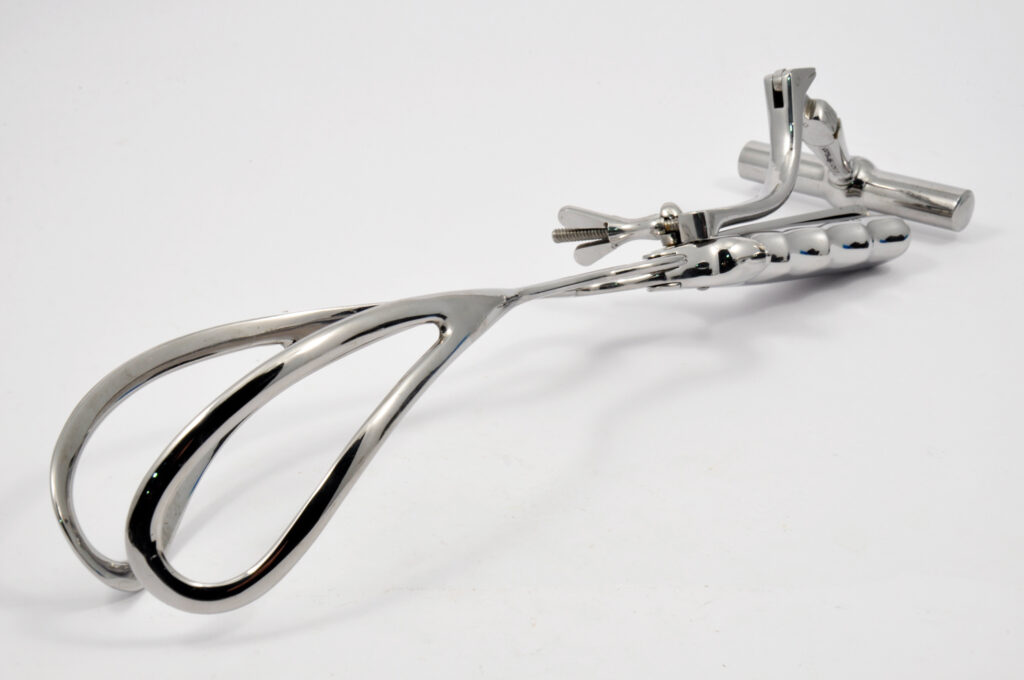
These forceps were used by local District Nurse McLean. They were an important part of the delivery toolkit – hoping you wouldn’t have to use them but prepared to do so if difficulties arrived. They were a crucial development in birthing care and made all the difference when compared to birth before having forceps available. Fairly easy to recognise nowadays and vital in cases of emergency in the past. However, it wasn’t always like this and certainly, birth like any other field of medicine or life, develops and things fall increasingly out of use.
Forceps have more recently fallen out of fashion, only being used on rare occasions, with the advancement and creation of more effective ways to assist in difficult births. However, they did become an important part of the midwives’ toolkit, used in emergencies to safely deliver the baby and help mum come out healthy too. Yet this recognisable medical device had an excitingly secret beginning. That’s because their inventors, a family of male midwives, fiercely guarded their knowledge and use of this device for profit and to have the upper hand in their industry. So while Obstetric forceps were invented in the 1600s, they weren’t widely used during childbirth until the early 1700s.

Chamberlen forcep design, 1680-1750. Available at: Chamberlen-type obstetrical forceps | Science Museum Group Collection
The Chamberlen Midwives and Hidden Advantage…Forceps
The Chamberlen brothers created what we recognise as the modern-day forceps (although earlier versions with much more basic and less efficient designs had been around prior). Yet for over a century, they kept quiet because they realised how their forceps set them apart from other medical practitioners. Before forceps, complications during birth were dire for babies who were stuck in the birth canal and consequently, it was deadly for the mother too in many cases.
Of course, with their forceps, the Chamberlens soon gained a reputation for being the best, they were who you wanted if complications arose. But how could they possibly keep such a device secret for so long? After all, certainly, the birthing mother was in the room with them! Well, when called to attend births, the brothers brought their forceps in a big locked box. No one was allowed to lay eyes on the forceps, not even the person giving birth! People were removed from the room and the labouring mother was blindfolded so not even she could describe what miracle intervention had been used. After the birth, the forceps were locked away again.
The brothers were very much in demand given the rumours that mothers and babies were more likely to survive when they attended. The Chamberlens were not popular with their competitors due to their success which is a tale as old as time. Eventually, knowledge of the forceps got out and outlived the Chamberlens. Continuing on the work, a Scotsman called William Smellie (1697-1763) developed and improved the design of the forceps for usage in Britain.
About the Author: Brooklyn Braeger is a graduate of the University of Glasgow with a History MA (Hons) and a Modern History MSc. She is a Volunteer Digital Collections Assistant within the Curatorial Team, North Lanarkshire Council Museums & Collections