
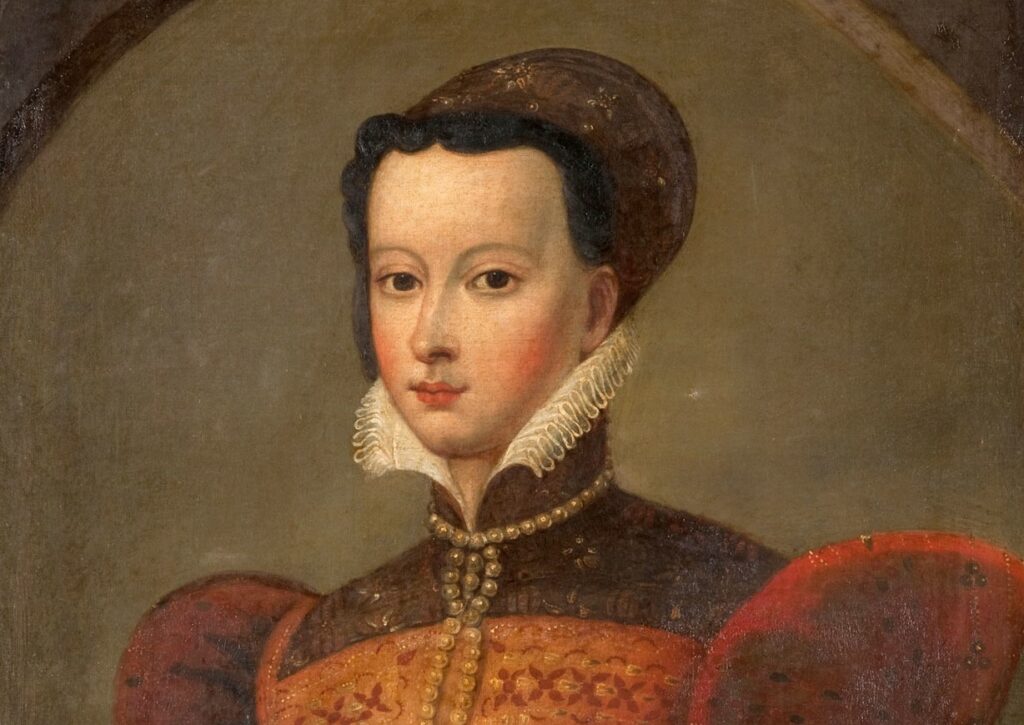
In this feature we analyse a ‘mystery painting’ to consider what can be discovered by careful observation.
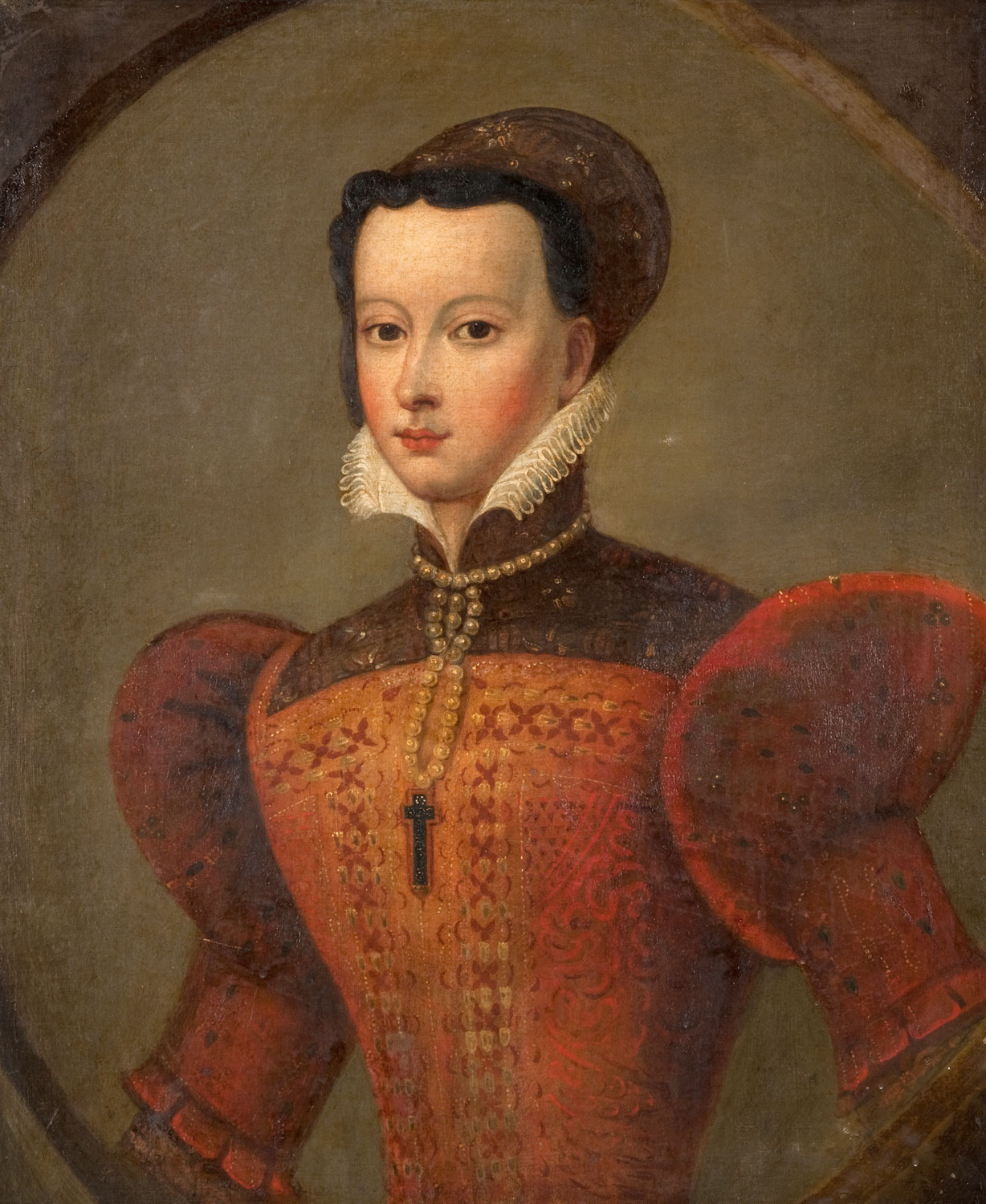
“Oil painting on canvas of an Elizabethan woman by an unknown artist.”
This portrait of a woman is undated, unsigned, and untitled. Each of these details are crucial in identifying for certain who the subject of the painting was meant to be, and what the artist hoped to achieve in his portrayal of her. We cannot know if the woman was a living model who commissioned the piece, or if perhaps the artist was inspired to recreate another’s work. How, then, can we know anything about it? Well, we can’t, not for certain. But there are particular features in the painting that can be interpreted as clues to fill in the many blanks of this puzzle.
It has been suggested, based on fashion and artistic style, that the subject of the piece as an Elizabethan woman. The Elizabethan period is the name for a historical era that aligns with Queen Elizabeth I’s reign of England, from 1558-1603. Her father was the notorious King Henry VIII, though he never named her heir, and it was far from clear that she would succeed him. Hundreds of years prior to the internet, paintings and portraiture would have had the same influential importance as social media platforms do today: they were an essential means by which Elizabeth promoted an image of herself as respectable, virginal, capable, and opulent.
Step 1: Consider The Owner
Much like celebrities today, the royals of the 1500s and 1600s set fashionable trends for those in society who could afford to follow them. Artists, likewise, learned to replicate the techniques and even the subjects of paintings that were already known and loved in wealthy circles. The ancient philosopher Aristotle encouraged artistic endeavours, and many of the affluent families in Elizabethan society were eager to follow such teachings, so as to appear as cultured and respectable as possible.
Paintings were also an appealing entertainment feature in stately homes where large gatherings were held, and visitors would have anticipated their presence. Combined, these social factors mean two things: firstly, that there was a reasonably high demand, at least among the upper class, for decorative portraiture; and secondly, based on style and subject alone, we cannot assume a painting from this era is the work of any particular artist.
Not all paintings were expensive, and it is perfectly plausible that less wealthy families had them, too. The best way to tell who owned what is by studying either wills, where people have specifically recorded the belongings they are leaving behind, or probate inventories, which were recorded after death in the absence of a will. According to the art historian Robert Tittler, Elizabethan paintings that have survived this long and are still in stable condition must have been “created with more costly, stable, and well-prepared materials and held by wealthy and successful families who could safekeep and preserve them through the generations” (2012, 43-44). He also reports that cities with notable cathedrals and universities were early collectors of portraits, which suggests that a higher concentration are likely to be discovered in such places (52). Based on this information, it seems likely that our painting was purchased for trendy display purposes, rather than having been commissioned to capture the personal likeness of a wealthy individual.
Step 2: Compare With Similar Paintings
The Metropolitan Museum has an engraved sketch identified as “Mezzotint print after the Carlton portrait, previously attributed to Federico Zuccaro” that greatly resembles the woman in our mystery painting. The ‘Carlton portrait’ (alternately spelled Carleton) was named after the family who owned it, and is not an original image. Instead it is a famous copy of the full-length painting done by the Italian artist Federico Zuccaro, believed to depict Mary Queen of Scots. Interestingly, the Metropolitan Museum reports that the woman depicted in these paintings is not actually Mary Queen of Scots – though who she really is, then, we are no closer to knowing.

Mary Queen of Scots (?)
Image Copyright: The MET metmuseum.org/art/collection/search/639240
The Cooper Art Gallery also holds a painting that looks very much like our mystery woman, and theirs is more confidently titled Portrait of Mary Queen of Scots, dated to the early 1600s, and likely authored by the Flemish painter Paul van Somer. Judging by details such as the woman’s headpiece, her stiff lace ruff, the crimson gown with rounded shoulders, and the pearl necklace with a black cross, the subject in our painting is the same as that of the Cooper Gallery’s portrait. The striking similarities between these paintings suggest that our untitled portrait is likely one of many similar paintings based on a popular image.

‘Portrait of Mary Queen of Scots’, Image Copyright: The Cooper Gallery cooper-gallery.com/collections/picturing-people
Step 3: Investigate The Symbolism
Every single piece of a painting can be considered a clue – from the use of brushstrokes to the choice of colour, the jewellery and clothing worn by a subject, or even the intentional similarities to other influential artwork. Take, for example, the pearls worn by the woman in our painting. In artistic representations, pearls are meant to indicate chastity. They were associated with the famously virgin Greek goddess of the moon, and Elizabeth I, never having married nor had children, relied heavily upon such symbolism to project a powerful image of herself. Mary Queen of Scots, however, was married three times in her short life – first to the Prince of France; then to Lord Darnley, with whom she had King James the VI and I, the son that Elizabeth would eventually name in her will as heir to the throne; and finally to the Earl Bothwell. These speculations are not to say that Mary Queen of Scots never wore or was never painted wearing pearls, of course, but in a portrait they do seem rather a strange choice when considering Elizabeth I’s use of pearls and their symbolism.
Another prominent feature in the subject’s attire is the cross hanging from the woman’s string of pearls. This reference to the Christian faith is a clear contrast to Elizabeth I, who was a Protestant ruler, whereas Mary was a Roman Catholic. While pearls might seem an unlikely choice of symbolism for the Scottish queen, the cross is more than appropriate. Ultimately, the woman in our portrait could very well be Mary Queen of Scots – though she could just as easily be a different noblewoman, and we might never know one way or another. What we can determine, however, is this: mystery though her origins may be, her image is not one-of-a-kind.
References
Art UK. “Portrait of a Lady, Formerly Known as Mary, Queen of Scots (1542–1587) | Art UK.”
Portrait of a Lady, formerly known as Mary, Queen of Scots (1542–1587) | Art UK
Royal Museums Greenwich. “Symbolism in Portraits of Queen Elizabeth I.” Royal Museums Greenwich | Home
Tittler, Robert. “Locating the Public.” Portraits, Painters, and Publics in Provincial England, 1540-1640, by, Oxford University Press, 5 Jan. 2012, pp. 40–59, doi.org/10.1093/acprof:osobl/9780199585601.003.0003.
Voorhies, James. “Elizabethan England.” In Heilbrunn Timeline of Art History. New York: The Metropolitan Museum of Art, 2000–. Elizabethan England – The Metropolitan Museum of Art
About the Author

Sara recently graduated with her MSc in Museum Studies from the University of Glasgow. Her research interests are very broad, but generally tend to focus on medical history. She moved to Scotland from Canada, bringing her two cats with her.