
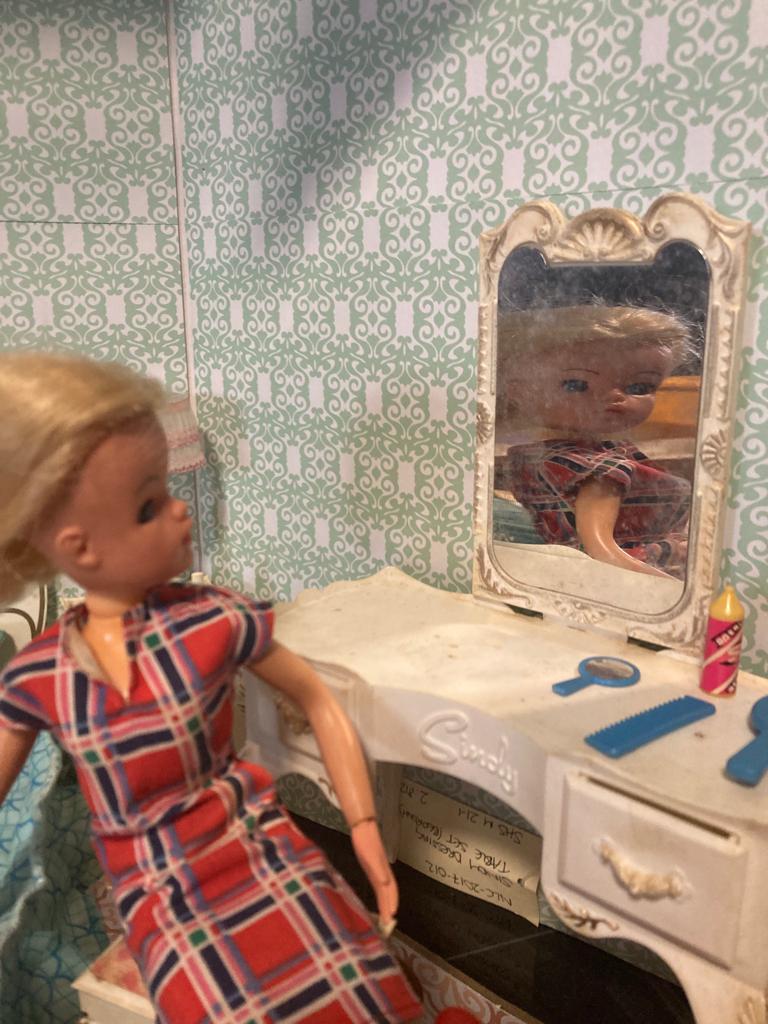

Sindy was the most popular fashion doll in the UK during the 1960s and 70s. In the collection at Summerlee, we have a Sindy doll, and her accessories which was donated by a local resident. We, Elinor and Molly, MSc students in Material Culture at the University of Glasgow, decided to explore this Sindy collection when the opportunity came up to redesign the community case here at Summerlee Industrial Heritage Museum. The community case is a temporary display space that can be taken over by different community groups who work with the museum.
The Sindy doll collection at Summerlee consists of a bathroom, kitchen, dining set, bedroom and various small accessories such as dinnerware and makeup; all domestic spaces. Since the display case consists of three glass shelves and a bottom platform, transforming the case into Sindy’s dollhouse became our goal. The first aspect of recreating Sindy’s dollhouse was to research Sindy dollhouses released in the 1970s. Firstly, there was Sindy’s Home, a dollhouse consisting of two sides of printed cardboard slotted together to create four rooms. The second dollhouse was the more traditional style of miniature home with three floors and an outside shell. Both were designed to display Sindy Scenesetters, what Pedigree Toys called the various lifestyle and home accessories that could be bought separately for Sindy. We decided to recreate the Sindy Home style of dollhouse as it would allow us flexibility of display across the two shelves dedicated specifically to Sindy’s household collection. The upper shelf would be for the display case title and the bottom shelf for the central text about the display.
Process
To create a doll house within the display, there needed to be a suitable background, which we achieved by using a tri-fold cardboard display. The wallpaper in the Sindy Home was different in each room with various patterned pastel wallpaper. We tried to recreate a 70s home feel by incorporating wallpaper designs similar to the originals.
We initially wanted to display Sindy advertisements from the 1970s in the exhibition to show how she was presented to the public. However this became a challenge as we needed permission from Pedigree. There were also no licensed for creative commons use which means they are free for anyone to reproduce and print. Instead we decided to source and display original Sindy boxes matching the objects on display from the collection at Summerlee. These showed images of how Sindy was intended to be posed with her various Scenesetters, as well as advertisements on the back of the box showing the rest of the Sindy Home collection.

Community case at Summerlee
Perspective
We wanted to look at Sindy from a gender perspective, considering what messages a child who played with this collection might have taken from it. Dolls are one of the most highly gendered toys when it comes to advertisements, specifically and almost solely targeting girls. They reinforce traditional gender roles and stereotypes. Looking through online catalogues of Sindy dolls and accessories from the 1970s, Sindy is shown in her home, with various hobbies like camping and horseback riding, but also with household cleaning tools, dinnerware and laundry kits. Play allows children to conceptualise adult life, and toys are the tools through which these ideals can be enacted. We wanted to point out that this Sindy collection reinforced the typical household roles for women in this time period. Of particular interest was a handmade bathroom scale that the donor had created for her Sindy. It’s interesting to wonder why this child felt Sindy’s home was incomplete without a way for Sindy to weigh herself. Playing with her Sindy doll, this child acted out the role she saw women in society to have, which included awareness of and maintaining their weight and appearance. Indeed, much of the Scenesetters in the Summerlee collection include notions of beautification such as her dressing table. Sindy herself fed into societies fixation on policing women’s bodies by providing children with an unattainable and unrealistic body image.

Conclusion
This was an excellent opportunity for us, as Masters students who work with objects and material culture theory, to gain firsthand experience with a museum collection. It broadened our perspectives to see what museum curators need to consider in terms of collections care and the practicalities of organising an exhibition. Upon reflection, it would have been wonderful to have had the time and resources to source old Sindy toy catalogues and research in more depth the larger themes around Sindy and how they evolved over time. This being said, it was great to explore the different themes and ideas Sindy represented.

This display case would not have come together without the help from the team at Summerlee Museum, Rosie Shackleton and Sarah Cartwright, and a special thanks to Martina Soderstrom from The Little Sindy Museum.