
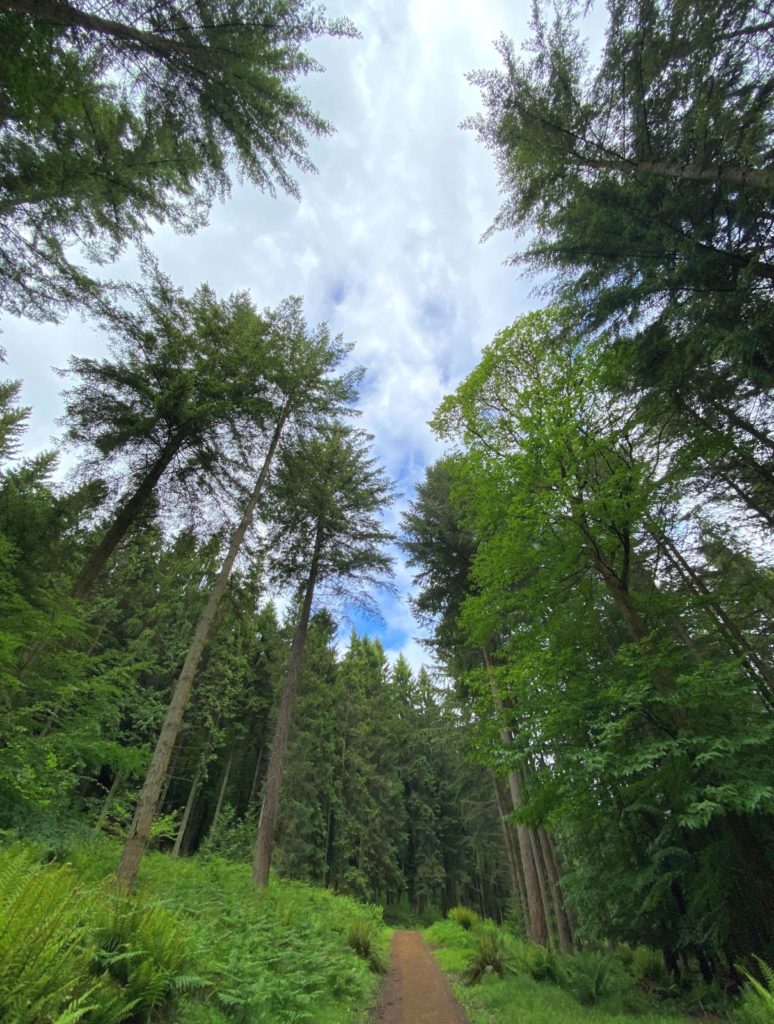
Once a royal hunting forest, the ancient Forest of Dean in south-west England has a rich industrial history.
In the early 1800s many people were drawn to the Forest in the hope of making their fortunes from the area’s mineral wealth. One of them was the celebrated Scottish metallurgist David Mushet.
Before arriving in the Forest of the Dean, Dalkeith-born Mushet played a key role in North Lanarkshire’s industrial development, not that he saw much reward for it. During a recent trip to the Forest I took the opportunity to visit some of the places associated with Mushet and to explore this unique place’s industrial past.

David Mushet was a life-long experimenter whose gift for metallurgy was matched only by a long-standing knack for falling out with people.
In Scotland, Mushet is associated with his crucial discovery, while manager of Coatbridge’s Calder Iron Works, that the local ‘black band’ ironstone (previously considered worthless) could be smelted directly in a blast furnace without additional fuel. However, it wasn’t until James Beaumont Neilson’s invention of the Hot Blast Process in the late 1820s that it became viable to make use of Mushet’s find. By that time the restless Mushet had long moved on to new adventures.
Exploring the Forest
Mining was usually small-scale in the Forest of Dean with hundreds of small levels linked on the surface by horse-drawn tramways (or waggonways) and railways. These lines are all closed now, apart from the Dean Forest Railway, which runs steam trains between Lydney on the coast and Parkend several days a week.

Most of the old railway lines and tramways through the Forest are now part of a huge network of walking and cycling trails linking the remains of mines and ironworks.
The Free Miners
Since Medieval times ‘Free Miners’ have been allowed to work small mines in the Forest. A Free Miner is awarded an area, known as a ‘Gale’, by the Crown, in exchange for a royalty. To be a Free Miner you had to be born ‘within the Hundred’ of St Briavels, aged over 21 and had to have worked as a miner within the Hundred for at least a year and a day.
In the early 1800s incoming industrialists increasingly found themselves in conflict with the Free Miners. This led to the rules for the latter being codified, for example Free Miners were not allowed to dig under an orchard. This meant that an outsider like Mushet could protect their colliery from unwanted mining by planting trees on top!
Today, there are still Free Miners at work in the Forest, with six active coal mines, one ironstone mine and several quarries. I took a tour down one of the working coal mines, Hopewell Colliery, which also runs tours for the public.


The Dean Heritage Centre in Soudley is a great place to start if you are visiting the Forest for the first time and want to know more about the area’s history. It also has a very nice café.

Mushet leaves Scotland
David Mushet left Coatbridge in 1805 after the partnership that owned the Calder Iron Works fell apart. David blamed the split on, “the speculative habits of one partner, and the constitutional nervousness of another”! He was offered the job of Manager at Alfreton Iron Works in Derbyshire but while working there also began to advise the owner of Whitecliff Ironworks in the Forest of Dean, on the side.
There was a long history of iron-making in the Forest, using charcoal from the plentiful trees as fuel. However, coke-fired iron-making had only arrived in the Forest within the previous ten years. David was highly respected for his knowledge of making iron using coke, having published several papers on iron-making, so his services were in demand.
As time went on David got so involved in the management of Whitecliff that he fell out with his bosses back at Alfreton. Consequently, in early 1810 he brought his family down to live in Coleford, the town closest to the works.
Today you can visit Whitecliff Iron Works, which was restored about ten years ago. Archaeologists aren’t sure exactly how big the works was but one blast furnace still stands and there seems to have been at least one other.

The large house that Mushet took for his family (by now he and his wife, Agnes had six surviving children) was known at the time as Tump House. The house came with a large field and a barn, in which David would carry out his experiments with iron. Sometimes Agnes would help by working the furnace bellows.

The barn has since disappeared under a residential development but the house survives as a B&B. Here David and Agnes’ next child, Robert Mushet was born in 1811. Robert would come to play a key role in the development of the steel industry.
By the time Robert was born, David’s relationship with his employer at Whitecliff had already foundered, Mushet quitting after just six months. The ironworks itself limped on for a few more years before going out of business. It doesn’t seem to have been profitable and problems smelting iron using local coke had already caused the other two coke-fired ironworks in the Forest (Parkend and Cinderford) to temporarily close around 1806. Much of Mushet’s work involved finding ways to improve the quality of iron made using coke, a fuel which introduced more impurities than charcoal.
Luckily for David, despite losing his job he had made shrewd investments in local coal mines and waggonways. These were more than enough to support him and his family, so it made sense to stay in the Forest.

What David Mushet really wanted though was his own ironworks, somewhere he could continue his experiments on a larger scale and without having to answer to anyone else. By 1818 he had amassed enough money and found a suitable location within walking distance of Coleford, at Darkhill.

Darkhill is an evocative spot in a small, wooded valley. The ironworks was mainly used for David’s experiments and doesn’t seem to have produced large volumes of iron for sale.
Close by, but harder to spot, are the overgrown remains of the large steelworks Robert Mushet built in 1862 after he had taken over the management of Darkhill and begun steel-making. Known as the Titanic Steel Works, they were named after the element titanium, which Robert’s father believed he had discovered.

Robert Mushet perfected Henry Bessemer’s process for turning iron into steel. When Robert fell on hard times in old age, it was Bessemer who gave him financial support, recognising the role Robert had played in Bessemer’s own success.
David Mushet died in 1847 and is buried alongside Agnes in a churchyard near Coleford. Despite having long protested poverty, David left a large fortune.
David Mushet finished up a long way from Scotland but the Forest of Dean gave him a place where he could finally do things his way.
About the Author

Justin Parkes has been Industrial History Curator for North Lanarkshire Council Museums & Collections since 2008.