
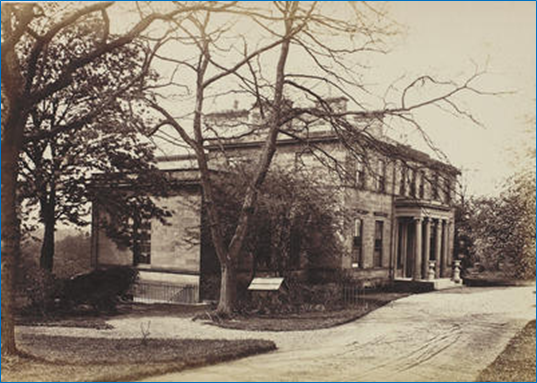
Gilbert and Cecilia Douglas have strong connections with North Lanarkshire and chattel slavery. Gaining much of their wealth from the profits of slavery, they used this money to purchase land at Douglas Park, Bellshill, and a grand mansion, Orbiston House.

Orbiston House, 1870
Photograph: Glasgow University Library, Special Collections, Dougan Collection
They also invested heavily in the newly emerging industries as the Industrial Revolution gathered pace in Scotland during the 1800s. The house was demolished in 1931 and its remains lie within the woodlands of Strathclyde Country Park.

Ordinance Survey Map, 1900s
Reproduced with the permission of the National Library of Scotland

Ordinance Survey Map from 1900s overlayed
Reproduced with the permission of the National Library of Scotland
Conditions on the Sugar and Cotton Plantations
Gilbert owned the Mount Pleasant Sugar Plantation on St Vincent and the Fairfield Cotton Estate on Demerara. He lived on St Vincent, most likely on his sugar plantation. Plantation owners purchased enslaved people to work in the fields and to process sugar cane and distill the juice.

Producing Sugar Cane, Antigua, 1823
From the St Vincent Slave Registers, which exist from 1817 until 1834, we can see the Douglas’s owned on average, 250 enslaved people with approximately half male and half female. At Fairfield they had around 273 enslaved people.

Mount Pleasant Slave Register, 1827
The National Archives
Conditions on the plantations were barbaric, and enslaved people were regularly tortured and beaten. Many died within the first few years after arrival. No records exist of the people they enslaved so we can’t tell their stories. Such were the horrific conditions that 12,000 enslaved people from plantations across Demerara revolted in 1823, demanding their freedom. Troops were deployed and the largely non violent rebellion was crushed after two days.

The Retreat of Lieutenant Brady, a plate from an account of the Demerara Rebellion.
Photograph: John Carter Brown Library
Over 200 enslaved people were killed in the fighting by British soldiers and 27 men were later executed.
Slavery continued until 1833 Slavery Abolition Act which ended slavery in most British colonies. The act freed more than 800,000 enslaved Africans in the Caribbean and South Africa.
The Profits of Slavery
Following the abolition of slavery, Cecilia Douglas received over £3,000 in compensation for the 231 enslaved people she owned on Mount Pleasant, which is around £3 million today.
From the profits of exploitation, she funded a lavish lifestyle including extended trips to Italy where she acquired a collection of fine and decorative art. She displayed them in Orbiston House and then bequeathed them to Glasgow Corporation (now Glasgow Museums) on her death.

The Death of Julius Caesar by Vincenzo Camuccini, around 1825 – 1829
Photograph: Glasgow Life
Cecilia also invested extensively in banking, railway and navigation companies, including the Forth and Clyde Canal. Her brothers, Thomas and John also benefitted from slavery compensation payments, buying shares in local railways such as the Wishaw and Coltness, Glasgow, Airdrie & Monkland Junction and Airdrie and Bathgate lines. The legacies of slavery extend across North Lanarkshire.