
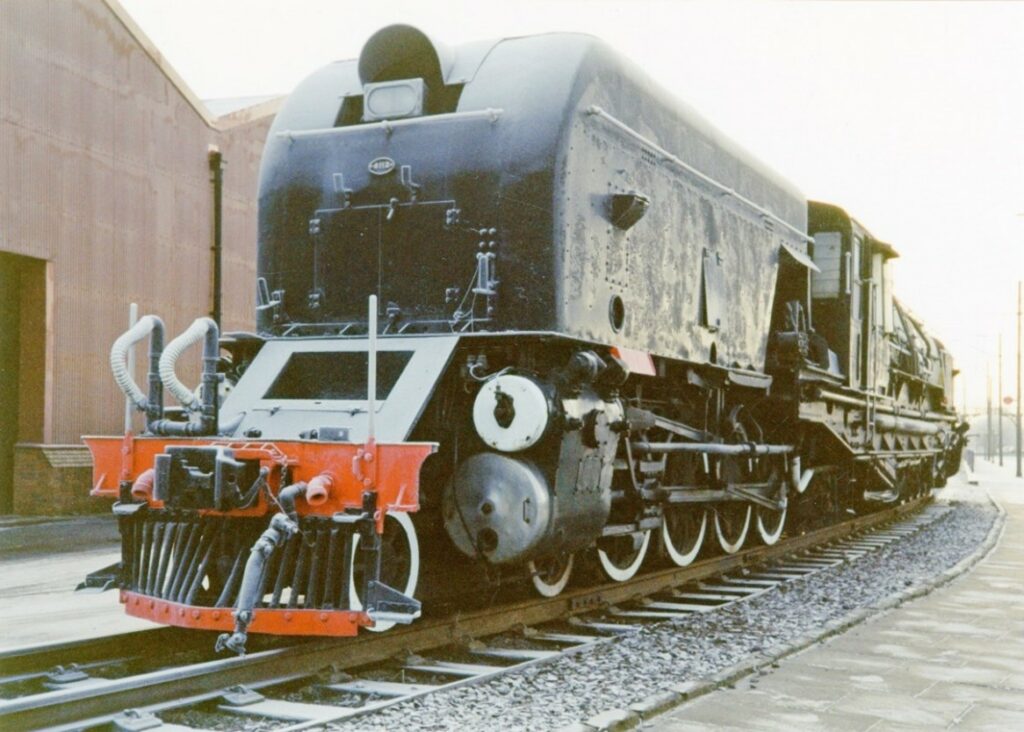
Garratt Locomotive 4112 at Summerlee Museum of Scottish Industrial Life
South African Railways locomotive number 4112 was constructed in 1956 by North British Locomotive Company Ltd. at their Hyde Park Works in Springburn. Later given the name ‘Springbok’ upon its return to Great Britain following its decommission in South Africa, the locomotive was used to pull coal trains across the Transvaal. A number of areas in South Africa, including the Transvaal, were rich in coal and the British were eager to get involved to exploit these natural resources.

Map of South Africa, circa 1930s.

Map of the Transvaal, circa 1930s.
GMAM class locomotives like 4112 were built to transport goods and were therefore, designed to have the power of two 14-class locomotives. They were able to run on the narrow gauge railway lines of South Africa and due to their wheel arrangements, could also navigate tight curves in the railways. Coupled with the sheer towing power they possessed, this met the needs of South African Railways perfectly. On the other hand, steam locomotives were one of Britain’s greatest exports and the nation had a keen interest in South African resources, so it is unsurprising that around 150 British-built GMA and GMAM class locomotives were ordered and delivered to South Africa between 1953 and 1958 alone.

Locomotive 4112 in Springburn before being transported to South Africa.
4112 in South Africa during Apartheid
Locomotive 4112 operated in South Africa during the Apartheid regime, which lasted from 1948 to 1994. This period saw the newly elected government introducing laws enforcing racial segregation across all areas of South African society. Millions of people of colour were forced into segregated neighbourhoods and robbed of employment opportunities during this time. In the context of the railways, the laws meant that although Black and mixed race people were still able to work on the lines, they could only work ‘unskilled’ jobs and were not allowed to drive the locomotives themselves. People of colour were often excluded from training exercises, meaning that they faced limited promotion opportunities in comparison to their white counterparts.
South Africa had long been of interest to Britain due to its strategic position in maintaining control over the maritime route to the East. Britain had ended the Dutch occupation of Cape Colony – an area in what is now South Africa – in 1806, and a heightened interest in the area came with the discovery of diamonds and gold in the 19th century. Britain was now heavily involved in the African economy and eventually Cape Colony was united with other British territories to lessen any threats of internal divisions between the colonies. This resulted in the formation of the Union of South Africa in 1910.
After centuries of both the British and Dutch colonising what would become South Africa, the 20th century saw the British profiting massively from the nation’s thriving coal-mining industry whilst the people working in the coal mines were forced to live in compounds without their families. There was a belief from the newly elected National Party in South Africa that Black South Africans were inferior, and this attitude was further reflected in the South African Railways system, where in this case the men working on the vehicles transporting coal faced racial discrimination daily. The railways became a symbol of the oppressive nature of Apartheid, both on passenger trains and freight trains, and with the backing of the South African Railway and Harbour Workers Union (SARHWU), workers organised strikes and protests demanding better working conditions and pay. These protests sometimes became violent as the government frequently responded with force in order to silence Black workers. This was the backdrop to the working life of locomotive 4112, and its colonial links should be remembered as a key part of its history.
The Journey Back to Britain
The development of diesel locomotives was highly beneficial for South African Railways, as the new developments could travel longer distances without refuelling, and additionally did not need to stop for water; ideal for journeys where water was in short supply. This all meant that running a diesel locomotive was far more cost-effective than a steam locomotive, and North British Locomotive Company Ltd. saw a steep decline in orders as a result. Unsurprisingly, following the rise in popularity of diesel locomotives, 4112 was retired whilst on loan to Zimbabwe in 1980. After returning to South Africa, it lay abandoned until Peter Pratt – the managing director of an early private locomotive group, 4160 Ltd. – learned of the rapid scrapping of British-built locomotives. A series of letter exchanges later, Pratt was informed that the locomotive was awaiting collection in South Africa. The aim of the return was preservation and display, though the transportation of the locomotive had to be funded entirely by 4160 Ltd. and other interested parties, most of which were preservation groups.
The long process of returning 4112 to Britain began in February 1982 and was not complete until 1984. The journey was not smooth sailing; after just 200km, the locomotive failed at Ladysmith and had to be towed ‘dead’ for the remaining 940km to its next stop in Beaconsfield. This was just one issue encountered on the journey. In addition, dockworkers were striking in many of Britain’s major ports in support of the ongoing miners’ strike and further complications also arose from Britain’s involvement in the Falklands War, which saw any available ships (which could have helped transport the locomotive) now being used by the Royal Navy to retaliate against Argentina to defend the Falkland Islands. This again highlights Britain’s involvement in colonial activity as their colonisation of the Falkland Islands hundreds of years earlier had now directly impacted the return journey of this locomotive. All of these issues led to a halt in the journey for more than 2 years. Nevertheless, after endless behind the scenes efforts, the vehicle saw movement again in July 1984 and was renamed ‘Springbok’ in homage to its working life in South Africa.
Upon reaching Britain, Pratt stated that it had cost his company more than £20,000 to transport the locomotive, yet this had been “the bargain of the year, when you consider what we have to show for it”. The 160 ton vehicle was offloaded in Southampton and transported in sections to Plym Valley Railway headquarters in Plymouth for reassembly. Following eight and a half hours, ‘Springbok’, as it came to be known, was fully reassembled and came to be displayed proudly at Marsh Mills in Plymouth. There had been hopes of running the Garratt on a small track at this location, but this did not happen, and the vehicle was to be sold in 1988, to Springburn Museum, who were eager to showcase a locomotive built in the area by North British Locomotive Company Ltd. The locomotive was dismantled once more for transport and the newly named ‘Springbok’ locomotive finally completed its journey north to Scotland. Whilst the initial aim was to display the locomotive back in Springburn, plans fell through and as a result, the vehicle was transported to Summerlee – where it has remained a permanent feature of the museum since 2002.

Locomotive 4112 ‘Springbok’ at Summerlee.
Glossary
Apartheid – The system of institutionalised racial segregation which saw all people of colour segregated from the white minority in all areas of South African society by law from 1948 until 1994. This impacted living conditions, employment opportunities, and, of course, race relations which were unsurprisingly at an all-time low.
Colonial links – Refers to the relationship between a coloniser and its colonies. The link between the two leaves a lasting impact, whether this is reflected in the languages spoken in a region, or the economic structure of a former colony. The history cannot be erased, and it is important to recognise these links.
Falklands War – An officially undeclared war between Argentina and the United Kingdom in 1982. Argentina invaded the Falkland Islands, claiming them as their own and the U.K. retaliated by sending troops across the Atlantic to reclaim their territories. Over 200 British and 600 Argentinian troops were killed before Argentina eventually surrendered after ten weeks of fighting.
Garratt locomotive – An articulated steam locomotive created by Herbert William Garratt. The locomotive is split into three sections – a central frame with the boiler and driver’s cab, and two steam engine units at either end.
GMA + GMAM – Different sub-classes of locomotives. The most notable difference between the GMA and GMAM class are their coal and water capacities. The GMA class can carry 11.6 tons of coal and 1650 gallons of water, whilst the GMAM class can carry 14 tons of coal and 2100 gallons of water.
Narrow gauge railway – A track with a narrower gauge than the standard width of 1435mm. These were often built across challenging terrain due to their lower construction costs.
Transvaal – A former province of South Africa from 1910 to 1994, when Apartheid formally ended. It bordered the Orange Free State and Natal provinces to the south, and Rhodesia – now Zimbabwe – to its north.