
Hi everyone! I’m Megan and I’m currently completing my master’s degree in Material Culture and Artefact Studies at the University of Glasgow. I have always had an interest in 19th and 20th century history and changes to industry during this time, so I was delighted to start a work placement at Summerlee Museum of Scottish Industrial Life as part of my course.
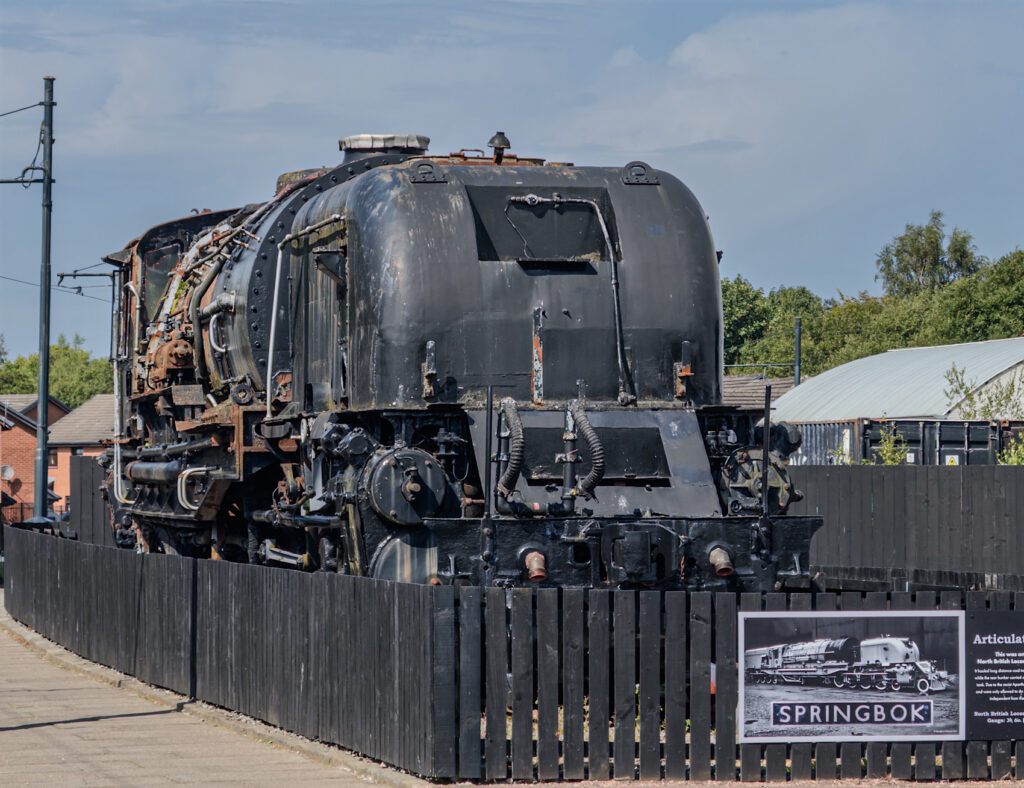
When deciding on a topic to research whilst on placement at Summerlee, it was hard to look past the largest object on display – the Garratt locomotive. This sits outside the museum, just 10 miles from Springburn, north Glasgow, where it was built in 1956 by the North British Locomotive Company. The vehicle was built for South African Railways during the era of Apartheid to transport coal across the country, and a lot of the associated objects are now in storage at Summerlee too.

The driver’s cab quickly became one focus in my day-to-day placement activities, as many of the items in storage appeared to have once been part of this room. For the most part I was working with pressure gauges and the nuts and bolts of the engine room. This was completely new to me as I do not have any kind of engineering background, but it felt exciting because every day I was learning new things and bringing this new knowledge into my existing understanding of South African Apartheid. All of this helped to build the story of the locomotive and understand the colonial links between Scotland and South Africa.

As you can see, the cab is not in the best condition, and this is why the objects are now in storage. It was important that I documented the objects currently held by the museum which are related to the locomotive as this helped to work out how many separate objects I would be dealing with. I then gave each object a temporary number to add into the collections records database at Summerlee, alongside a brief description of the item. I enjoyed doing this as it felt very productive and knowing that even if these objects are not suitable for display, they are now catalogued as being part of the locomotive, and their location in storage is also noted. Once each object had a label, they could be repackaged in bubblewrap for safe storage until I needed them again.


It was great to be behind the scenes working in a museum and I loved seeing how popular Summerlee was, especially during the school holidays! I am grateful to have had this opportunity and would really recommend anyone getting involved at the museum where possible because it can be so rewarding!
About the Author

Glossary
Apartheid – The system of institutionalised racial segregation which saw all people of colour segregated from the white minority in all areas of South African society by law from 1948 until 1994. This impacted living conditions, employment opportunities, and, of course, race relations which were unsurprisingly at an all-time low.
Collections records database – A database where information relating to each object in a museum collection is stored. Details recorded may include a description, measurements, and the physical condition of an object.
Colonial links – Refers to the relationship between a coloniser and its colonies. The link between the two leaves a lasting impact, whether this is reflected in the languages spoken in a region, or the economic structure of a former colony. The history cannot be erased, and it is important to recognise these links.
Temporary number – A unique combination of letters and numbers given to each item in a museum collection to catalogue how many separate objects are in the collection. This allows for the first stages of cataloguing to take place.