
In the summer of 1770 two of the greatest engineers of their age met beside the Monkland Canal in Coatbridge.
Englishman John Smeaton (1724-1792) was the elder by 12 years and the world’s most famous civil engineer. By contrast, the Scot James Watt (1736-1819) had just made the breakthrough that would ensure his fame. However, as yet he had little to show for it.
While both men worked as civil engineers it was their respective improvements to the steam engine that turned them into rivals. It would be Watt who eventually came out on top.
John Smeaton
Born in Leeds, as a young man Smeaton studied wind and water power before becoming a civil engineer.
Smeaton’s first major project was also his most famous, the third Eddystone Lighthouse. This was a huge challenge for any engineer and led Smeaton to develop a new formula for cement, effectively reinventing concrete. His career continued with major projects to build bridges, harbours and canals, including the Calder & Hebble Navigation and the Ripon Canal.
Having erected a Newcomen engine in London in 1767 Smeaton decided to scientifically explore improving every aspect of the engine’s operation. He was the first person to take this approach and his experiments led to the construction of a 38 horsepower Newcomen Engine at Long Benton East No.3 Pit in Northumberland in the early 1770s. This improved engine was 25% more efficient than the best Newcomen engine to date.
James Watt

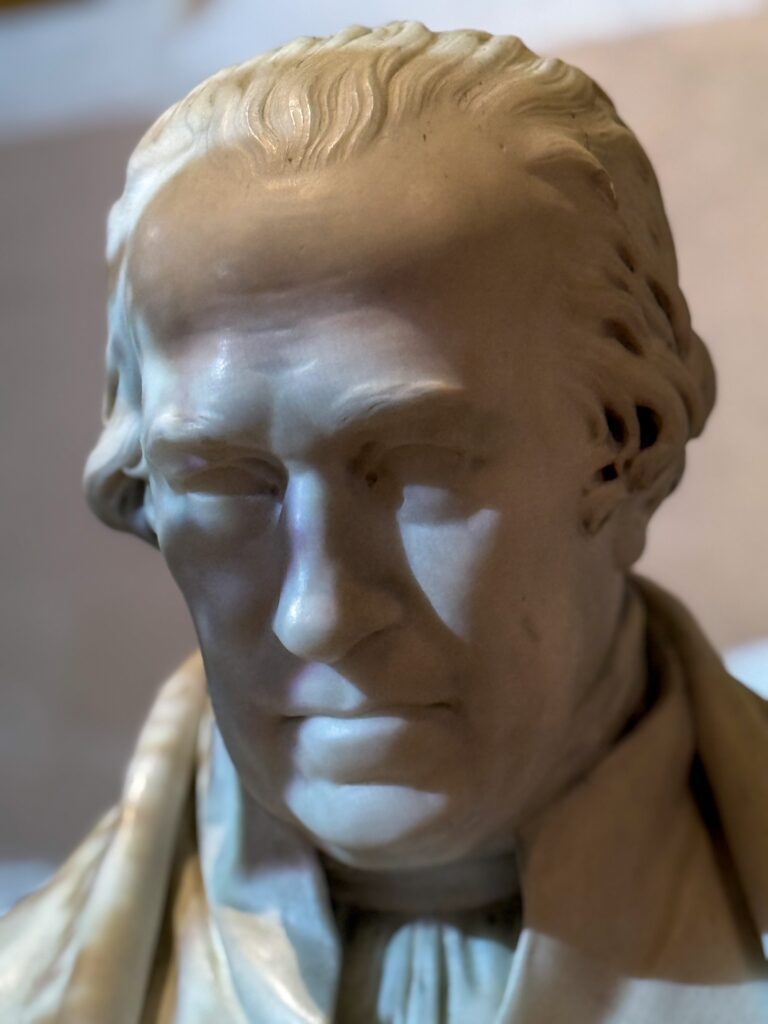
This posthumous statue of James Watt was sculpted in 1830 by Francis Leggatt Chantrey. Hunterian Museum, University of Glasgow.
Greenock born Watt studied at the Old College in Glasgow. While there he was asked to repair a teaching model of a Newcomen engine and while doing so hit upon his idea of a separate condenser as a way to improve the engine’s efficiency way beyond Smeaton’s results.
Improving the Steam Engine
Thomas Newcomen made the first successful steam engine in 1712. His ‘atmospheric engine’ condensed steam in an open-topped cylinder to create a vacuum. The piston inside this cylinder was then driven down by atmospheric pressure.
Smeaton and Watt were among those who turned their minds to improving Newcomen’s engines.
A Meeting in Lanarkshire

Part of William Forrest’s map of Lanarkshire, published in 1816, over 20 years after the Monkland Canal was completed. The first section to be built, from 1770 is beneath the word ‘Canal’ in the centre of the image (National Library of Scotland).
July 1770 and James Watt was supervising workers digging a new canal a little over a kilometer west of the weaving village of Airdrie. He was already regretting it.
The Monkland Canal was planned as a way of transporting coal from the Monklands to Glasgow and beyond. It would mark the beginning of industrialisation in the Monklands.
The previous year had seen Watt patent his steam engine with a separate condenser, an innovation that would eventually make him very rich. However, right now he was broke and had gone into civil engineering and consulting to make ends meet. The job wasn’t a pleasant one but the challenge would stand the young engineer in good stead.
He acted at the same time as surveyor, superintendent, engineer, and treasurer, assisted only by a clerk. But the appointment proved useful to him. The salary he earned placed his family above want, and the out-doors life he was required to lead improved his health and spirits. After a few months he wrote Dr. Small that he found himself more strong, more resolute, less lazy, and less confused, than when he began the occupation.
Lives of Boulton and Watt by Samuel Smiles, 1865.
However, Watt had no experience of canal engineering and was in constant fear of being found out by the hundred or so men under him. He also found it difficult to deal with the men under his command. As his first biographer, Samuel Smiles put it, Watt ‘was timid and reserved, and had nothing of the navvy in his nature. He had neither the roughness of tongue nor stiffness of back to enable him to deal with rude labour gangs.’ Watt was also uncomfortable haggling as he needed to do, writing that ‘nothing is more contrary to my disposition than bustling and bargaining with mankind; yet that is the life I now constantly lead.’

The filled-in Monkland Canal, photographed in 2022. This picture shows the small scale of the canal as well as how deep the navvies excavating it had to dig. The swing bridge carried a late 1800s line.
One of the biggest headaches for any canal engineer was ensuring a steady water supply to keep the canal topped-up. On the first stretch of the Monkland Canal Watt was able to tap the nearby South Burn but he knew that he wouldn’t always have that luxury as work advanced.
Watt sent an invitation to John Smeaton, who was in Scotland supervising work on the Forth & Clyde Canal, Scotland’s first canal. Smeaton had designed the canal two years earlier and was the obvious person to approach.
At this stage, Watt’s workers were digging the first section of the Monkland Canal in what is now the town of Coatbridge. This initial section ran from Blackhill (now Locks Street) in the east to the Hamilton Road (now Coatbank Street) in the west. This was an area where small coal mines were already operating and as each section was completed and filled with water it would immediately go into use by coal barges, helping to pay for further work on the canal. The canal would continue to be extended both west to Glasgow and east to Calderbank.
Smeaton came to see Watt on the 28th of July. As they talked, the more experienced engineer suggested to Watt that it would be better to make the canal 4 feet deep rather than the planned 3 and Watt followed his advice. This was still shallower than the 7 feet of the Forth & Clyde Canal which was designed to accommodate sea-going ships.

The site of Sheepford Basin, the starting point of construction of the Monkland Canal. This is a view west from the bridge that carries Locks Street over the filled-in canal. Photo taken in May 2022.
The other subject on John Smeaton’s mind was James Watt’s patent for the separate condenser, which the older engineer had read with interest. Smeaton regarded this innovation as being the most important improvement to the steam engine since Newcomen’s first successful engine in 1712.
Soon Watt would link up with the English industrialist Matthew Boulton and start mass-producing steam engines. Boulton and Watt would even try to hire John Smeaton for their firm!
In 1777 Smeaton examined one of the earliest Boulton and Watt engines and was reported to have described it as ‘a pretty engine’ but ‘too complex’. Worse still, Smeaton was said to have plied the engine driver with drink, leading to him damaging the engine. Smeaton had made many incremental improvements to the steam engine himself but crucially none of them were patented.
In 1778 Watt’s friend and supporter Dr Joseph Black wrote to him saying ‘I have heard from many hands that you have succeeded in all your undertakings with your Engine to the Conviction and Surprize of all Unbeleivers [sic] and that even Smeiton [sic] has been converted’ (Black to Watt, 27 November 1778).
Nevertheless, Smeaton’s backhanded compliments rankled with Watt and the following year saw him bristle at remarks Smeaton had published on one of Boulton and Watt’s engines: ‘let him keep the modest honour he aspires to of being the second best – between you and I we have it in our power to give a very sufficient and effectual answer to any of his publications but should we labour to depreciate others when we have more work than we can properly do’ (Watt to Joseph Black, 24 July 1779).
Later years saw relations thaw and a friendship developed between Smeaton and Watt, the two men now assured of their places in history. They had come a long way from that day they first met beside the Monkland Canal.