
Under Scottish law, all objects of historical, archaeological or cultural significance must be reported. This is where the Treasure Trove System (TTS) comes into play. The TTS states that “by law all portable antiquities… of significance are subject to claim by the Crown.” This means, that any object found, be that metal, wood, fabric, or stone, should be reported to the TTS if it is considered to be valuable. Whilst there is no hard and fast definition of ‘valuable’ for the TTS, anything that is old or rare should be reported. Modern objects, such as modern coins or pottery do not need to be reported. Natural artefacts such as fossils or animal remains do not need to be reported to the TTS and any human remains should be reported to the police.
The TTS can be traced back in varying forms to medieval Scotland. It is based upon the principle of bona vacantia (ownerless goods). In Scotland, objects of value that are deemed ownerless are subject to claim by the crown. This is why any artefact found should be reported to the TTS as it is deemed property of the crown. In the 1990s the system was modified and later in 1999 it was finalised to its present state. The system is in place so that any objects of significance are protected and can be passed onto museums in order for their proper display and care. This allows communities and future generations to enjoy and learn about the past.
The TTS offer guidance to anyone going out and actively treasure hunting, or for those who stumble across treasure accidently. For those who find treasure, the TTS states that the person should:
- Accurately record the location of each find and preferably record the National Grid Reference.
- Bag each find individually and clearly label with location reference.
- Leave the object/s as they are. Do not clean or apply any substances.
- Report the object/s via email or the form located on their website.
If a hoard of objects is found, the finder should:
- Leave them in the ground and cover over. Avoid disturbing any of the hoard.
- Take a grid reference or mark on a map the location.
- Contact the Treasure Trove Unit immediately.
After objects are reported, a reward is assigned to them based upon their deemed worth/value. This reward is then given to the person who found and reported the object. After this they are given to the proper authority or museum.
North Lanarkshire Museums themselves have acquired a few objects this way. Such as a silver gilt finger ring. This object was found in Cambusnethan Priory through metal detection and is believed to date to around 1500 AD.

Medieval Finger Ring, about 1500 AD. Cambusnethan Priory.
Another Treasure Trove donation given to North Lanarkshire Museums is a coin mould. Found through metal detection in Waterside Farm, the mould is believed to date to around 1889. This mould would have likely been used to create forgeries of the impressed coin.

Coin Mould, about 1889. Waterside Farm.
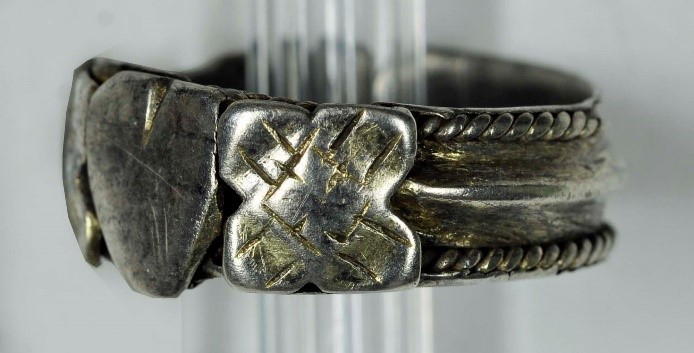
Another incredible find that was donated to the museums through the TTS is the medieval Fede ring, found by a civil engineer working on the south bound carriage way of the A73. The ring dates back to around 1400 – 1499 AD.

Medieval Fede Ring. Museum Ref: NLC-1999-867.
It is thanks to the TTS that our museums have these objects and are able to share and learn from their history.
For further details on reporting artefacts and the appropriate forms and contact details, please visit: https://treasuretrovescotland.co.uk/. Or to learn more about our Fide Ring that was found and reported through the TTS: https://www.culturenlmuseums.co.uk/blog/to-be-a-fede-ring-or-to-not-be-a-fede-ring-that-is-the-question/
About the Author
Written by Digital Collections Volunteer Bryony Chapman. Bryony has a BA (Hons) in Ancient History and an MSc in Museum Studies. Her main area of interest is Roman life and influence in Scotland.