
When telling the history of colonialism, its impact on the natural world is often lacking. Indeed, European colonisers collected large numbers of natural history specimens during their exploratory voyages, saw hunting as a way of collecting trophies, and developed industries to exploit natural resources. Imperial use of natural collections for research also contributed to the development of ecological science, which should thus be seen as an imperial science. Colonial exploitation of nature caused extensive and in many cases irreversible damage to animal populations and natural environments.
Many specimens and related objects were acquired into museum collections as a result of colonial collecting. In North Lanarkshire, the Airdrie Museum; opened in 1895 and closed in 1974, displayed objects from across the British Empire. Most objects were donated by local Airdronians, who collected objects and specimens on their travels and sent them home to be viewed in Scotland. In the records of the Airdrie Museum, a great deal of donations were natural history specimens from abroad. As these objects and specimens were removed from their original contexts, there is often little or no specific information about where they came from. This raises significant challenges when researching this collection and reinterpreting them to address their troubling past.
The following examples from the North Lanarkshire Council collection, will hopefully shed a light on the range of natural history objects that may be found in Scottish collections, brought from across the British Empire, and highlight the difficulties in researching or displaying them in museums today.
Birds
Collecting birds and their eggs played a significant role in colonial collecting. In contrast to the colonial period when bird collecting was widely encouraged and accepted, whether to continue collecting birds has been a topic of ongoing debate among ornithologists and scientists in recent years. Scholars who oppose collecting argue that in extreme cases of endangered species, collecting may pose a threat to bird populations and that modern scientists can use new technologies instead of specimen collecting. Pro-collection scholars argue that scientists’ collecting does not affect the recovery of populations where habitat exists, and insist that the scientific utility of specimens is of higher value. The debate in academia is worth reflecting on: how did specimen collecting of the past contribute to making a certain species vulnerable or endangered today? what duty does a museum have to address this narrative?
Hornbill Bird’s Head

Hornbill Skull, North Lanarkshire Council Collection
This Hornbill Skull was found in the North Lanarkshire Council collection, sadly, with no provenance information. It may have previously been part of the Airdrie Museum collection, a large proportion of which were natural history specimens, including many birds and eggs.

Great Hornbill, Photograph by Shantanu Kuveskar, available at: https://en.wikipedia.org/wiki/Great_hornbill#/media/File:Great_hornbill_(Buceros_bicornis)_Photograph_by_Shantanu_Kuveskar.jpg
Hornbills are found in Africa, Asia and Melanesia. They are mainly threatened by habitat loss due to deforestation, but have also been hunted for meat, fat, and body parts (such as casque and tail feathers), as well as for traditional tribal use. The meat is considered medicinal and the young birds are considered a delicacy. The Greater Hornbill has been on the IUCN Red List since 2018 and is defined as a vulnerable species. Some conservation programmes, such as Mumbai: Wildlife Trust of India (WTI) are attempting to protect the species by providing tribes with captive hornbill feathers or fibreglass ‘beaks’ as an alternative.

Tadab Nabum with a fibreglass ‘hornbill’ beak, Photograph by Gautam Chatterjee, available at: https://www.sanctuarynaturefoundation.org/article/can-fibreglass-save-the-hornbill%3
Because we have no specifics about how, why and wherefrom this Hornbill skull was brought to North Lanarkshire, this object is very difficult to display. One way to try and reassign it context, is to look at the species today and attempt to see how this specimen fits into the history of that species more widely. In this case, it seems that collecting a sample for science or display in a museum, has contributed negatively to the Hornbill species, which continues to be vulnerable.
Bird Eggs
These bird eggs are part of an egg collection of British species collected in New Cumnock, Ayrshire, between the 1930s and 1950s. North Lanarkshire Council acquired it in 1989.

Bird’s Eggs collection, North Lanarkshire Council Collection
In the 19th century, Oology emerged as a a branch of ornithology related to egg collecting. It was common to shoot birds and collect their eggs for research. It was particularly important to science as a source of information on the life and past distribution of bird populations. Scientists can use collections to study the timing of egg laying and monitor the effects of climate change and other factors. The collection of wild bird eggs by amateurs was considered a respectable scientific pursuit in the 19th and early 20th centuries. From the mid-20th century onwards it was increasingly seen as a hobby rather than a scientific discipline and it remained popular, despite its scientific value became less prominent. Bird egg collectors built large collections and would trade them with each other. Often, collectors would make every effort to acquire the eggs of rare birds.

Mid-19th century illustration showing the eggs, Lorenz Oken – Allgemeine Naturgeschichte für alle Stände, available at: https://en.wikipedia.org/wiki/Oology#/media/File:Bird_eggs.jpg
UK legislation such as the Protection of Birds Act 1954 and the Wildlife and Countryside Act 1981 makes it illegal to collect the eggs of wild birds. In the UK, it is only legal to possess wild bird eggs if they were captured or granted a scientific research license before 1954. The eggs in the North Lanarkshire Council collection were collected before the Act and are allowed to be held as objects by the museum. Although these are all British species and aren’t necessarily the eggs of endangered species from abroad, this example shows how this collecting, i.e. disrupting species and harming their environment and life cycle was accepted, encouraged and welcomed by museums, even with less ‘exotic’, british, native species. In the Airdrie Museum minutes, we see this enthusiasm for eggs time and time again. Many eggs, as well as whole bird specimens, were accepted as donations to the collection.
Emu egg jewellery box
This jewellery box is made from the egg of an Emu. It was donated to the Airdrie Museum in 1900 and transferred to North Lanarkshire Council in 1997.

Emu egg jewellery box, North Lanarkshire Council Collection
The Emu is Australia‘s largest native bird, with its habitat ranging over most of the Australian mainland. There was once a Tasmanian, Kangaroo Island and King Island subspecies, but all became extinct after the European settlement of Australia in 1788 due to overhunting and the introduction of domestic dogs. In 1932, a wildlife management operation was conducted in Australia to allay public concerns about crop-destroying emus, this was also known as the Emu War and hundreds of birds were culled. Since 1999, however, wild emus have been given formal protection under the Environment Protection and Biodiversity Conservation Act.
The first sighting of an Emu by Westerners was on a colonial expedition led by Dutch Captain Willem de Vlamingh and the birds were first mentioned under the name of the “New Holland cassowary” in Arthur Phillip’s Voyage to Botany Bay, published in 1789.

Captain Arthur Phillip, 1786, by Francis Wheatley, oil painting, stored in State Library of New South Wales, available at: https://en.wikipedia.org/wiki/Arthur_Phillip#/media/File:Arthur_Phillip_-_Wheatley_ML124.jpg
Early European settlers killed them to provide food and used their fat to fuel lamps. At the same time, their economic value caught the attention of European colonisers, who began to exploit it for meat, oil and leather. This began a dramatic decline in the emu population, and indeed the extinction of several subspecies. The jewellery box shows another product made using the Emu; namely its eggs. Emu eggs are a striking dark green colour, unlike any eggs of British native species. The eggs would be collected, the insides and any chicks removed, and then adorned with decoration for display.
This example has a metal insert and a hinge added to strengthen the fragile egg shell. The stand has a decorative display of native Australian species, including the Emu. There is a sense of irony in using an Emu egg, stolen from a nest, to create a jewellery box adorned with images of the Emu on the side. Indeed, at the time of its donation to the Airdrie Museum, the Tasmanian, Kangaroo Island and King Island subspecies of emus were already extinct. One again we see the desire for the ‘exotic’ or unusual often outweighed the life of the animal and species as a whole.
Sea Life
Colonisers exploited local natural resources to form economic industries in order to better control the colonies. The exploitation of natural resources included the killing of large numbers of animals, which had a serious impact on biological populations and natural ecosystems. Marine life was an important resource for colonial exploitation and shark fishing was became an important industry, especially for the Dutch in the waters around Indonesia. It was soon discovered that the whole body of the shark had a strong economic value and sharks were hunted for their meat, skin (shagreen), fins, fertilizer and oils. The vitamin A extracted from sharks was even used to provide nutritional supplements to soldiers during the Second World War.
Today, countries around the world are gradually restricting the production and consumption of shark fin products and many countries around the Indian Ocean have banned shark fishing altogether. The effects of overfishing are becoming all too apparent as species become endangered and livelihoods built around the sea are becoming increasingly unfeasible.
Shark Jaws Mirror
This shark jaws mirror was donated to the Airdrie Museum in 1932 and was so unusual that it was mentioned in the Airdrie and Coatbridge Advertiser newspaper.

Shark Jaws Mirror, North Lanarkshire Council Collection
In the article we learn that the object was presented to the Town Council by a local man from Airdrie called Mr David Brand, who was either travelling around or living in Durban, South Africa. The mirror is made up of the jaws of a Blue Pointer Shark captured in the Indian Ocean.

Airdrie and Coatbridge Advertiser 1932.06.18, stored in Airdrie Library, available at: https://www.britishnewspaperarchive.co.uk
Mr Durban then had the jaws mounted on a board and mirror for exhibition purposes in his local museum, namely the Airdrie Museum. He is quoted as saying:
“During my lifetime, I have been in the habit of bringing back home souvenirs of these parts, and it was suggested to me that I might be able to get something suitable to put in the museum. In this town, where shark fishing is indulged in real earnest, it would appear that this particular specimen is something “out of the way” in its own line, seeing the original owner has seen fit to go to no small trouble to have the jaws removed from the fish, cleaned and mounted, offering same for sale.”
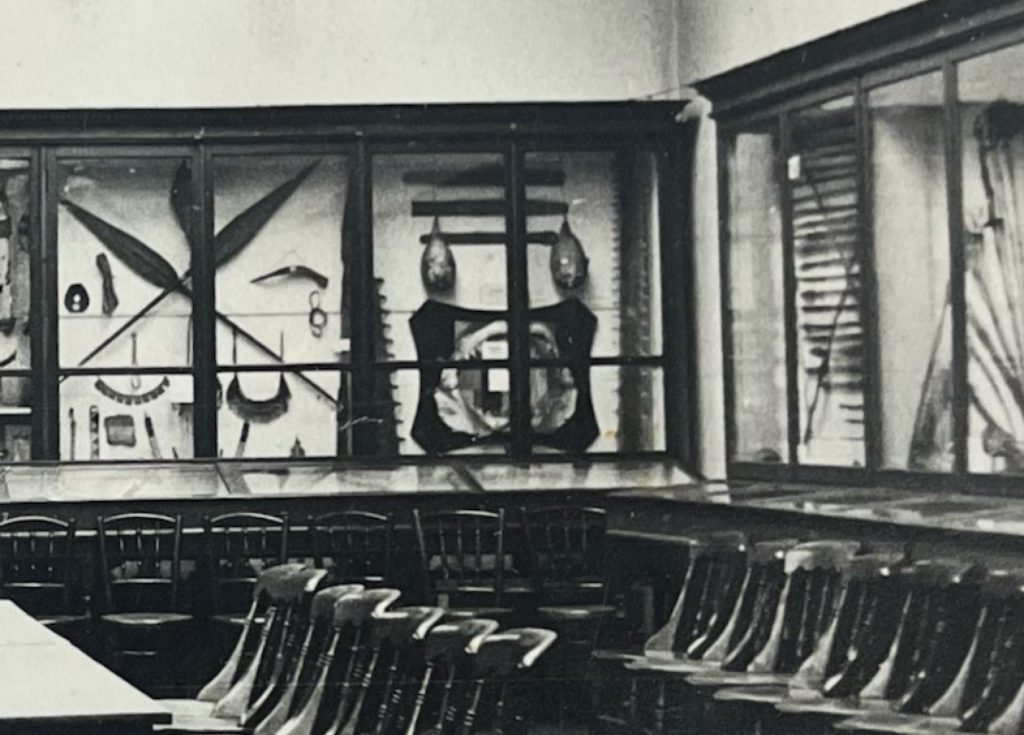
The above quote shows the enthusiasm of people to bring or send back souvenirs for their collections, and on the other hand shows the willingness of the museum to collect and exhibit natural history specimens to satisfy the curiosity of their visitors. When the mirror arrived in Airdrie, It was put on display at the Airdrie Museum which can be seen in this archival photograph alongside other natural history specimens:

Airdrie Museum before 1953, North Lanarkshire Council Collection
Ivory
Ivory is a hard, white material from the tusks, traditionally from elephants, and teeth of animals. As a material, it has been valued since ancient times for making carved goods (e.g. piano keys, fans, sculpture.) The ivory trade became closely linked to slavery in the 1700s. Captured Africans were used to transport ivory from the interior to the coast, where they would then be sold as commodities along with ivory. When colonisers discovered the precious value of ivory, they began hunting elephants at a increasingly higher rate and exporting their ivory across the Empire. It gradually became a symbol of social status to own ivory items and was continued to be highly prized material for sculpting.
Today, ivory is still considered a valuable material, but the buying of selling of ivory goods is now illegal in the UK, unless you have a special license. As a result of extensive hunting, the African elephant was listed in the Convention on International Trade in Endangered Species of Wild Fauna and Flora (CITES) in 1989. According to rough statistics, 100 African elephants are still illegally hunted every day, and more than 30,000 African elephants are still killed every year. Here we see a clear correlation between the exploitation of a trade on an imperial scale, and the drastic endangerment of a species.
Carved Elephants with Ivory

Carved Elephants with Ivory, North Lanarkshire Council Collection
These two carved elephants were originally in the Airdrie Museum and were transferred to North Lanarkshire Council. No donor or provenance was identified but they are believed to be from India and were probably made for the tourist market as such items were popular in the 19th century. The tusks of Asian elephants, found in India, are more durable than those of African elephants. As a result, there has been increasingly more demand for Asian elephant ivory and smuggling has increased. The Wildlife Protection Act, 1972, provides for the protection of Indian elephants.
In a tragic irony, the tusks of these two carved Indian elephants are made from ivory; the same material that a real elephant would have been killed for. These two sculptures show how the past desire for ‘exotic’ items from the Empire and want for certain materials, outweighed the life of the elephant.
Ivory Armband

Ivory Armband, North Lanarkshire Council Collection
This ivory armband is believed to have been donated to the Airdrie Museum in 1926 however we now have no provenance about where the object came from, apart from that it came from ‘Africa’. The armband is presumed to be of tribal origin and other cultures do have a history of using ivory in this manner, for example, in Ethiopia.

Mursi tribe men, Photograph by Amanda Ahn, available at: https://www.alamy.com/mursi-tribe-men-lower-omo-valley-ethiopia-image6427787.html?imageid=8903481C-FBE8-4ED5-893A-36C1B2403FB5&p=33419&pn=1&searchId=6cf8ac630295a7f12df0b5c099563bc7&searchtype=0
This object shows the use of ivory internally within Africa, in tribal contexts. This being said, it is interesting that this object is now in North Lanarkshire. Much like the raw ivory, this object has been collected and transported to Scotland as a curio, commodity or exotic material, and is now without the context of the culture it came from. The lack of information shows the result of removing such objects from their original context and means it is now incredibly difficult to find out where this object originally came from.
Conclusion
Exploring the natural history objects in the North Lanarkshire Council collection reveals that there is often troubling past linked with these types of specimens. Whether it be a connection to colonial exploitation of natural resources, collecting for supposed scientific merit at the expense of the animals life, or even a museums’ enthusiasm for ‘exotic’ items which fuelled collectors, we see how this environment has lead to many species becoming extinct or vulnerable.
While museums’ efforts to decolonise their collections are mainly focused on archaeology, anthropology and world cultures collections, it is not difficult to see that natural history collections also have links to colonial history, and are therefore in urgent need of decolonisation as well. By looking at current conservation efforts and changes in laws around collecting of specimens, we can begin to see how natural history collections can be linked to social issues such as conservation efforts. Looking at both colonial history and current environmentalism can begin to provide an insight into where these objects fits into the wider history of certain species, and help us see the role played by museums, like the Airdrie Museum, in this narrative.
About the author:
 Bella Gao is a current MA student in Museum Studies at the University of Glasgow. The controversy over the restitution of artefacts faced by museums prompted her interest in the topic of decolonisation of museums. She focuses on silent voices in museums and the silencing of natural history specimens in the narrative of colonialism. This research theme encompasses both the ecology of the natural environment and the historical context of colonisation as a topics related to social justice. Within this, she expects to be able to effectively combine scientific and cultural narratives in museums and communicate the unique historical stories behind natural history collections to audiences.