
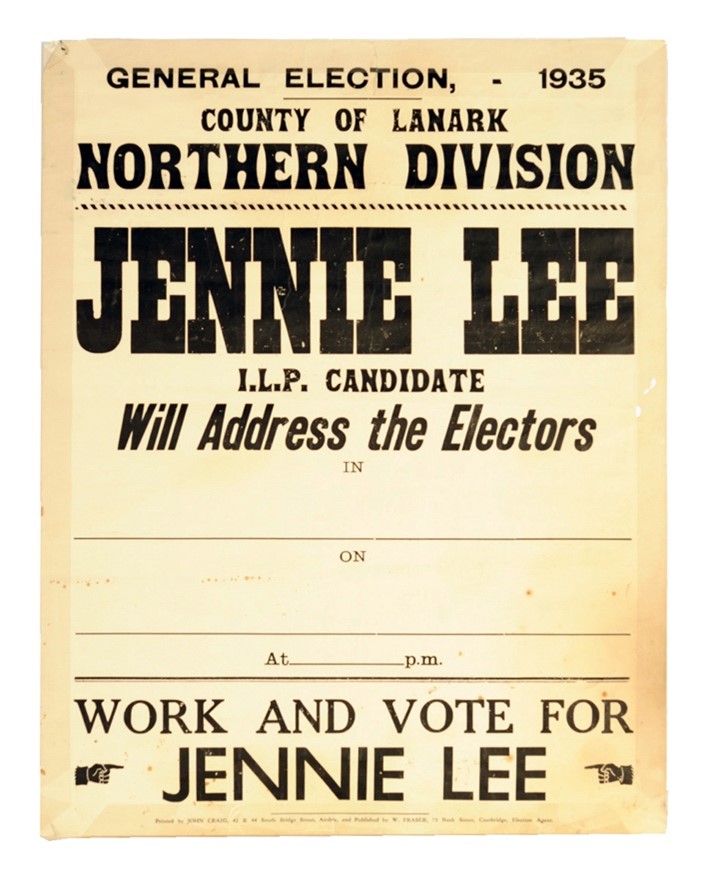
This campaign poster opens up a story, a story tied to the emergence of women in national politics and which highlights the importance of local communities and family roots to the bigger picture.
Change, change and more change:
The 20th Century brought with it sweeping and hard-fought changes in many areas of life. It was a time of transformation and progress, changing the landscape in many ways. One of the most crucial developments was the introduction of the vote for women and granting women the ability to stand in National elections. The other critical political change was the rise of socialism and the Labour Party – no longer exclusively a small, conservative boys club, Westminster was cracked open and in flooded a wider range of people and political beliefs. A gateway to a richer democracy where more peoples’ interests were represented and debated and where the landscape of Westminster was permanently changed.
Jennie Lee: family, politics and the working-class story:
Enter Jennie (Janet) Lee, a fascinating woman who is woven into the fabric of history of North Lanarkshire. A socialist woman who came to the forefront of politics in the 1900s. 1918 had given the vote to some women (women over the age of 30 who owned property) and all men; it also brought the introduction of the Parliament (Qualification of Women Act) which allowed women to stand for election to the House of Commons. Jennie Lee was one of many women who seized these new opportunities and ensured she left her mark. To understand her politically we must first look back.
A mining family steeped in the socialist movement:
Lee was born in Fife in 1904 into a mining family who were strongly tied to the Independent Labour Party. Jennie, rather than being excluded from the politics of her family due to being a girl, was raised fully immersed in the politics of the household. This was to shape her life and her politics. A bright academic child, she delighted in books and was allowed to be in the room where her family had political discussions. She persuaded her mum and dad to let her stay on at school, even though money was tight in the hard years following strikes in 1919 and 1921. Through her hard work and the ability to get grants for her education, she went on to study at Edinburgh University.

Political entry:
Lee went on to have a vibrant career in politics marked by victories and her fair share of losses but she was at heart, a socialist woman blazing onto the scene in Westminster. Her road into national politics came when she was chosen as the Labour candidate for North Lanark, a mining constituency much like the one she was raised in. The miners were impressed by her, a university graduate with undeniably strong and authentic working-class credentials and passionate politics driven by ideals rather than a lust for power. Jennie Lee was elected to Parliament at a by-election in February 1929 and at 24 she was the youngest member of the House of Commons. It was clear from the beginning that Lee was prepared to say no despite her age and her newness to Westminster. Jennie was set to have many clashes with Labour Leadership during the course of her career.
1935 election, North Lanarkshire:
Once again Jennie Lee stood for election in North Lanarkshire but this time she was not successful. With a voter turnout of 78.1% in North Lanarkshire, Lee came in second with 17,267 votes. She was beaten by her Scottish Unionist Party competitor William Anstruther-Gray who won with 21,301 votes. Despite her loss, she carried on with her political career, with her life story forever tied to the history of North Lanarkshire even when her time as the area’s MP had come to an end.

Jennie Lee, available at: Jennie Lee and the University of the Air – UK Parliament
Legacy:
When people think of women in history we tend to think in bigger terms. Cleopatra, Marie Antoinette, and Emmeline Pankhurst for example. But look closer to home and delve deeper into our local communities and you find the everyday figures who don’t get the same attention but who worked to make an impact. Jennie Lee is one such woman who is tied to the history of North Lanarkshire, to the socialist movement and to making a political career in an era when women entering front-line politics was still so new. She became Minister for Arts in Harold Wilson’s government 1964-1970, and perhaps her greatest enduring legacy was that she played a key role in founding the Open University with the principle of creating an education that was open for everyone.
Upon her death in 1988, she was Baroness Lee of Asheridge, having journeyed through a long and fruitful career. From being born into a socialist mining family at a time when no women could vote, to becoming MP for North Lanarkshire and beyond, she is a figure who is once more brought to the forefront.
Info about the author: Brooklyn Braeger is a graduate of the University of Glasgow with a History MA (Hons) and a Modern History MSc. She is a Volunteer Digital Collections Assistant within the Curatorial Team, North Lanarkshire Council Museums & Collections