
Hi everyone, I’m Bella, a current MA Museum Studies student at the University of Glasgow. I’ve always been interested in decolonisation work in museums, and I was lucky to be involved in the work placement at the North Lanarkshire Museums, where I learnt that the museum was working on a Museums and Galleries Scotland funded decolonisation project. Decolonisation work on natural history objects and specimens required further research, so I joined the project.

As part of the museum’s collections are based on trophies looted unjustly during colonial expansion, the main aim of the museum’s decolonisation work is to tell the audience transparently about the colonial history behind the collections and to acknowledge the mistakes of the past. Many explorers plundered local natural resources during colonial expansion, killing local animals and bringing them back as taxidermy. The purpose was partly to serve as trophies of colonial conquest and partly for scientific research. My research work focuses on finding the historical links to colonialism and empire behind the natural history collection, which can be used to further present to the audience in exhibitions and provide ideas for subsequent researchers’ studies

The mirror surrounded by shark jaws stored in the Summerlee Industrial Museum immediately caught my attention (Figure 2) and I began my research on this specimen. I opened the records for this shark mirror in the collection management system and compiled information that would allow for in-depth research:
- Species Information: The defleshed jaws of a blue pointer shark mounted in front of a mirror on a large wooden board.
- Date Information: 17/6/1932
- Provenance Place: The shark was caught in the Indian Ocean.
- Production: Brand P.
- Acquisition Information: Transferred from the Airdrie Museum
- Donation Information: Donated to Airdrie Museum by David N. Brand of Durban in South Africa on 1932.6.17 and also reported in the Airdrie & Coatbridge Advertiser of the time.
A newspaper article in the Airdrie & Coatbridge Advertiser explicitly mentioned the object, so I searched for the article in the British Newspaper Archive. I found a newspaper article published on 18 June 1932 (Picture 3), describing the information about the object as it appears in the records, and confirmed the source of the information.

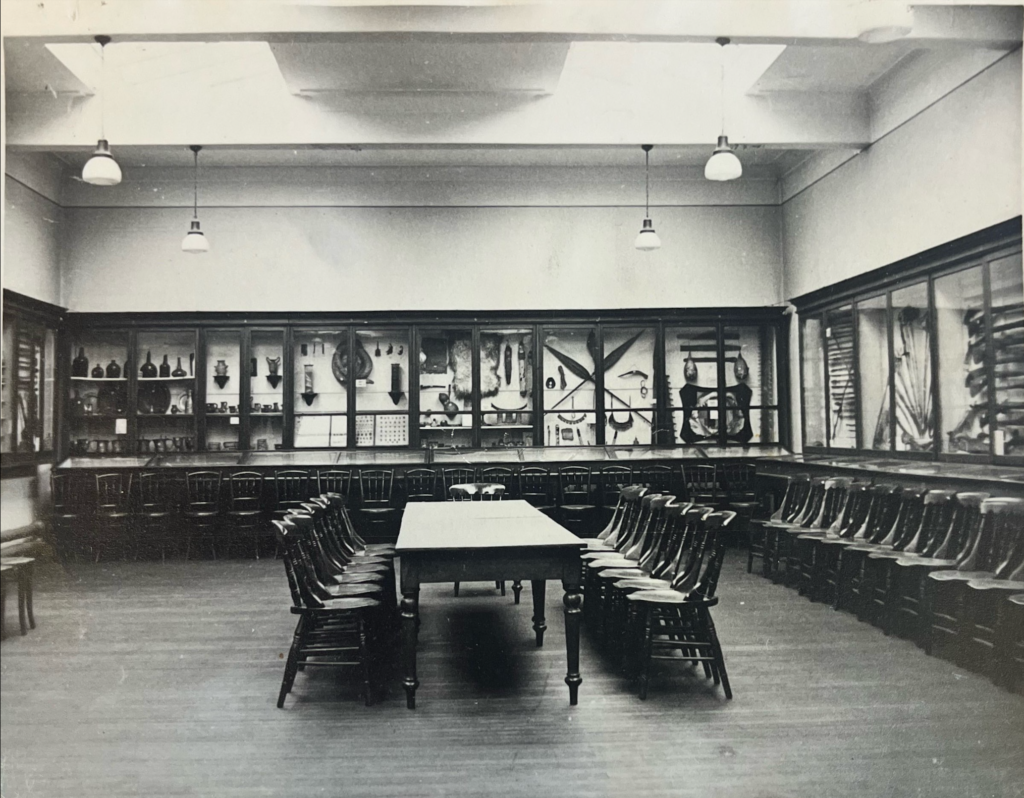
Records and newspaper articles indicated that the shark mirror was a gift donated to the Airdrie Museum, so some historical research work on the Airdrie Museum was required. Airdrie Museum was a local museum open from 1895 to 1974 and was integrated with the Airdrie Library. In 1975, ownership of the collection was transferred to Monklands District Council and after a series of transfers, the collection eventually came to North Lanarkshire Council in 1996. Airdrie Library and Museum has undergone several refurbishments and to better understand the way it collects and exhibits, I wanted to find some old photographs in the local archives to visualise this. In the Motherwell Heritage Centre’s archive collections, I found a historic photograph (Figure 4) which not only helped me to learn information about the historical layout of the museum, but I was also pleasantly surprised to find the shark’s jaws mirror in the exhibition! (Figure 5).


Later, I learnt about the connection between colonialism and this object based on information such as the place of provenance. Investigations revealed that this object might be linked to the shark fishing industry in Colonies around the Indian Ocean. This corresponds to the historical period when most of the Indian Ocean was surrounded by British colonies (Figure 6.) The shark fishing industry was a product of the colonisers’ exploitation of local natural resources, and the colonisers found that sharks had great value, and used this to develop the economy in order to better control the colonies.

I will follow this up with more research and catalogue work on decolonising North Lanarkshire’s natural history collections. I will continue this research in my applied dissertation which will be based on relevant research findings, the challenges encountered during the research process, and the implications of decolonising natural history collections. I am in contact with a number of curators associated with the natural history collections in the hope of exploring the historical context behind once-vibrant lives and telling more stories about colonialism.
The museum is a place that embodies the idea that ‘the past is the present’, and I look forward to breaking the silence in the museum and telling a transparent history to visitors. It is hoped that this work I have undertaken will contribute to the decolonisation of North Lanarkshire Council collection.

About the author:
Bella Gao is a current MA student in Museum Studies at the University of Glasgow. The controversy over the restitution of artefacts faced by museums prompted her interest in the topic of decolonisation of museums. She focuses on silent voices in museums and the silencing of natural history specimens in the narrative of colonialism. This research theme encompasses both the ecology of the natural environment and the historical context of colonisation as a topics related to social justice. Within this, she expects to be able to effectively combine scientific and cultural narratives in museums and communicate the unique historical stories behind natural history collections to audiences.