
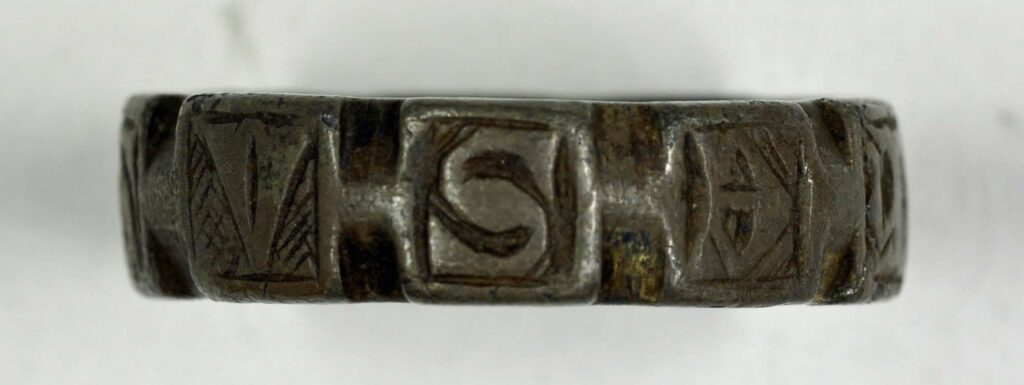

The Summerlee Museum of Scottish Industrial Life has a permanent exhibition of artefacts from the Cistercian Monks that occupied Monklands (Coatbridge and Airdrie) and within this exhibit a ring, labelled as a Fede ring caught my attention. The current description of the ring is: “The Fede ring is a bronze alloy finger ring. The outer circumference is divided into 9 slightly raised square panels, each containing a single letter or symbol, some legible, other too worn to read”. From my slight knowledge of Fede rings and from being in Scotland where Fede rings are very common, this ring did not appear to match a Fede ring at all. So why did this ring get labelled as a Fede ring?
The information posted on the display label and on the website seemed not to match the object. I wanted to use skills I’ve learned from my Material Cultures and Artefact Studies course from this past year to find out what kind of ring this really was and see if it actually could be a Fede ring. The first step was to clearly decipher the panels on the ring. There are nine that show some sort of inscription or figure. I was able to take the ring out of the display case and photograph them using my iPhone. The pictures did little justice to the ring and provided very low-quality photos. After the failure of my photos, I took to the collection site of Summerlee to see how the photos were there. From the pictures posted on the website, the letters are difficult to read (figure 1 see below). However, the outlines of the letters were very distinctive and could be made out, at least in their shape.
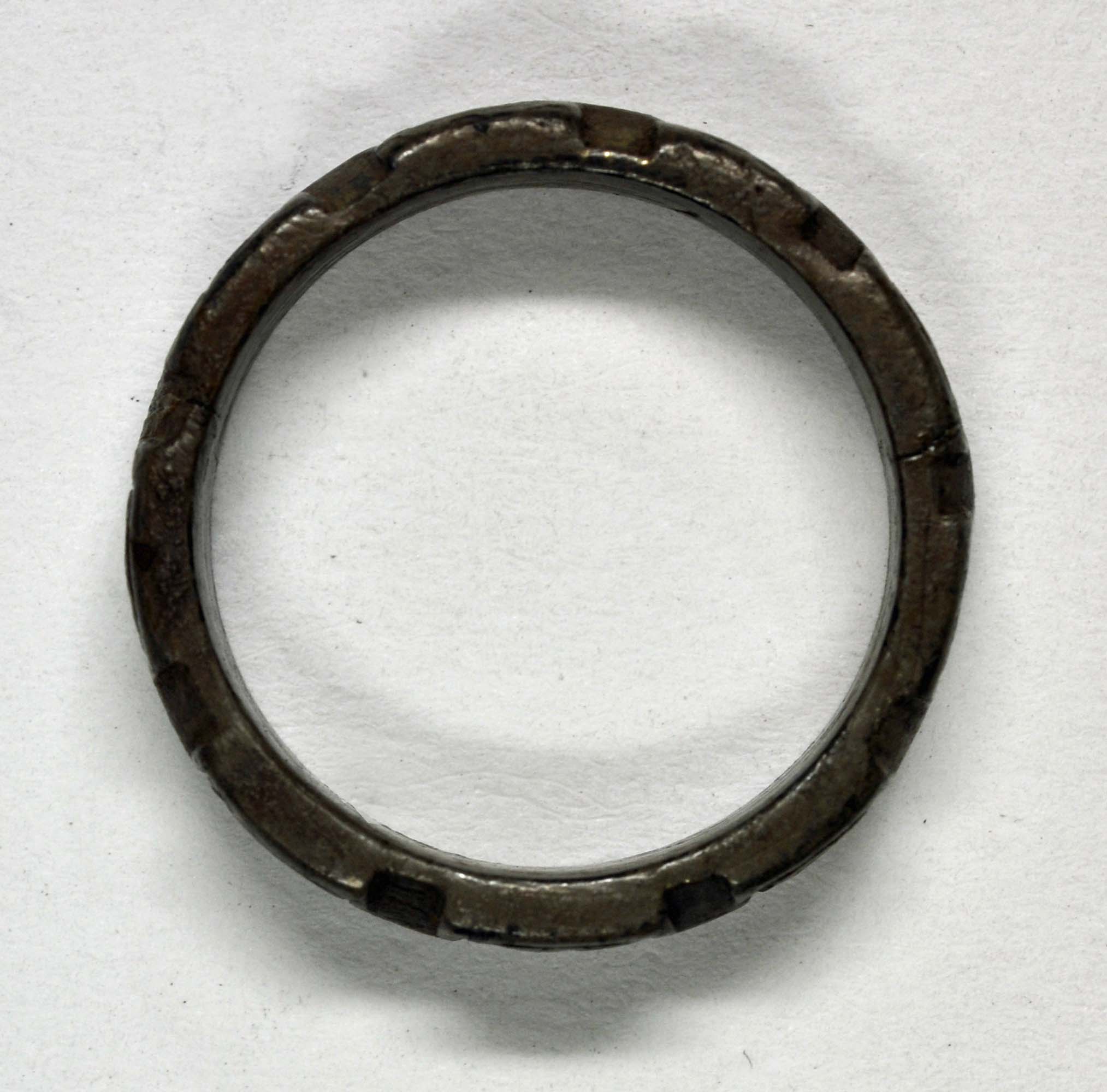
The original photos online show the distinct outlines of letters, such as the ‘S’ and ‘I’. However, not all of the panels were photographed, and this needed to be done to identify the rest of the ring. The digital imaging team at Summerlee Museum photographed this Fede ring and the 9 panels to better examine the letters (Figure 2).

The panels on the ring show a Maltese cross, which is commonly used at either the beginning or the end of a phrase during the medieval era. I took the panels and cropped them to a smaller size and put them in order that made the most sense. I still did not know what kind of language or script that was used for this ring, I knew I needed to find similar objects. I visited the British Museum Website and browsed their online collection under the search of 14th century Scotland. There I found two annular brooches that share the same language and script!

Figure 3 is a silver, flat narrow annular brooch that is engraved in Latin, using the Lombardic script, “+IHESVS: NAZARENVS: REX IVDEORVM” which translates to, ‘Jesus the Nazarene, King of the Jews’. Figure 4 is a flat gold annular brooch that is engraved in Latin, using the Lombardic script, “+AVE NARIA GRACIA PLENA DOMINV”, which translates to “Hail Mary, full of grace, the Lord is with you”. I was so excited to find similar traits to the Fede ring! I was finally going to be able to have a clue, what this ring said. There are similar letters between the annular brooches and the Fede ring which led to the conclusion of what the Fede ring reads, ‘+IHESVS DI’. This translates to ‘Jesus God’. Although these annular brooches provide the same Lombardic script, the information regarding the type of ring still needed to be investigated.
Since finding similar letters and identifying the phrase, how is this ring a Fede ring? The definition of a Fede ring is hands in fidelity (ŠLANCAROVÁ 2:2010). The significance of Fede rings is the symbolism, the hands are clasped together symbolizing respect, friendship, fidelity, and reconciliation (figure 5 and 6).

While researching this Fede ring, it was brought to my attention that there were other Fede rings present in the Social History Store of the museum (Figure 7).

The ring in figure 7 does show a curved top and bottom, which is similar to Fede rings, like figure 5 and 6. The Museums Accession Register gave information about the ring and that it had a known distribution on the East coast, however there is no other information about the exact location of a store or company making these rings. Just like the original ‘Fede’ ring, more information was needed to better understand the history and decision on calling the original ring a Fede ring. While searching for information online, it was stated in the Treasure Trove collections that there were similar rings but they were no where to be found on the site. I emailed them asking for information regarding the three similar rings, and they were very helpful in providing the information.
When I opened the documents that were sent by Treasure Trove, I was astounded! Not only were these rings similar, but they were also nearly identical! The only missing feature was the clasped hands. Figure 8 shows the Fede Ring from Treasure Trove have the same colouring and inscription style and markings.

Treasure Trove also states there are other rings similar in style that are found in the Bankfoot, Perth and Kinross area (Figure 9), they are suggesting that since there is a cluster of similar rings then the manufacturer of the rings are from this area (Figure 9).

The two rings on Treasure Trove and the original Fede ring show an immense comparison in craftmanship and detail. The Treasure Trove rings are indeed Fede rings, however, the Fede ring from Summerlee is missing the clasped hands on the front.
I was wondering if this ring could be deemed as a Fede ring after all, but this information was not an answer that I could find. I then thought this ring was a ‘posey’ ring, which used Lombardic Latin (Figure 10).

The ring in figure 10 is engraved stating: “+IESVS: NAZARNVS: REX: IVDEORVM”, which means “Jesus Christ of Nazareth, King of the Jews”. Although this ring does not have panels, it shows similarities in a religious saying in Lombardic Latin on the outside of the ring as well as no clasping hands.
When reflecting on whether this ring is truly a Fede ring, or a Posey ring, the question remains unanswered. When trying to figure out why the original ring and the Fede ring in figure 8 share identical markings, I am beginning to wonder if they might have been a set. In my opinion, I think it’s clear that the original ring and the Fede ring in figure 8 came from the same workshop but that the original ring cannot be called a Fede ring as it is missing the iconic clasped hands design. Ultimately, we’ll never be able to find out the full story of these rings, but I would like to think they are a pair.
About the author:

Molly Bentzel is a student at the University of Glasgow studying her MSc in Material Cultures and Artefacts Studies. Her speciality is in Islamic History and Art History. While studying in Scotland she has focused on Medieval and Neolithic eras. Her passion for history has led her to researching artefacts studying the cultures behind them.