
Hello! My name is Olivia McPhee, and I am currently a fourth-year student at the University of Edinburgh. I am doing my Honours in Ancient History, and have a specialised interest in the Roman Empire, Ancient Roman and Greek literature, and the study of Classics in a historical/modern context.
As part of my University’s Mentorship Programme, I met with Dr Anna Groundwater, who is a Principal Curator at the National Museums Scotland, as I am interested in a career in the museum sector. Her advice about the museum sector got me much more intrigued about this career, and she got in contact with her former colleague Michael Allan from North Lanarkshire Museums to see if there was any volunteer work I could do. After meeting with Michael, he showed me four pieces of ancient pottery that had been sitting in storage at the back of the museum.
As someone who grew up in Coatbridge, I have visited Summerlee Museum many times, and am very familiar with their Roman display. So when I discovered there were even more pieces of ancient pottery, I was excited to find out more about them. Problem was, there wasn’t much information on these objects. As I mentioned in my collections story, they were either donated by Mr. Garstang as part of the Beni Hasan Excavation if Egyptian, or by Dr Hunter as part of the Braidwood Collection if Cypriot. The rest of the information was for me to find out.

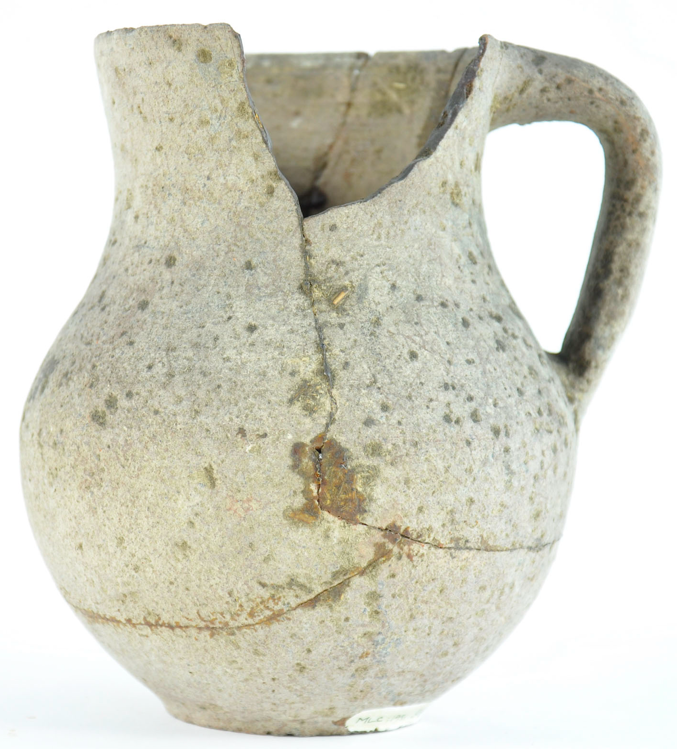
The task was daunting, but I was ready to get started. The objects themselves were unfamiliar to me, minus the jug. They were pretty generic too – no painting of scenes that would hint where they were from. So all I could do was research what these objects were. The first object I looked into was the unguentarium. I had an old textbook on art and archaeology in Ancient Greece, and to my luck there was an illustrations page of different pottery shapes, one which included the unguentarium. By figuring out what the vessel was I could further research what it was used for. I applied this method to the other vessels, comparing to similar ones I could find online, but fell into an issue with one of the objects- which I’ve now labelled ‘mystery vessel’.
After scouring every page on ancient pottery shapes on the internet, I couldn’t find any similar to this object. At this point the only thing I could think to do was to contact someone with more knowledge than me. I emailed the Ancient Mediterranean department at NMS, and Dr Daniel Potter got back to me. He too was stumped about the object (which made me feel slightly better), but asked to take a look at the other objects in my collection, since I mentioned the Beni Hasan excavation, and they had recently wrote an article about Ancient Egyptian Collections across Scotland. To my luck, he was happy to inform me that two of the objects (the unguentarium and the olla) were in fact from the Beni Hasan excavation, noted by the numbers on the vessel (as Garstang was known to write on the objects).
The other two objects, which have stickers, meant they weren’t from Egypt (as Garstang wasn’t a sticker user), so they could possibly be from the Cypriot collection. Although Dr Potter and his colleagues were unable to give much detail on the mystery object, I got a ton of fantastic information about where the other objects came from. Despite being originally stumped with where to start, a mix of using my own knowledge and research and consulting others in the field when I’m unsure, gave me enough material to write my blog on these four pieces of ancient pottery for North Lanarkshire Museums.
Overall, writing the blog has been an exciting yet challenging experience which has given me a lot to think about. I enjoyed researching the pieces of pottery, and it allowed me to discover more not only about the objects, but the work of a curator. I was nervous in case anything I wrote would be wrong, but soon realised a lot of this work is just taking what we know and making educated guesses based off that information.
I want to thank Dr Anna Groundwater from National Museums Scotland on her advice on this sector and for getting me in contact with Michael. I too of course want to thank Michael for assigning me these pieces and helping me through the process of writing the blog. Lastly, I want to thank Dr Daniel Potter and his colleagues at the NMS for their advice on the two pottery pieces from Beni Hasan, it was a great help!
Doing this research and writing has made me surer than ever that I one day want to be working in the museum sector, and I am grateful to have been given this opportunity to share what I’ve found out about these four pottery pieces for Summerlee.