
If you think of a material that you use, see, or consume every day, your answer is likely to be Plastic. In the 21st century, it can be found in almost everything we use in our day-to-day life. This is something for the sake of our planet we are now trying to change, swapping our one-use plastic items for plastic-free alternatives.
The reason? Well, that would be Climate change. This is a phrase we are all familiar with and the reason we are all being encouraged to ditch the plastic, walk more, and leave the car at home to hop on public transport. But how did it all start? Well, before plastic, the most common material of everyday use was metal. Iron could be found in every Victorian home, from kettles to bedframes. It too surrounded people like plastic does today, replacing wood as a key construction material.

We know now how bad plastics are for our environment. Unfortunately, in the 1800s the devastating effects of creating all the Iron they were using had yet to be discovered. Coatbridge was at the centre of this industry, from the steeple of the parish church around 50 furnaces could be seen when the most iron was being made. During this time, roughly 1855 -1859 the United Kingdom had made 3.5 million tons of pig iron.
1 ton = 1018.18kgs.
The issue with Iron
The iron production that took place in Coatbridge saw the area grow, only 2,000 people stayed there in 1831 but by 1876 22,000 people called Coatbridge home. This increase is likely down to the fact that one furnace employed around 200 men. This would mean at least half the population were working in the Iron industry, with even more employed on the side-lines, transporting raw materials or finished goods. The huge number of furnaces made for a rather unpleasant place a quote from 1869 paints a picture of Coatbridge during this time.
“Dense clouds of Smoke roll over it incessantly and impart to all the buildings a peculiarly dingy aspect” (Bremner, The Industries of Scotland, 1869,1969).
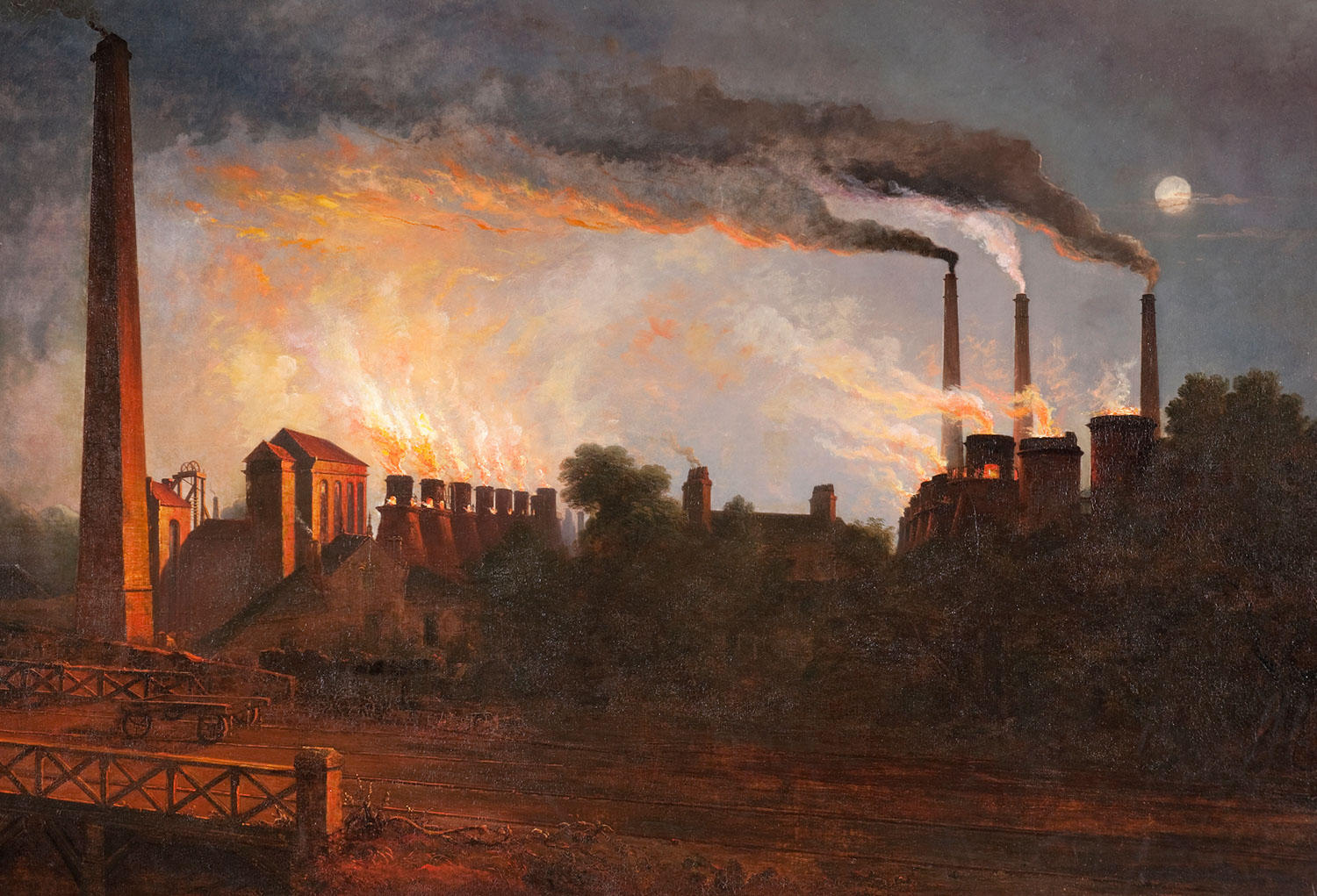
Dingy, dark, smelly. All words we may associate with things that are not good for us. These clouds of smoke certainly were not good for the atmosphere. The Gartsherrie ironworks painted here are recorded as having made as much gas in a day as ALL the gas works in Glasgow made in a fortnight. How might you describe this painting? It certainly seems a sight that would have been extraordinary to see in real life. And it is certainly not what you picture when you think of the quote above.
Often when we discuss the process of industrialisation, the inventors are praised for their new technologies and our negative attention focuses on the working and living conditions of the workers that kept all these new factories going. But often this past is looked at through a lens that is only seeing this industrialisation for its moneymaking success. The picture above can show us this, and we can understand it by looking at the difference between the painting and the description we have of Coatbridge from the 1860s. The painting does not look like a place that is dingy and dark, some may even describe the picture as beautiful. While the sight of ironworks at night will have always been wonderful, this industry was pumping something into the sky that would have us all talking 150 years later.
Fuel for Climate Change

Map of Coal and Iron Resources, 1945 (COSTL -1994-105-6)
So, what fuelled all these furnaces? Well, that was fossil fuels. We now know a lot about these fuels and the harmful impact they have on our atmosphere. But in the 1800s this was not common knowledge so these fuels were burned in their thousands. To make a ton of pig iron (this was the iron bars that would then be melted back down into more useful objects) you needed around 5 tons of coal in the 1800s. The Gartsherrie ironworks in the painting is recorded as having burned 1,000 tons of coal a day in 1869.

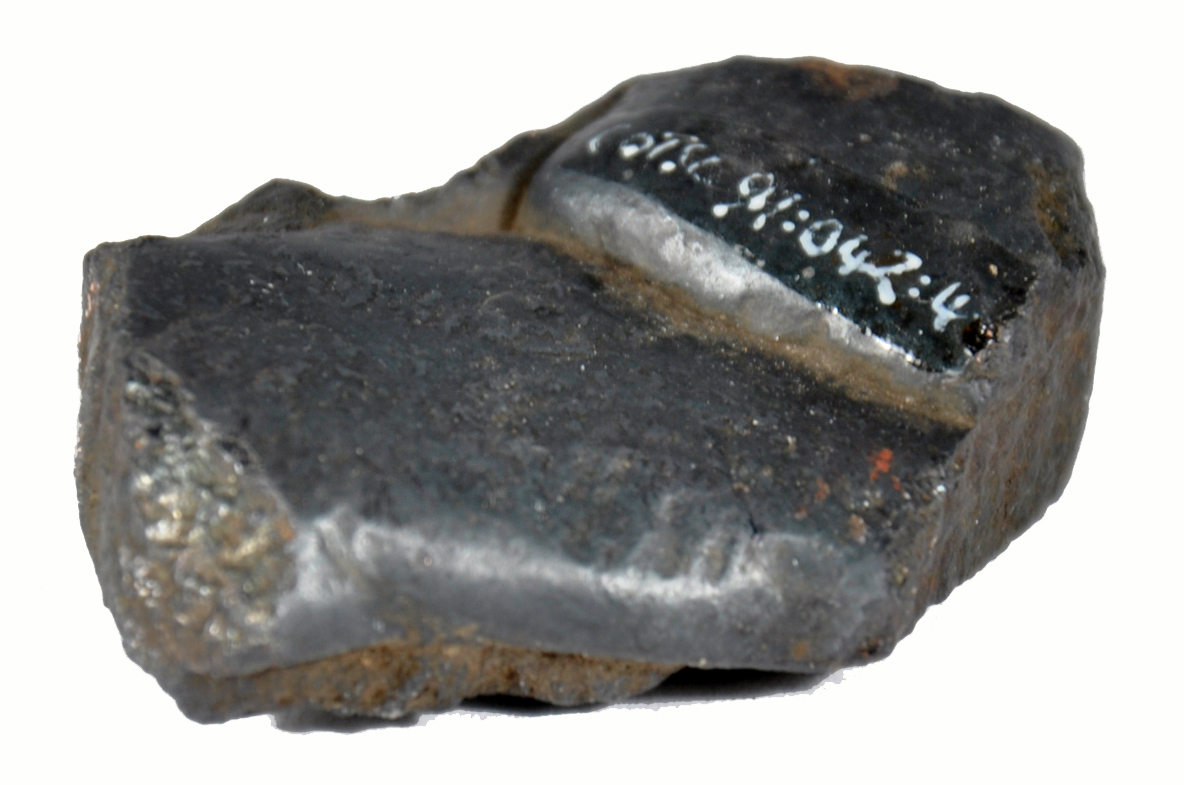
Virgin coal similar to that used in the iron production Process.
When you burn coal it produces a harmful gas called Carbon Dioxide (CO2) which is what damages the atmosphere, this damage is what causes climate change. CO2 stays in the atmosphere for thousands of years; it is a gas that absorbs and radiates heat. When too much of this gas is in our atmosphere the extra heat from the earth becomes trapped in the atmosphere and raises the earth’s temperature leading to climate change. This can cause places to get warmer like the poles of the earth where ice bergs melt, but climate change is an imbalance and may lead to other places getting colder.
When you burn a ton of coal you get 2181 kilos of CO2 meaning the Gartsherrie ironworks in 1869 will have created 2,181,000 kilos of CO2 a day. If we go back to the 3.5 million tons of pig iron produced by the United Kingdom and we use the coal burned in a day at Gartsherrie as an estimate, this will have been made using 10.5 million tons of coal which will have resulted in roughly 22.9 billion kilos of Carbon Dioxide which was pumped into our atmosphere between 1855-59.
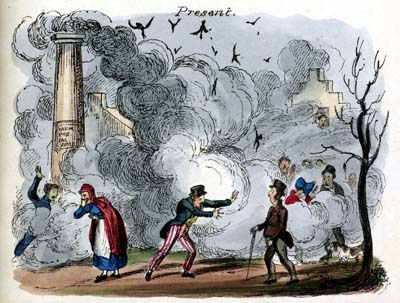
Consumption of Smoke: Present
From Vol. 1, no. 8: Northern Looking Glass
17th September 1825
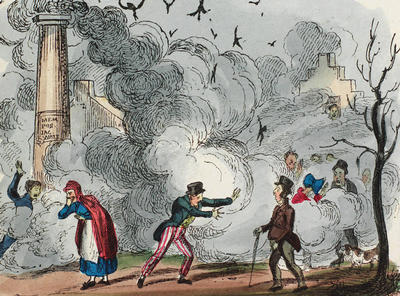
Now while we know that the inventors and businessmen of the 1800s did not have the knowledge we now do. This does not mean they did not know that all the Gas and smoke made when creating iron was harmful. We know that the greenhouse effect of the earth’s atmosphere was discovered in 1824, this is when the atmosphere acts like a Greenhouse – trapping the sunlight and warming up the earth’s surface. This can then be made worse when gasses like Carbon Dioxide are also in our atmosphere. The cartoon you see above was created in 1825 and it shows an exaggerated view of what it would have been like to live in a city or town that was as industrial as Coatbridge or Glasgow, we can see that it shows people coughing and birds falling out of the sky. It even refers to James Watt on one of the chimneys.
James Watt was an important Scottish inventor that was famous for making the steam engine more efficient. The steam engine was something that could be found in factories across the country and would transport raw materials and finished products nationwide, an invention that also relied on burning a lot of coal. Here he has been given the blame for the pollution of the city. At the time this cartoon was created it has been recorded that Britain counted for 80% of global CO2 emissions because of burning fossil fuels e.g., coal.
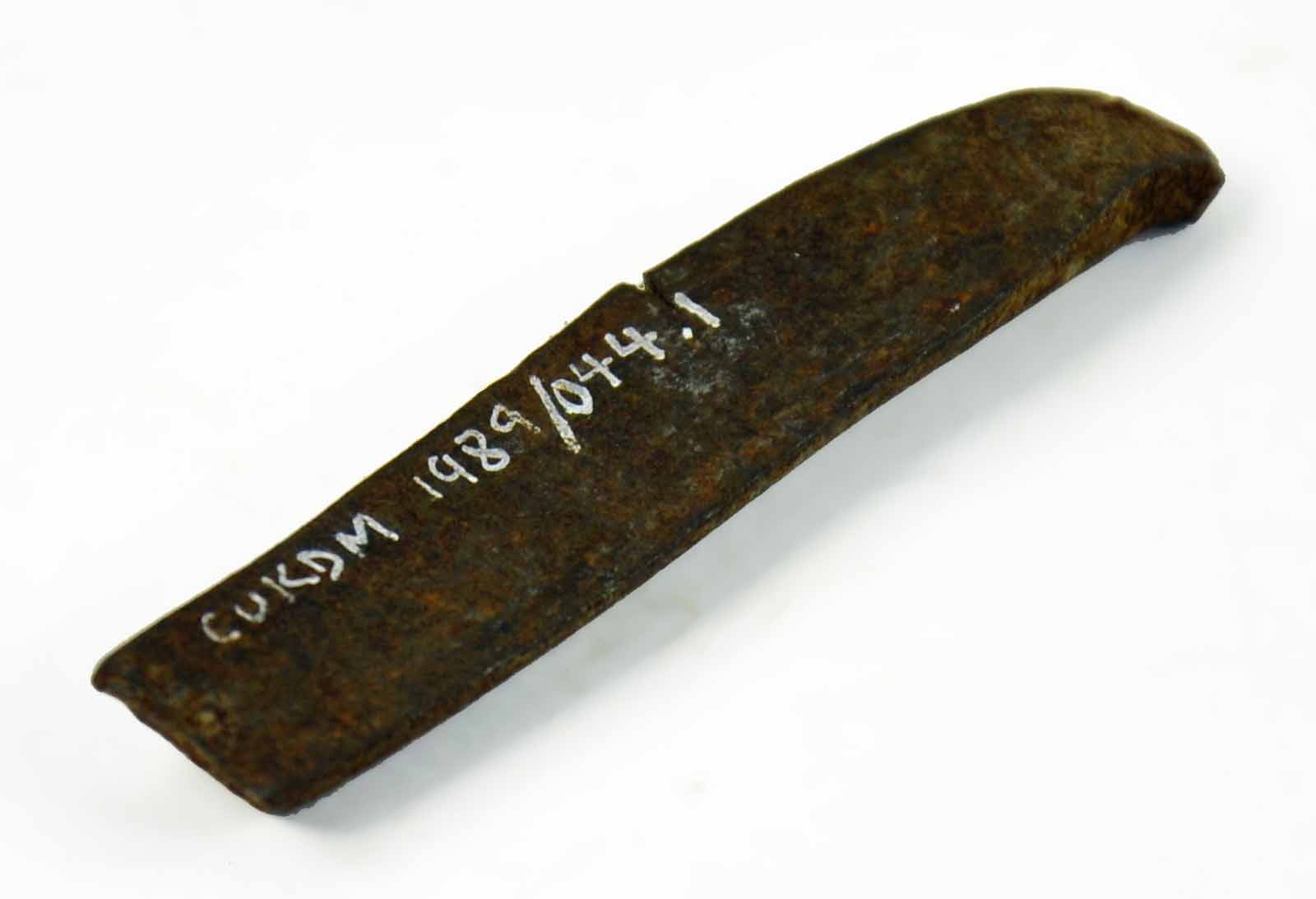
So, what about Summerlee? In 1871 it is recorded as being very successful as they had been using a bigger furnace. The average price for pig iron during this year was 70 shillings whereas Summerlee Pig Iron is recorded as being sold for 80 shillings per ton! Like the picture of Gartsherrie, the archaeological finds of Summerlee Ironworks tells us a lot about the triumph of this business but it can also show us the harmful side of this industry.
What is left of the Ironworks here has been turned into a great asset for the heritage of the area, but this is not always the case, the remnants of closed down industrial sites like this one often tell us more stories about environmental damage as they lie forgotten about and become known as eye-sores. It may be difficult now to picture Summerlee as a place that harmed our Climate when it is such a pleasant place to be, but it did and we must remember that.
The Big Numbers
So, if 22.9 billion kilos of CO2 were made between 1855 and 59, how much did Coatbridge produce altogether. This tricky sum can be done when we consider the years the ironworks were producing iron and the amount of coal that was used in their furnaces. This will give us the amount of greenhouse gases produced per ton of coal burned. The furnaces used in Coatbridge made around 7000 tons of pig iron a year. For one ton of Iron, you need around 5 tons of coal. We have already learned you get 2181 kilos 0f CO2 when you burn one ton of coal to make this sum a little easier for us, we will say that this is roughly 2 tons of CO2.
7000 x 5 = 35,000 tons of coal needed a year.
35,000 x 2 = 70,000 tons of CO2 created annually by one furnace.
To get the total number of CO2 made in Coatbridge a year we now need to multiply this number by the total number of furnaces in the area, which is recorded at being 52.
52 x 70,000 = 3,640,000 tons of CO2 created!
We now must work out the total amount of time these Ironworks were working for. To do this we multiply the number of furnaces by the Ironworks years of operation.
Gartsherrie – 1830-1967 = 137 years and 16 furnaces (137×16) = 2,192
Langloan – 1841-1921 = 80 years and 6 furnaces (80×6) = 480
Summerlee – 1837-1921 = 84 years and 8 furnaces (84×8) = 672
Dundyvan – 1839-1868 = 29 years and 8 furnaces (29×8) = 232
Calder – c.1795-1921 = 126 years and 8 furnaces (126×8) = 1,008
Carnbroe – 1839-1921 = 82 years and 6 furnaces (82×6) = 492
If we add together the total operating times for each ironworks, we get 5,076. To find the total amount of CO2 produced in Coatbridge we then must multiply this total by the amount of CO2 produced in one year.
5,076 x 70,000 = 355,320,000
Or three hundred and fifty-five million, three hundred and twenty thousand tons of CO2!
This number is huge, we know now that even just one ton of CO2 will stay in our atmosphere for thousands of years. However, this gigantic number is not the end. All this CO2 only made pig iron, these bars needed to be melted down again to be made into useful objects. So, what does that mean? You got it, more coal! So really, we should double this number. However, it doesn’t stop there, coal was burned when transporting coal and the iron bars. And it was also used in many steam engines that powered machinery as well as being burned in every home for heating, washing and cooking, so it would be very hard to work out the real amount of CO2 that was created in Coatbridge.
Without the creation of iron and the use of coal to make it we wouldn’t have the world we live in today. Railway tracks, trains, ships, beds, kettles, pots, and pans were just some of the many things that were made from iron. Despite all these inventions we now take for granted, it is important to highlight the impact on our climate. We are now in a period of change, and more people are beginning to understand the need to reduce climate change and help save our planet. Despite the damaging effect iron making had it can be seen as an early example of recycling as most of the iron that was made at Summerlee is likely still in circulation today as Iron is often melted down and reused. By understanding just how it all started, hopefully, we can be inspired to create great inventions like the entrepreneurs of the 1800s, but this time with the health of our environment and atmosphere in mind.