
In this guest written collections story, Olivia McPhee – a student of Ancient History at the University of Edinburgh – takes a closer look at some puzzling ancient Mediterranean pottery in the North Lanarkshire Museums collections. Check out her blogpost on researching these pieces here.
Hidden away in storage at Summerlee Museum are numerous pieces of ancient pottery from Egypt and the Mediterranean. As an Ancient History student at the University of Edinburgh, I was given the task of delving further into what these mysterious artefacts were and where they came from. To begin with, there was very little documentation on these objects. I was told they were donated originally to Airdrie Museum in the late 1800s/early 1900s. If they are Cypriot, then they were donated by Dr John Hunter-Selkirk as part of the ‘Braidwood Collection’; if they are Egyptian, then they were donated by John Garstang as part of the Beni Hasan Excavation. With such little information, I was having to prepare to do a great deal of research. Therefore, as a starting guide, I decided to see if I could find out what the objects were.
Throwing myself headfirst into the deep end, I decided to begin with this bizarrely shaped object.

MLC-1991-298 ©NLC Museums
Firstly, I thought about the shape of the vessel. As we can see from the picture, it has a slender base, before expanding at the middle, then narrowing down at the neck once again. It is long, hollow, and could possibly stand on its own.
Despite being originally bewildered, thinking about its design and researching further led me to similar shaped objects. I discovered the oddly shaped vessel had an equally odd name: unguentarium.
There are two different types of unguentarium: piriform (‘pear-shaped’) and fusiform (‘spindle-shaped’). The item pictured is the latter. Fusiform unguentarium are believed to be heavily influenced by pottery from the Near East during the 4th Century BC, but its use soon spread across the Mediterranean for centuries to come.
But what exactly is this vessel used for? Primarily, it is believed to mostly be used for storing oils. However, other liquids and powdered substances were able to be stored as well. A common factor seen with the excavation of these vessels is that, whether in Rome or Cyprus or Egypt, they were often discovered in cemeteries. This location detail gives us another significant hint about what they could be used for.
In the Ancient Mediterranean, funerary practices were very important. It was essential the deceased were buried with enough necessities to make sure their journey to the afterlife was complete. These gifts included food, money, perfumes, and oils. The discovery of so many unguentarium in cemeteries across the Mediterranean could imply they were used as part of these funeral practices, especially to store oil, wine, or perfumes.
With unguentarium being so common among Mediterranean cemeteries, where exactly did this one come from? I have to say, normally it would be near impossible to give an exact location for these objects, but due to a minor detail I landed quite lucky. Written at the base of this vessel was the number ‘412’.

MLC-1991-298 ©NLC Museums
Unsure myself about the mysterious number, I contacted Egyptologists at the National Museums Scotland. Dr Daniel Potter was happy to inform me that the numbered vessels were from John Garstang’s Egyptian Excavations, which matched the information I was given. ‘412’ is a tomb number, referring to the ‘tomb of Bakta’, where many different pieces of pottery were unearthed, including this unguentarium. In National Museums Liverpool another relic from the tomb of Bakta is on display: a small model of a man lifting a yoke with two jars. The clothing and manual labour depicted in this model heavily imply they were most likely an enslaved person. But this raises the question as to how did such items find their way from this tomb to the UK?
Born in 1876, John Garstang was a British archaeologist who had a passion for the Near East, where he participated in many excavations. From 1902-1904, Garstang spent two seasons excavating Beni Hasan, an Ancient Egyptian cemetery south of modern day Minya, where he uncovered over 888 tombs. Today, there are 39 tombs open to the public which depict paintings of everyday life in Ancient Egypt. The site was primarily used during Egypt’s Middle Kingdom (2040BC to 1782BC). So how did artefacts from a site over 4000 years old end up in the Monklands area of Scotland?

In 1904, The Times newspaper advertised that Garstang had donated countless pieces of pottery from his adventures to museums across the UK as part of a bid to make education more accessible to the public. According to archives at the University of Liverpool, this included 42 ceramic vessels which were donated to Airdrie Museum.
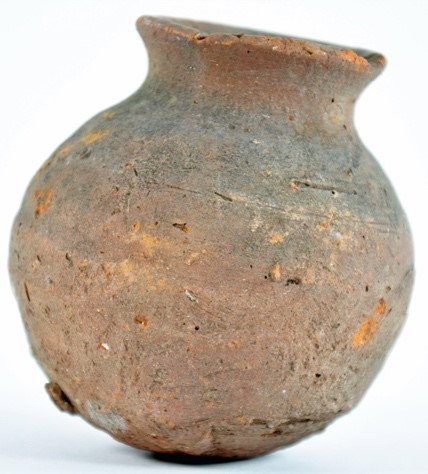
Another item most likely from Garstang’s Egyptian excavation is this rather bulbous piece of pottery.

MLC-1991-297 ©NLC Museums
It is closely matched to Garstang’s type 37. This type would make it one of his class E pieces, which he describes as ‘small globular forms’. The size and shape of this vessel is reminiscent of an olla, another storage item used in ancient times. An olla, much like an unguentarium, was multipurpose: it could store water or food and be used as part of funerary traditions. Not only could ollas store food, but they were also used in cookery as well. Its flat base allowed it to sit on hot surfaces such as logs, or tripods above stoves. Of course, the wideness of the olla makes it a perfect fit for storing grave goods.

As mentioned with the unguentarium, funerary practices across the Mediterranean were a special ritual for the deceased. Many believed not being buried properly would lead to problems such as the deceased wandering the Earth as a trapped spirit. It was crucial people were buried with the correct items to pass into the afterlife smoothly, and an item such as an olla would be perfect for carrying the grave goods. This included money, personal belongings such as jewellery, wine, and much more. The spherical base would have also made it easy to be buried into the ground. The Roman historian Livy mentions in book 41 of his History of Rome an olla which was used to boil the liver of an ox as part of a sacrifice. This demonstrates that although it may seem like a typical storage vessel, it has a variety of uses and this helps historians understand more about the everyday lives of citizens of the ancient world.
The third piece of pottery I was assigned to research is a lot more familiar looking – a jug.

MLC-1991-304©NLC Museums
It is a relatively standard shape that we still use even today, and without a number to suggest it could be from Garstang’s excavations it is difficult to say exactly where it is from. But there is still plenty of information we can get just from recognising its shape and material. The jug itself is made from earthenware – an easily workable clay that contains iron, allowing it to reach its optimum hardness at a lower temperature, typically between 950C and 1100C. The handiness of this clay type means it’s one of the most commonly used even today.
Earthenware clays were one of the first ever types used by potters in the ancient times. Its use in pit fired pottery dates as far back to 29,000-25,000BC, and the earliest known kiln (heating chamber) found in Mesopotamia dates to around 6000BC. They are usually grey, brown, red, or orange in colour, with terracotta being the most popular type of earthenware. This reliable material had a variety of uses in ancient life, from everyday uses such as jugs, or in life-sized sculptures such as the Apollo of Veii. But what were objects such as the above used for? Much the same as we would use them – storing and pouring liquids such as water, and one of the ancients’ favourites: wine (at its height, the Romans consumed over 180 million litres of wine per year, about a bottle each day for every citizen).

The final object I was presented with is a bit of a mystery.

MLC-1991-309 ©NLC Museums
Experts confirmed for me it is neither from the Pharaonic excavations at Beni Hasan nor Cypriot, meaning it could be from another site or it is more modern (late Roman). The object itself is also quite difficult to pinpoint. It is brownish in colour, with a wider base, contracting in shape until it opens at the top. There are also score marks around the circumference of the centre. The object can sit by itself, meaning it could be another use for storage, although there are no handles or sprout for pouring. The neck and size of the object appears suitable for easy grabbing, suggesting it may be some form of cup itself. If not, it could store liquids such as perfumes. The score lines across the centre are unusual- possibly being used as a way to count something rather than for design. This object raises many questions in regard to its use and where it came from, meaning we can only guess these factors based off the unconventional design.
Overall, these pieces of pottery tell us a great deal about ancient life. They may seem typical for storage, but the different shapes suggest a variety of uses – such as the wider olla being used for cooking, or the jug being used for pouring. The location of where they were discovered also tells us that their storage could be for the purpose of funerary practices, such as the unguentarium found in a burial spot.
Although most of their original information has been lost, through rediscovering their likely origins and purpose they can again be used for interpreting and understanding the ancient Mediterranean world, just as when they were first collected by Airdrie Museum 120 years ago.